Two weeks ago, in our ongoing exploration of the ideas of the Situationist International and their application to the ongoing crisis of industrial society, we ended up face to face with a point of immense importance. I didn’t develop that point in that earlier post, partly because it took the rest of the post to get to the point from which its importance could be grasped, and partly so that I had the time to brood over how best to communicate that importance to readers. It’s not that it’s a difficult point—it’s quite simple. The difficulty is that it flies in the face of everything that our current political thought treats as obvious common sense.

A metaphor might be better suited to make sense of the point I have in mind than any more literal or simplistic approach. With that in mind, I’d like to welcome you to the Democratic Republic of Lower Slobbovia. Any of my readers happen to be fans of the once-famous Al Capp comic Li’l Abner already know about Lower Slobbovia, though it’s been a while since the last press releases from that far-off country and they may not be up to date on its current political situation. Those who didn’t have the privilege of growing up in the company of the inhabitants of the town of Dogpatch will want to know that wherever you are, Lower Slobbovia is a long, long, long way off. It’s very cold there, the national dish is either bagels or raw polar bear meat, depending on who you ask, and its currency is the rasbucknik. One rasbucknik is worth nothing. More than one are worth even less, due to the trouble of luggng them around.
Back in the day, Lower Slobbovia was a monarchy, constitutional in theory but not in practice, ruled by King Nogoodnik II. He died in 1982, and his even more feckless son Nogoodnik III was overthrown by an insurgency of irate polar bears in the Glorious Ursine Revolution of 1996. Since then it has been, on paper, a democratic republic. What this means in practice is that it’s a one-party state headed by President-for-life Goldarn Stubbornovsky. (One scurrilous rumor claims that the president is really Nogoodnik III under an alias and a fake beard. Another claims that he’s actually a polar bear.) Stubbornovsky’s party, the Lower Slobbovian People’s Revolutionary Progressive Conservative Party (LSPRPCP), holds elections every third leap year in which Stubbornovsky inevitably wins reelection with 110% of the votes.
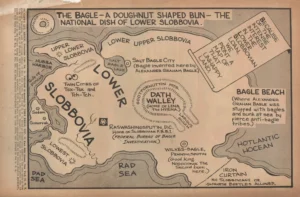
The Stubbornovsky regime has all the usual trappings of a modern state, including a Peoples Assembly to take lavish bribes and pass ineffective laws, plenty of ugly government buildings in the capital of Raswashingsputin DC, and a military equipped with whatever dilapidated gear got cleaned out two decades ago from warehouses in the US, China, and a dozen other nations, and hasn’t yet been passed on to the international arms trade. The Stubbornovsky All-Slobbovia Blivet Factory, the nation’s one industrial concern, churns out three-prong, two-slot blivets under contract to several big multinational blivet firms. Secret police agents spy on each other in the back alleys of the capital, polar bears parade down Stubbornovsky Avenue on the anniversary of the Glorious Revolution, and envoys from global and regional powers fly into Raswashingsputin International Airport, pay absurdly inflated prices to stay at the Hilton-Stubbornovsky Hotel, and compete for attention from the president and his inner circle of advisers with an ample stock of grants, loans, kickbacks, cute sex workers, and outright bribes.
It’s all of a piece with every other small nation in the backwaters of today’s global politics. The one distinctly odd thing is that if you travel outside Raswashingsputin, signs of the LSPRPCP and the Lower Slobbovian government fade out very quickly. Slobbovian villages are governed by their elders in the traditional fashion, and the handful of cities outside the capital have equally simple and old-fashioned arrangements for governance. Since you’re an outsider, of course, everyone you meet claims to be loyal to the Stubbornovsky regime, to go in fear of the secret police, and to pay crushing taxes to the bureaucrats in Raswashingsputin. They also do their level best to extract every penny of hard currency from you that they possibly can.

Get them good and drunk, on the other hand, and they’ll admit that it’s all a sham. After the Glorious Revolution, a coalition of tribal elders and polar bears decided that they’d better set up a modern government, or the US, the Chinese, or any of a dozen other nations would do it for them. That didn’t mean they wanted a government interfering in their lives. The arrangement they made with Goldarn Stubbornovsky was therefore quite simple: he can be president-for-life, and stash his ill-gotten gains in Swiss bank accounts, so long as he doesn’t expect the Slobbovian people (or the polar bears) to pay for his government or follow his orders. All those grants, loans, kickbacks, and bribes from abroad provide him with his budget. (For some reason nobody anticipated the cute sex workers, and neither the elders nor the polar bears are sure what if anything to do about them.) Similarly, none of the idiotic laws passed by the Peoples Assembly are ever enforced for more than a short distance outside the city limits of Raswashingsputin.
Mind you, there’s a steady trickle of Slobbovians who decide they want a more exciting life, some of that foreign cash, and maybe a shot at bedding one of the cute sex workers, and move to Raswashingsputin. Once inside the city limits, they have to obey the laws, find jobs as soldiers, secret police agents, government bureaucrats, or workers at the Stubbornovsky All-Slobbovia Blivet Factory, and assist the Stubbornovsky regime in furthering the nation’s one real industry, which is extracting money from the foreigners. There’s also an equal and opposite trickle of Slobbovians who get bored with the game and move back to some other part of Slobbovia to gnaw on bagels and polar bear meat and resume a less hectic life. A case could be made that those Slobbovians who live in Raswashingsputin are in fact oppressed by the regime, but it’s a very curious form of oppression: it falls only on those who choose to accept it.

Now of course most of us don’t live in Lower Slobbovia, and most countries don’t have quite so impressively absurd a system of government—though I suspect there are nations in the global South that approximate more closely to the Slobbovian model than most pundits like to admit. In most countries in the developed world, however, there’s an extent to which Slobbovian conditions actually do apply. Romanian-American historian of idea Ioan Couliano pointed straight to this odd fact in his deservedly famous book Eros and Magic in the Renaissance, where he argued that most industrial societies in the modern world no longer bother with police state tactics in most cases. He described them as “magician states” that maintain the obedience of their populations through methods closely akin to those of Renaissance sorcerers, manipulating the mases through symbols that conjure up desires and hatreds, luring them into thoughts and actions that benefit the system at their own expense.
This isn’t quite as true as it was in 1984, when Couliano’s book first saw print, and of course it wasn’t entirely true even then. Every modern industrial state, even (or especially) those that love to mouth platitudes about democracy, keeps the full arsenal of police state tactics in readiness, and uses them from time to time on visible targets to remind everyone else to stay in line. Most people in modern industrial nations, however, experience what the Marxists of my youth sulkily called “repressive tolerance”—that is, the regime lets them believe what they want and, within fairly broad limits, do as they like, while using control over the media and educational systems to keep alternative ideas from finding a mass following. That leaves a lot of room available for those who want to make constructive use of it.

The metaphor of the magician state has been taken up by various later authors and put to work in some very thoughtful ways. One book that deserves very close attention in this light is Mauricio Loza’s The Hounds of Actaeon: The Magical Origins of Public Relations and Modern Media, which appeared in 2020. Though there’s a crucial flaw to its central argument—one that it shares, interestingly enough, with Couliano’s work—it’s a tour de force in its own right. Loza took Couliano’s fascinating but brief discussion of the magician states of the modern world and filled in the gaps, showing how the machinery used by modern states to manufacture and manipulate public consensus uses the same principles and, via some of the odder channels of the history of ideas, derives some its historical roots from the Renaissance sorcery that Couliano chronicled so ably in his book.
The essential flaw that Loza’s work shares with Couliano’s is one that I’ve discussed on this blog already. Neither writer paid anything like enough attention to the fact that for every spell, there is a counterspell, and that these counterspells are readily available to individuals. Nor did they mention that because of the nature of magic, counterspells by individuals have a massive advantage against the incantations of the sorcerers whose job it is to maintain the established order of things.

Let’s take the road from Raswashingsputin to some distant corner of rural Lower Slobbovia as a metaphor for the process by which the sorceries of the magician state reach their targets in the minds, hearts, and unthinking reactions of individual people. It’s not a short road by any means. Consider a television ad meant to whip up support for some corrupt policy or other. Students of occultism will recognize most of the steps in the process by which this incantation has its effect. First, the intention of the spell has to be clearly formulated by the sorcerer who casts it; then it has to be embodied in a symbolic form that will have an effect on the target; next, it has to be communicated effectively to the medium that will carry it to the target; after that, it actually has to reach the target; and finally, it has to evade the target’s defenses, so it can convince the target to believe or act out something that is not in the target’s best interest.
The first three steps along the road from Raswashingsputin are, so to speak, under the control of the Stubbornovsky regime. That doesn’t guarantee that they’ll be done competently, just that it’s usually not effective for a counterspell to interfere with them at this stage of the working. Badly done sorcery, in fact, is astonishingly common in today’s magician states. Quite often the intention of the working is poorly thought out, the symbolic form isn’t well suited to affect the target, and the spell isn’t transmitted to a medium that will get it to its intended target. The failed Democratic presidential campaigns of 2016 and 2024 are particularly fine object lessons in all three of these classes of magical failure, for those that are interested.

The target of the sorceries in question rarely has the chance to influence the spells sent their way on that part of the road from Raswashingsputin, however. It’s in the last two stages of the trip that counterspells become most effective, because those are the stages when the power of the individual to shape what is received becomes stronger than the power behind the message. The most lavishly funded and professionally produced television ad ever made won’t have the least effect on an individual who chooses not to watch television. It will be no more successful if the person in question knows how to use appropriate symbols to shape his or her own consciousness.
The reason for this latter point is important to understand. The sorceries of public relations and advertising are vulnerable to this sort of individual counterattack because they have to be aimed at whole populations. They can’t be tailored to the specific passions, fears, and quirks of individuals; they must aim at the lowest common denominator of human reactions, and so their workings can only be blunt instruments. By contrast, anybody with a little self-knowledge and a very modest capacity for reflection can develop far more effective spells to use on himself or herself, targeting personal desires and aversions with much more precise effect than the sorcerers of the regime can manage.
It’s intriguing, at least to me, that Couliano never mentions this in his book. If what he wrote in Eros and Magic in the Renaissance is anything to go by, he believed that magic is and can only be the manipulation of people in the mass by individuals who have the requisite knowledge and power. Loza makes exactly the same curious and inaccurate assumption repeatedly in The Hounds of Actaeon. As every real mage knows, by contrast, the most potent of all forms of magic are those that the individual works on himself or herself.

What makes this all the more fascinating is that both writers had every reason to know better. Couliano was a capable practitioner of Renaissance magic and knew the occult literature of the period inside and out; he quoted the great Florentine mage Marsilio Ficino at length, and so he had to be aware of the potent spells Ficino taught his readers to use on themselves to ward off melancholy and elevate their minds toward the Divine. Loza, for his part, references Theosophy, Martinism, and New Thought in his book; all of these are occult schools that teach individuals to transform their own states of consciousness, and thus provide effective tools against the sorceries of the status quo; yet he relegates Martinism to a footnote and dismisses Theosophy and New Thought as shallow and vapid.
It’s a very odd blind spot—but it’s one that we have seen already in this sequence. The job of developing the most incisive possible critique of the existing order of society, while being exquisitely careful never to suggest any meaningful way to do anything about the problems thus made clear, isn’t simply assigned to the beta-Marxists we discussed in previous posts. It’s just as strictly incumbent on all those professional intellectuals whose work is officially disparaged by the manufactured opinion of the day but is supported financially by academic venues and publishers. For what it’s worth, I doubt that either writer ever consciously censored his work to fit this mandate. There are thoughts that every respectable intellectual knows better than to think, much less hint at on paper.
For those of us out here on the utterly unrespectable fringes, by contrast, the questions that doubtless comes to mind first center on just how far the counterspells can be pushed. Does the road from Raswashingsputin really extend to places where the power of our current crop of Goldarn Stubbornovskis doesn’t reach at all—and if so, how many people can go there at a time?

Those are valid questions, if complex ones. To begin with, it’s entirely possible, using relatively simple means of signal jamming and personal counterspells, to reach a state of relative immunity to the public relations sorceries of the existing order of society. Getting rid of your television, minimizing your screen time, and using a good ad blocker will do quite a bit all by themselves; replace the excluded content with something you choose—old vinyl records and books by dead people are my inputs of choice, but your mileage may vary—and add in daily spiritual or esoteric practice focused on developing self-knowledge and reflective awareness, and you’ll soon be watching the people around you with considerable bemusement, while stepping around the pitfalls into which they plunge with unwavering enthusiasm.
It’s when you put your awareness into action that you have to be careful. The evidence of history and my experience alike suggest that you can get away with an enormous amount provided that you do it quietly, don’t call attention to yourself, and avoid whatever activities panic the system into police-state actions. This is easiest to do if you’re alone. It’s not that difficult if it’s just you and a partner or spouse. As the number of people involve mounts up, so do the challenges, because anything that looks even remotely like the beginning of a mass movement will set off violent overreactions from the ruling elites.
How far individual freedom can be pushed by these methods also depends to a great degree on historical factors. In an era of decline like the present, two seemingly contradictory trends show themselves. On the one hand, a failing system cannot tolerate public dissent. You can see this in Britain right now: the facts that some 10,000 people have been imprisoned there over the last year for criticizing government policy on social media, and that the government is abolishing jury trials for most crimes, are not signs of confidence. They display very clearly the stark panic of a ruling elite that knows it’s circling the drain.

At the same time, the resources available for repression in an age of decline are far from unlimited, and tend to focus quite reliably on highly visible expressions of dissent. In effect, if the officials back in Raswashingsputin don’t notice your existence, they’re not going to spend increasingly scarce resources trying to control your behavior. Yes, I’ve seen the current claims that omniscient computer systems will soon overcome that obstacle; if you believe that, I have shares in a defunct dotcom company to sell you. One of the great speculative frenzies of modern times is raging around us, and it centers on generative large language models, the complex and resource-intensive programs mislabeled “artificial intelligence;” the destiny of the AI bubble, and the impending collision it faces with the hard limits of energy and resource availability, will be the subject of a future post.
The fine art of not being governed, to borrow a phrase from a book we’ll be discussing a bit further down the road, thus involves both significant challenges and remarkable opportunities. As we’ll see, the legacy of the Situationists offers certain very useful tools for dodging the challenges and making the most of the opportunities. We’ll get to that in an upcoming post.
*****
In the meantime, there’s another issue that deserves attention. December has five Wednesdays, and by longstanding tradition, the commentariat gets to nominate and vote on the subject for the fifth Wednesday post. What do you want to hear about? Goldarn Stubbornovsky’s secret agents want to know.
Hi JMG,
Off-topic 1 of 2:
Hoping all is well with you and yours.
Central Time, USA, about 10pm last evening, Dec 2. I am mentioning this because it felt like something happened a half a world away, at that time.
I fell asleep early. I dreamt about NATO missiles pointing at Russia, where NATO did a preemptive strike at Russia. The image, very much part of the dream, was that European cannons (and the like) turned into gigantic human mens’ p_nises (or is it ‘penii’) (call them ‘peckers’), deflated like the air was being let out, so to speak. The heads of the peckers sat on the ground, useless (a debacle). Word spread worldwide; Europe’s missiles had turned into a laughingstock/scandal because their metal cannons turned into flaccid peckers. After the debacle, Europe was “done for.” Europeans could not live down the debacle for two generations (roughly 55 years).
Was there anything that happened to NATO that would coincide with the timing of this dream?
I never remember my dreams. This is the one dream I remember in twenty years. Hmm.
💨💪🏼🍆Northwind Grandma💨
Dane County, Wisconsin, USA
Off-topic 2 of 2:
As you may know, I am attuned to wind. One might say, I specialize in wind. When winds are tumultuous here, I step outside and show my reverence and pray to the God of Wind.
Anyway, this last Saturday (29 Nov 2025), the upper Midwest had a gale and snowstorm that lasted well over 24 hours; at least here at the house, the wind was headed from east to west (the opposite the storm was taking). The wind was horizontal and fierce. From my kitchen window, the wind carried human ghosts—I saw and felt them. It was as if millions (if not billions) of human “spirits of the dead” were whizzing by—being cleansed.
The experience was utterly fascinating. I never saw anything like it, nor expect to again. I will never forget it. It was a high point.
💨🧘🏼♀️👻🙏🏼Northwind Grandma💨
Dane County, Wisconsin, USA
For 5th Wednesday I vote for downward mobility and its equivalency to freedom.
Dear JMG,
I must admit the bimonthly sensationalist posts are amongst the most anticipated, I just reread all the posts up to now as review. 🙂
As for the vote, last time the topic of downward mobility as opportunity for freedom was mentioned. I would like that.
Best regards,
V
JMG,
Todays post reminds me of a quote by the great Writer , Ed Abbey, “”How to Overthrow the System: brew your own beer; kick in your Tee Vee; kill your own beef; build your own cabin and piss off the front porch whenever you bloody well feel like it.”
I vote for downward mobility for the fifth Wednesday post
Given that the polar bears won the Glorious Revolution, I’m not surprised that they’re the ones benefiting from the subsidized housing. The new regime doesn’t want them rebelling again.
T’would be a cold daze in Helleninkyii before such a thing as Capp’s creation were to be unveiled today! Why… it’d be considered down right anti-semantic, what with the chewy donuts and all .. or for that matter racyist, being that those fast-furried polies are all snow white..
You keep hitting them out of the park, in increasingly enjoyable ways. Thanks for your efforts.
I’m curious if you’ve ever considered having tabs under your “Archives” (On the right-hand band of your web-page under “Subscriptions” & “Tip-Jars” & such), that are not only organized by time, but by theme?
For example, you could have a tab there labelled “Situationism” that then takes the reader to all of the relevant essays in this series of essays, in order of first appearance.
Other tabs could include “The Ring Cycle”, “Yeat’s Vision”, “Levi’s High Magic”, etc. etc.
Anyways, I know it would be a whole other thing to do, and you’re not necessarily looking for another thing to do. But I just want to say that it would be great.
I know some of these series have or will turn into books that you want to sell, so I don’t know that all works out. But admittedly, I partly do. For example, I read all of your posts in the series on Levi, but still went ahead and placed a pre-order on the forthcoming book. I read all of your posts on the Ring Cycle, but would also gladly buy that book if ever published. Just to have them all together in one place. Even if you put them all together in one place under a thematic tab online, I’d still buy the books just to have the in one place in book form. I can’t imagine I’m alone in that regard.
Anyways, thanks for entertaining the idea. and thanks again for your writings.
At this page is the full list of all of the requests for prayer that have recently appeared at ecosophia.net and ecosophia.dreamwidth.org, as well as in the comments of the prayer list posts (printable version here, current to 10/20). Please feel free to add any or all of the requests to your own prayers.
If I missed anybody, or if you would like to add a prayer request for yourself or anyone who has given you consent (or for whom a relevant person holds power of consent) to the list, please feel free to leave a comment below.
* * *
This week I would like to bring special attention to the following prayer requests, selected from the fuller list.
May Satoko L in Kyoto, who is undergoing at least a month’s hospitalization for Acute Hepatitis while in a state of immunodeficiency, heal quickly and safely, and return to full vitality.
May Bob Ralston (aka Rasty Bob) and Leslie Fish, both in hospice care in Buckeye AZ, be blessed and find relief from their pain and discomfort; may Bob’s heart remain strong, and may Leslie’s foot ulcers heal.
May Lydia G. of Geauga County, Ohio heal and recover from prolonged health issues.
May John N. receive positive energy toward getting through a temporary but irritating health issue.
May Patrick’s mother Christine‘s vital energy be strengthened so she can continue healing at home without need for more surgical operations.
May both Monika and the child she is pregnant with both be blessed with good health and a safe delivery.
May Mary’s sister have her auto-immune conditions sent into remission, may her eyes remain healthy, and may she heal in body, mind, and spirit.
May Marko have the awareness and strength to constructively deal with the situation.
May 5 year old Max be blessed and protected during his parents’ contentious divorce; may events work out in a manner most conducive to Max’s healthy development over the long term.
May the abcess in JRuss’s left armpit heal quickly.
May Brother Kornhoer’s son Travis’s left ureter be restored to full function, may his body have the strength to fight off infections, may his kidneys strengthen, and may his empty nose syndrome abate, so that he may have a full and healthy life ahead of him.
May Corey Benton, whose throat tumor has grown around an artery and won’t be treated surgically, and who is now able to be at home from the hospital, be healed of throat cancer.
(Healing work is also welcome. Note: Healing Hands should be fine, but if offering energy work which could potentially conflict with another, please first leave a note in comments or write to randomactsofkarmasc to double check that it’s safe)
May HippieVikings’s baby HV, who was born safely but has had some breathing concerns, be filled with good health and strength.
May Trubujah’s best friend Pat’s teenage daughter Devin, who has a mysterious condition which doctors are so far baffled by necessitating that she remain in a wheelchair, be healed of her condition; may the underlying cause come to light so that treatment may begin.
May J Guadalupe Villarruel Zúñiga, father of CRPatiño’s friend Jair, who suffers from terminal kidney and liver damage, continue to respond favorably to treatment; may he also remain in as good health as possible, beat doctors’ prognosis, and enjoy with his wife and children plenty of love, good times and a future full of blessings.
May DJ’s newborn granddaughter Marishka and daughter Taylor be blessed, healed, and protected from danger, and may their situation work out in the best way possible for both of them.
May Kevin’s sister Cynthia be cured of the hallucinations and delusions that have afflicted her, and freed from emotional distress. May she be safely healed of the physical condition that has provoked her emotions; and may she be healed of the spiritual condition that brings her to be so unsettled by it. May she come to feel calm and secure in her physical body, regardless of its level of health.
May Pierre and Julie conceive a healthy baby together. May the conception, pregnancy, birth, and recovery all be healthy and smooth for baby and for Julie.
May Frank R. Hartman, who lost his house in the Altadena fire, and all who have been affected by the larger conflagration be blessed and healed.
* * *
Guidelines for how long prayer requests stay on the list, how to word requests, how to be added to the weekly email list, how to improve the chances of your prayer being answered, and several other common questions and issues, are to be found at the Ecosophia Prayer List FAQ.
If there are any among you who might wish to join me in a bit of astrological timing, I pray each week for the health of all those with health problems on the list on the astrological hour of the Sun on Sundays, bearing in mind the Sun’s rulerships of heart, brain, and vital energies. If this appeals to you, I invite you to join me.
@Vitranc
I feel like that’s pretty simple:
“Freedom is just another word for nothing left to lose.” — Janis Joplin
“It’s only after you’ve lost everything that you’re free to do anything.” — Tyler Durden
“Then there’s nothing left to threaten you with, is there? You’re free.” — V
(I do dislike the last one because of the context but it makes the point forcefully.)
It’s a harrowing thought but the idea is that others can only control you if they can take away something you have and want to keep more than you want your freedom. The less you have, the less power they can have over you.
Thanks again for this series – it is up there with the Wagner series in a series I wasn’t enthusiastic about originally but became more and more interesting to me and a favorite of mine.
I will vote for how to put awareness into action in groups larger than a person and spouse as a 5th Sunday topic.
Thanks again,
Drew
John,
A valuable post.
Having come of age in the 60s and participated in the protest movements of the time, I found it difficult to give up the idea that mass movements couldn’t effect much change. I watched with dismay as the many good ideas of the time were, if not thoroughly squashed, relegated to the shadows of the culture. I’ve lived my life under the radar since then, so this post was very useful confirmation. Thank you.
As for 5th Wednesday, downward mobility sounds like a good idea to me
Cheers
For the 5th Wednesday, I nominate/vote for cognitive collapse in the USA.
Another fascinating post, JMG!
After a long hiatus, I have decided to try and do some consistent writing again. Since I like to think and write about topics that are sometimes quite outside the approved mainstream, the last four paragraphs of this post in particular give me some very useful food for thought on the practical issues of how to proceed.
Thank you!
My nomination for the 5th Wednesday post is the best and worst of the New Thought Movement.
JMG, thanks for this further meditation on situationism.
Of late, I’m observing the “big” powers attempting to push the string of their narratives with ever-diminishing effect. Not to say that lots of “well informed” people aren’t completely bamboozled (or at least are bamboozled to some large degree). It’s a good thing that our scope of actual activity is mostly limited to our own “little” lives. Nonetheless, surely such as I am are convinced of many things that aren’t so, simply by virtue of living in a technologically driven society.
On the one hand it’s a fearful time. On the other hand, it’s difficult to keep enough popcorn on hand, as we are entertained by dimwitted kleptocrats and lenocrats stumbling around making incredible pronouncements. Kaja Kallas, anyone? Jubilation T. Cornpone is surely a serious improvement over most of the clowns stumbling around the world and in our country and states, etc. Or even Foghorn Leghorn. I hereby nominate the “Jubilation T. Cornpone” song from “L’il Abner: the Movie” as a good theme song for watching the spectacle(s) in motion.
https://i.kym-cdn.com/photos/images/newsfeed/002/121/827/dd4.jpg
Become ungovernable
Does this mean that the medium of a spell need not be the Astral Light, but can be more physical media such as television broadcast?
Wow. I could swear I’m a resident of Lower Slobbovia! So if you’re wondering where to send your bribes and kickbacks, I will gladly accept such payments and provide nothing in return 😉
On a more serious note, I second (or seventeenth, or twenty-third, or however-many-we’re-up-to-now-th) the vote for a treatise on vertical mobility vs. freedom.
Hello JMG and commentariat:
Before I enter in the most serious topics of this today John essay, I’d like to tell you I didn’t know Lil Abner stories. Although John says (and I can believe him) that comic’s the most famous in the USA and maybe the rest of the world, it’s the first time I see it. Well, it could be my age or whatever other cause I don’t know yet, but thank you for having letting me to learn about another pop culture fact which was under my radar…
The 5th Wednesday. I am stuck on “ghosts” at the moment, namely ghosts written about in the 1800s. I am currently reading the short story, about twenty pages, “Poor Pretty Bobby” by Rhoda Broughton (1840-1920); the story is in the book “Victorian and Edwardian Ghost Stories,” edited by Richard Dalby, 2002, MetroBooks, ISBN 1586637371.
“Poor Pretty Bobby” first appeared in Temple Bar (as in Temple Bar–A London Magazine for Town and Country Readers, 1860-1906) in December 1872.
Man, is Bobby ever a great ghost story. They don’t make ’em like this anymore.
I vote for “ghosts” for the 5th Wednesday, for no good reason besides we now begin the Season of Death🏴☠️. Anyone for a game of gangrene🦠?
💨📚✏️💀Northwind Grandma💨
Dane County, Wisconsin, USA
All I can say is that here in the United Kingdom, the magician state has unravelled, and we’ve been moving inexorably into police state mode. Latest victim: RIP Jury trials. “All the better to lock you up for your thought crime, Peasant”.
JMG, don’t know if you or anyone here follows what is going on over here, but I’d be interested to know: Do you think our government is merely incompetent? Or is there active malice involved? I really fail to grasp the reasons for the ruling elite of this country seemingly being hell bent on destruction.
“The sorceries of public relations and advertising are vulnerable to this sort of individual counterattack because they have to be aimed at whole populations. They can’t be tailored to the specific passions, fears, and quirks of individuals; they must aim at the lowest common denominator of human reactions, and so their workings can only be blunt instruments. By contrast, anybody with a little self-knowledge and a very modest capacity for reflection can develop far more effective spells to use on himself or herself, targeting personal desires and aversions with much more precise effect than the sorcerers of the regime can manage.”
And the latest tactic on the part of the sorcerers has been to overcome precisely that barrier with focused advertising and tailored control based on highly customized (anti)social media (meta)data mining and various personality assessment models (i.e. what Farcebook et. al. have been specializing in for the last decade plus, cf. Cambridge Analytica and the like). That’ll all only get worse and seems to be the real point of all this so-called AI. Fortunately the solution is as easy (or as “easy”) as the rest of what our host lays out here. Kill Your Television!
5th Wednesday thoughts. My actual vote: “cognitive collapse in the USA.” But downward mobility and freedom sounds like a fine topic. And I’ve been wanting to float this idea, or perhaps to seed it: what would everyone think of a post on Robert Anton Wilson? Specifically RAW as mage and as high prophet of the myth of progress? Judging the magician’s work by the tangible results in his life, I’d say there are certainly plenty of failures to chew on fnord. And yet much value remains in his work; I believe I’m not the only here who’s benefitted from his writings.
Great essay, thank you.
My choice of media is a bit later than yours, but still a vanishing medium – physical music CDs. Believe it or not, I just checked on Amazon and both the Solti and Karajan recordings of the Ring cycle are out of print, as is Karajan’s Bruckner symphony cycle.
Music is now all about online streaming services and youtube. I have very little experience with music on either and wish to keep it that way, and your essay touches on part of the reason.
This makes me think of an oldish book by Wilson Bryan Key called Subliminal Seduction about the uses of magic (he didn’t call it that) in advertising .
Michael Clark
I’ve tallied everyone’s votes; thank you all.
Northwind, I don’t know of any event at that time that would explain the dream, but it certainly seems to be prophetic. As for the ghosts in the wind, well, I hope that’s not prophetic!
Vitranc, not a bad idea.
Clay, Abbey was onto something very important, and very American.
Pygmycory, yeah, they’ve done very well from the new regime. 😉
Polecat, Capp would have blistered today’s wokesters with incandescent humor — this is the guy whose character “Joanie Phoanie,” a rich folk singer and pampered limousine liberal, mocked Joan Baez for her pretensions, and who also featured a mob of student protesters belonging to SWINE, Students Wildly Indignant about Nearly Everything. He’d have had enormous fun with “anti-semantic,” not least because he was Jewish. I’m surprised that today’s conservative populists haven’t started having fun yet with Li’l Abner, since Capp was a political moderate in his day (and thus counts as fairly far right these days). It’s not as though we lack plutocrats like Capp’s J. Roarington Fatback and General Bashington T. Bullmoose, or congresscritters like Senator Jack S. Phogbound…
Chris, thanks for this. It would be a bit of work, but I’ll consider it.
Quin, thanks for this as always.
Drew, glad you’re enjoying it!
Caracara, I was a little too young to see those movements in their prime, but I came of age while the last dregs of them were trickling away into irrelevance. I’ll have more to discuss about that as we proceed.
Roy, I’m delighted to hear this. Apply the seat of your pants to the seat of your chair and the pads of your fingers to the keys of your keyboard, and make it happen!
Clarke, it’s fascinating to watch. Europe really has become a toothless, elderly chihuahua barking its lungs out at a bear, who regards it with a mix of annoyance and amusement, and may just gobble it down in a single bite if the experience gets too boring. I noted Putin’s comment the other day that if Russia went to war against Europe, very soon there would be nobody left for the Russians to negotiate with. He’s quite correct, of course; half the reason Russia has been slow-pedaling it on the Ukraine front is that it’s been building and equipping entire reserve armies in case it comes to war with the EU. Unlike the current chihuahuaocracy that runs Europe, Putin knows his country’s and his continent’s history, and acts accordingly.
Other Owen, ha! That’s a fine addition to my “Become Ungovernable” meme collection.


Rajarshi, it does indeed. You can cast a spell using any medium that affects the consciousness of the target.
Slobbovian Steve, yours is the fifth.
Chuaquin, it’s a matter of age. Capp’s comic strip was shoved into the memory hole after he died in the late 1970s.
Northwind, there’s a lot of fine spooky literature from those days.
Miow, their backs are to the wall. Now that Europe has lost its African neo-colonies and the center of the global economy is shifting to south and east Asia, what’s left of the economic basis that props up Britain is crumbling rapidly. The mass migration that’s causing so much disruption is being manufactured as a last-ditch attempt to prop up the wildly inflated price of real estate in the industrial world, because that’s what undergirds the whole house of cards of the financial economy of the western nations. When that collapses, and it will, the entire political and economic system comes down with it, and the current privileged classes will not survive the experience — in some cases, in even the most literal sense. What you’re seeing from Whitehall right now is the same kind of stark terror, desperation, and scrambling for temporary expedients you’d have seen in Berlin in the early months of 1945.
Math, we’ll be discussing the more targeted sorceries of our current magician state as the discussion proceeds. By all means propose a post on Wilson one of these months — but thanks for the heads up, as it’s been years since I’ve read anything of his but the Illuminatus! trilogy.
Charlie, oh, I have CDs too, including the Solti Ring. (I also have it on vinyl.) I’m appalled, but not surprised, to hear that it’s been allowed to go out of print — one more step toward the erasure of culture and history.
Michael, good! There’s a whole literature on that; Vance Packard’s The Hidden Persuaders is another book of the same kind.
@Quin #10: Leslie Fish has passed away, according to an s/f fan source.
I vote for Cognitive Collapse
The Lower Slobbovia government reminds me of how rapidly the Afghanistan government collapsed when the so-called Biden administration decided to withdraw from the country.
My Fifth Wednesday vote is for how downward mobility can bring freedom. While I am interested in cognitive collapse, I suspect you will write a post about that process after you develop that idea further.
For Fifth Wednesday: Oswald Spengler comes up occasionally when the predictions he made come true. My request is a post about the things you think he got wrong, what you suspect will not come true, and perhaps the limitations of his method.
For the 5th Wednesday, I would like to propose the topic of “the Antichrist.” Since it’s the end of the year and we know that it’s celebrated at the end of the year, and also since days like “Black Friday” are more like something the Antichrist would do, I think it’s a good topic.
Suggested subject for the fifth Wednesday post:
The life and collected works (or just one segment thereof) of Ophiel, aka Edward C. Peach.
– “The Life of Author Edward C. Peach – Ophiel” (very short bio) https://saythemagicalword.blogspot.com/2017/09/the-life-of-author-edward-c-peach-ophiel.html
– “Ophiel using a yellow highlighter on books” (funny vignette of a bookstore encounter) https://www.reddit.com/r/ophiel/comments/hxwqj9/ophiel_using_a_yellow_highlighter_on_books/
– Online catalogue of Ophiel’s books – https://www.akuriandocuments.com/Ophiel.htm
(I know there may well not be very much to add to this – the man spoke for himself well enough in his books, and he was not preoccupied about promoting his own personal history; I’m just curious about him – he seemed a real character – and what your take might be about his ideas, which are intriguing to me and for which he almost seemed to have a childlike enthusiasm for sharing).
I’m curious about the dates assigned to the death of King Nogoonik II (1982) and the Glorious Ursine Revolution of 1996. They seem anachronistic for a comic that ended in 1977. I’ve heard of L’il Abner of course, but the series was not part of my upbringing so I don’t know the particulars.
About an hour ago I walked into the local dollar store, and my attention was grabbed by a little christmas diorama: Mary, Joseph, baby Jesus, and a very small cow or a calf. Mediocre/meh sculpting, and terrible paint job: $2.75 CAN. I don’t normally buy Christmas tat, but I got seized with the idea of painting it up properly as an act of worshipful meditation this Christmas season.
Christmas is at center a celebration of the birth of Christ, but these days that tends to get lost in all the commercialization, bad music, and christmas tat, much of it only very tangentially related to Christ at best. Add in the movement to rename everything ‘winter holidays’ and strip out any references to Christ or Christianity, and it is really hard to unbury the birth of Christ from all the stuff its been buried under.
It’s been an issue for a long time, but it keeps getting worse.
Taking a piece of Christmas tat and turning it into an actual work of religious art is probably some kind of magical working along the lines of what you’re talking about here, isn’t it? What have I gotten myself into?
(I second everything that Chris Farmer says too in #9)
JMG, thanks for the encouragement!
I’m a bit old school though, so I like to do my first drafts and at least some of my editing and revising longhand in a notebook. I find I write better when I’m not trying to organize my thoughts on a screen.
Today post looks like to me more provocative even than another posts of you, John (and your posts have being always provocative to me in the good sense of the term). It’s true you’ve debunked some of the conventional political “wisdom” which goes on MSM and online nowadays. You’re right especially at pointing the two apparently opposite tendences in present and future governments: towards more control/towards less effective power. So I think totalitarian governments “wannabes” have their days numbered, in historical terms. The metaphor of that imaginary country from that cartoonist fits in a realistic view of the industrial world in the times ahead us: an apparently powerful government whose real power doesn’t reach rural areas not very far from its capital city. Very good!
I also take note of your advices to not be hypnotised by modern magic from the usual suspects. It will be useful in these times of fragmented but pervasive Spectacle. Thank you!
Oog, Britain’s abolishing jury trials in most cases? It’s getting worse than I thought over there, and I thought it was looking awfully bad.
I will second the vote for ghosts as the fifth Wednesday topic, actually. I find myself disquieted by some of the clairvoyant reports regarding those who died post-COVID vax. I have also been thinking about the role of the dead in Yeats’s writings. Are there really masses of unquiet dead drifting about, cut off from higher realities and unconsciously influencing or preying on the living?
JMG: for the 5th Wednesday post, I’d like to see an essay about The Magic Flute and its symbolism. I believe you’ll be attending a performance of it in the near future? If so, maybe I can suggest it again after that.
I will add my vote to the best and worst of the New Thought movement. It would be nice to have a few handy resources that are still viable. I would consider the old will training manuals in this same vein, though I know they aren’t exactly New Thought.
First of all, my vote for the 5th Wednesday’s a question: What books and writers are worth to save during the Long Descent to the next generations?
—————————————-
Now, my comments about your comments…
Northwind Granma # 1 and 2:
Your dream and experience look like very bizarre to me, maybe you’ve seen some reality aspects in those forms.
————————————-
Clarke # 17:
I agree. The Spectacle perpetred by “high spheres” is getting more and more absurd; the more it grows its with frantic efforts, the more gets less and less appeal (at least to people like me). You’ve also remembered the infamous Kara Kallas: you couldn’t find a better example of bluntest propaganda in western elites.
———————-
Old Steve # 20:
I’d like to send you money in form of bribes and so on, but unfortunately, I’m too poor to do it…
———————————
JMG # 27:
Thanks for your explanation about my unknowledge of that comic streep. If the author died at last ‘70s, when I was a baby busy on learning to speak and walk, it’s clear I couldn’t know that kind of humor works.
**********
CDs: I’ve got a lot of CDs at home and in my storage room, to my family despair. They repeat the conventional “wisdom” which digital pundits spread on MSM and online: digitalization has outdated physical forms of recording music and blah blah blah…Of course, I don’t pay attention to these sirens chorus, I also think people who believed that b**t will regret it. If the online clouds would be shut down by whatever problem, online music indeed wouldn’t be available…
Hi JMG,
I have been feeling that the Governments in the West are tipping over into a morbid psychosis. For a number of reasons, I have stopped writing my local column in the paper on our tiny island. I feel that going dark just now is a good idea.
Maxine
@Northwind: This might qualify; On the morning of 3. December I opened a local news page and on the first site two articles were posted side by side:
1.) “Ursula von der Leyen pledges the EU to ZERO energy imports from Russia starting 2027”
2.) “Viktor Orban, having gotten a special tariff exception from president Trump to import Russian oil and gas. Is now negotiating with Putin”
@Slithy Toves: Ha, well that works. I am right now thinking about how the first option could be applied to all sort of creative life choices. Hey hey not go live in Northern Canada and try the new climate change farming, you have nothing left to lose. 🙂 But in context of this weeks post, I do wonder how many home made enemies have the magician states been producing as of late.
@JMG: Oh my, this is feeding some “what do you call a, not train of thought, but a feeling, you are on the verge of figuring something out, but cannot grasp it quite yet” that I had of late. There are possibilities, especially if Europe goes the way of Northwind Grandma’s vision.
Best regard,
V
Once again, everyone’s votes have been tabulated — thank you.
Patrick, that was one of many things in my mind as I wrote that bit.
Zarcayce, you might be pleased to hear that I’ve gotten the rights to my book Apocalypse Not back from the publisher and am currently busy preparing an updated edition, Antichrist and all.
Oisin, good heavens, there’s a name I haven’t heard in many years. Thanks for the blast from the past.
Brandi, er, I invented those dates, and the entire history of Lower Slobbovia after Capp’s time. I do write fiction, you know — and I recall using the word “metaphor” in the post…
Pygmycory, it’s a very clever and subtle bit of magic; its technical label in the jargon of Situationism is détournement. We’ll be discussing it in a couple of weeks.
Roy, by all means — every writer has their own way of doing it. May the work go well.
Chuaquin, you’re welcome — and yes, that’s part of what I’m hinting at. More as we proceed.
Jennifer, no, fortunately. Most of the dead go where they belong, and cycle back into incarnation after a while. The unquiet, wandering dead are a small minority.
Maxine, that’s quite a good description, all things considered. Yeah, being quiet — especially where you are — may be wise.
Vitranc, glad to be of help!
WRT your upcoming post on the imminent collapse of the AI bubble, I hope it will be relatively soon, because I’m really looking forward to reading it. Chris Martenson thinks that this collapse will precipitate the next leg down of “the” collapse, and it will constitute the greatest financial crisis is human history (which means that, at the very least, it will exceed the severity of The Great Depression of the nineteen-thirties).
And apologies for repeatedly re-sending that comment on that post a few weeks back. I had recently injured myself by tripping on a section of poorly-maintained road (and yes, I blame the City of Cudahy in Milwaukee County for that) and I was feeling out-of-sorts and disoriented.
I already know from voluntarily collapsing in the mid 1990s to early 2000s that downward mobility is the key to freedom, so my choice for the 5th Wednesday topic is to learn what you have to say about Gnosticism. Not that I’m not already reading about it and collecting more books to read about it later, but I’m very interested in learning your take on it to add to the mix.
My husband and I ditched the TV 30 years ago and I stopped watching it a few years before that. It made a huge positive difference in my mood when I stopped watching; to me that was even more important than the extra time gained and the loss of all the expenses associated with TV. I also practice most of the rest of your list in that paragraph, but I watch the people around me with more sadness than bemusement. When possible, I try to offer a few words that I choose carefully to chip away at one tiny bit of the Spectacle that they’ve fallen for. It’s all I can do, besides continuing to deepen the tracks in space through active practices to keep up my immunity to public relations sorceries.
I don’t use an ad blocker because I spend most of my screen time on sites like this one that don’t have ads, but I do have to check email which is infested with pesky ads. Do you or the commentariat have suggestions for a good ad blocker? If so, I’ll trial them.
I also do my best to keep my head down and out of view of those who cannot tolerate dissent. So far it hasn’t been difficult, but I am keeping an eye out for changes in the situation that may require me to make countering changes.
I should probably look into detournament then, so I have some idea of what I’m doing. It also occurs to me that because Christ is the redeemer who came to repair the broken relationship between man and God by offering forgiveness, this is an even more appropriate than I’d thought originally.
I’m actually really excited about the project. Thus far, I’ve removed the price sticker, though it’s still sticky, used epoxy putty to fill in a couple of holes and a broken off bit of star, filed down a few edges that shouldn’t be sharp or lumpy but are (including the Joseph-figure’s nose), and done glitter removal with a q-tip. I think the glitter must have come from the other pieces of christmas tat, but the fact that I needed to do a ‘glitter removal’ step kind of says everything about its current state.
I think I might post before and after photos on facebook, where it will probably be seen by a couple of family members and a somewhat larger number of wargaming and mini painting nerds.
I’ll also toss my vote for cognitive collapse!
With regards to the Magician States, I’ve thought for a while that algorithmically targeted social media is, from a magical perspective, the most dangerous invention in recorded history. Like broadcast media, it is chiefly used for advertising, and thus, like broadcast media, part of the Magician States. However, unlike broadcast media, it can target each individual user’s unique and specific weak points; and unlike broadcast media, it is able to learn in real time what works and what does not work, provided it has data. This is trivial, given how much data a typical “smartphone” collects.
It is trivial to avoid the worst offenders, but an astonishingly small number of people ever even think of it, or choose to follow through on it, and instead everyone bemoans the tech companies while ignoring the fact that most of what makes the internet so miserable is optional. It is surreal to watch this play out, and now that I’m waking up from the spell, I am quite confident that a lot of the madness of the last twenty odd years is directly related to this utterly insane system.
For 5th Wednesday, I will once again vote for a post about the celebration of American’s 200th anniversary in 1976 vs. the 250th anniversary in 2026. What changed in the last 50 years to move the country from a huge birthday deal that sucked up all the oxygen to “anniversary? what anniversary?”
Thank you for clarifying. I understood the metaphor but wanted to make sure I wasn’t missing anything significant in the dates you selected.
Speaking of counterspells – A college success program titled On Course by Skip Downing offers a toolkit lifted from New Thought. Naturally, academia spends plenty of time and effort denouncing it. What is this guy thinking? Teaching kids to think their way out of failure?!? Shocking!
(Sigh.)
Dave in WA’s downward mobility idea sounds good. It has worked pretty well in practice for me.
JMG,
I’m glad!
I add my vote for “Best and Worst of New Thought.”
Northwind Grandma, the plural is “penes.” And the only people I’ve ever heard of who thought they had to censor the word are the congregants of Landover Baptist Church, where you have to call them “tallywackers.”
JMG: “Capp’s comic strip was shoved into the memory hole after he died in the late 1970s.”
A lot of the humor relied on then-current pop culture, so reprints (like they did to Peanuts later) wouldn’t really work. Plus the whole concept of hillbilly humor had run its course, to the point of being borderline offensive in some quarters (know what I mean, Vern?). Although we still have the Smuffy Smith comic strip, and “redneck” humor is kissing cousin, so to speak. with the hillbilly stuff. TV’s “rural purge” which ended the Beverly Hillbillies and other such shows may have been a related trend. Of course, the stereotypes have grown further and further out of touch with current reality, e.g. the idea of a woman asking a man to a dance is no longer odd. Maybe we could compare the situation with Beetle Baily, whose depiction of military life is very strange (a kind of camp-comedy fantasy based on WW2 models), but whose observations about (for example) dimwitted officers will never grow old.
Scott Adams had “Elbonia.” He was, of course, cancelled before he died, although that was his own bloody fault.
@Northwind Grandma (#1 and #2):
Not NATO, but the European Union, has indeed begun discussing a preemptive strike on Russia over the last few days or weeks. This has something to do with Kaja Kallas, current Vice-President of the European Commission and former Prime Minister of Estonia. She seems to me to be either dangerously ignorant of Russia’s current military strengths, or irrationally consumed by Baltic Russophobia–or both. Apparently Friedrich Merz, Chancellor of Germany, is flirting with the same idea of a preemptive strike.
If the EU acts on this and actually does strike Russia preemptively, Russia has recently developed the military means to decimate the leadership of the EU and all its countries within a matter of hours. (See the fourth paragraph following.)
Fortunately for us here in the US, Trump has been distancing our country from these utterly insane plans of the EU leadership. But a sizeable faction within our own government also hopes to see Russia’s destruction, and has nourished this hope for most of the last hundred years. So it’s ultimately a toss-up whether Trump or the anti-Russian faction in our own government will prevail, that is, whether we will abstain from this European fools’ war or take part in it.
So over the last few weeks the international scene has become the scariest it’s ever been in all my 83 years of life. I am seriously worried these days about our future, not so much for myself as for the future of all the rising generations, in the West.
And of course, such a war would yield cities-full of dead humans within a matter of days — so there may indeed be a vast wave of ghosts, perhaps even a couple of billion of them, within no more than a few days.
As for Russia’s military response to such a preemptive strike, note that they seem recently to have developed and tried out two wholly new powerful weapons, (1) a new kind of warhead that can deliver the explosive force of a small nuclear explosion without using nuclear materials or leaving any radioactive fallout; and (2) a warhead that can produce an electro-magnetic pulse able to permanently fry the electrical grid of a sizeable city. They also seem to have developed a very long-range hyper-sonic missile delivery system that can remain aloft for a very long time, can be guided in its flight path (in real time) from an on-ground control system, and has enough fuel even to reach, say, a US target by a route that passes over Antarctica and enters our territory across its southern border, thus bypassing most of our anti-missile defense systems, which chiefly guard our northern and eastern borders. (So Andrei Martyanov, who shares my view of the utter incompetence of the US and EU governments, but who has the engineering knowledge that I lack, and who also keeps up assiduously with all military news available from Russian sources. He is a US resident — IIRC, a naturalized citizen — who is a Russian, with Russian military experience in his past, and knows how to find information better than almost any American.)
Russia, to be sure, does not have the manpower to occupy European territory (or the US, for that matter) indefinitely; but they do have the manpower to take control for a few months and kill off almost all the higher echelons of national government fairly rapidly, then withdraw and leave the leaderless population to save what it can from the wreckage.
There is more that could be said, but this is probably already too much for most readers.
One final remark: victory in a military conflict is not solely a matter of troops and weapons, not of money, but in large part it is a matter of morale, and especially of the ability to take extremely severe losses and not stop fighting — generally for some intangible higher cause. Historically, Russians have excelled for centuries at enduring years, even decades, of severe attrition in war and not surrendering. Does the West even have some intangible higher cause of this sort? I am not sure we do, but I am sure that your average, ordinary Russian does.
Caracara @ 13, the protest movements of the 60s were effective for their time, and scored important victories. Especially effective were the civil rights and environmental movements. Look up Jim Crow laws sometime. Segregation was mandated By Law in many states. There were rivers in the US which caught fire because of the effluent being discharged into them. However, the authorities have learned how to deal with mass demonstrations and how to buy off movement leaders.
Math Fletcher @ 24 and JMG, you wrote above, as quoted by Math, “The sorceries of public relations and advertising…have to be aimed at whole populations. They can’t be tailored to the specific passions, fears, and quirks of individuals…” Ah, but they don’t have to be tailored to individuals. The mages can rely on the army of guardians of Niceness, that is, Respectability, to keep the vast majority of those pesky individuals in line. Those selfsame wizards of advertising have managed to convince the bossy cows who used to enforce public morals that consumerism is The Same Thing as morality. It is a pretty neat trick, morality=Nice, which itself is something that can be bought.
I will also vote for downward mobility and I hope you will share any ideas you may have about how to keep the bossy cows (and angry bulls) off our backs. It is easy to avoid notice by government and their minions, the minions being generally overworked; dealing with a nosy neighbor is a different proposition entirely.
As for the holiday formerly known as Christmas, maybe we should simply call that season Saturnalia, or Winter Party Time.
Other people may be mesmerized by the state’s magic, but not me, for I am an independent thinker. This is because my tastes differ from those of the thought-controlled masses. Rather, I
(which of the following would work, in that you could finish the sentence with it, and have the result make sense?)
(a) listen to NPR
(b) am a Brony
(c) read lots of occult books
(d) am drunk all day
>The mass migration that’s causing so much disruption is being manufactured as a last-ditch attempt to prop up the wildly inflated price of real estate in the industrial world, because that’s what undergirds the whole house of cards of the financial economy of the western nations.
It’s a three-legged stool, but you can only have two of the legs at this point. They are: functional banking system, affordable housing, and sound currency.
Pick two, any two. Or you can do what they’re doing, try to have it all and send the whole thing right off the cliff.
They don’t want a future.
I had never heard of Li’l Abner, but President Stubbornovsky’s sources of income remind me very strongly of the board game Junta, which my university course mates and I loved to play in the 1990s!
Hi JMG, thank you for the post.
I assume you were referring to the book The Art of Not Being Goverened: An Anarchist History of Upland Southeast Asia. I’ve recently read a very interesting book by Paul Kingsnorth called Against the Machine, which quotes from The Art of Not Being Governed, particularly about what in China used to be called the “raw” and “cooked” barbarians. Whereas the “raw” barbarians were the unincorporated hill tribes who managed to avoid taxes, laws etc., the “cooked” barbarians were former hill peoples who were now living in the towns and cities, but they were not quite like the other Chinese, and were not trusted. Kingsnorth presents the “cooked” barbarian’s approach (or perhaps “cooked ascetic” might be more fitting) as a valid option for most of us, who do have to live in the midst Slobbovia’s capital, but can set our own limits.
In that same book (Against the Machine, that is), I’ve also found the most interesting quote for most of what we discuss here in terms of lifestyle changes, spirituality, etc. and I would like to present it as a tentative motto for a better life in our present society: “To raindance on the astroturf”. Why not?
I would like to vote for cognitive decline for the 5th Wednesday topic. I am curious if cognitive decline is related to the crisis of competence that I have seen in my previous professional life. In my opinion, the crisis of confidence has been caused to some extent by the “hoarder” mentality that I see of the 60 and 70 year olds that are in charge right now. For some reason, they just want to hold on to information, refuse to train or teach the younger generation (the under 30 crowd) then blame said younger generation for being incompetent. Not sure if it’s related, but I’d be curious if anyone else has noticed this.
Regarding the conclusion of today’s post, I’m noticing more and more people dropping out, but they are having difficulty in steering themselves in a new direction when functional poverty prevents even dipping their toe into an alternative way of life. It’s all great to say “I’ll live the van life,” until you actually need to pay for gas or campground fees.
Lower Slobbovia will soon begin sounding like paradise to the Brits, Scots, and much of Europe…At least there are places there that allow you to ignore the State…
Mr. Greer .. in regard to Miow’s comment/question .. the current MI-6/High$treet scenario (I mean, this appears to be an English Deep-$tate thang .. is that the ‘template’ .. at least from my vantage point, tracks pretty close with the ‘V for VENDETTA’ storyline .. All that’s needed is: A new High Chancellor, with a completely PHONY precident for usage towards coralling the plebs, through fear .. aka a ‘McCready’ and such .. to to stoke abject horror into the citizenry, thereby allowing the ‘Punks-At-The-Top’ ..e.i. STARMER .. or his successors et. al. , to do as they wish, whilst still calling the shots .. before they get their eventual comeuppance .. V, or no V!
When I read
“It’s when you put your awareness into action that you have to be careful. The evidence of history and my experience alike suggest that you can get away with an enormous amount provided that you do it quietly, don’t call attention to yourself, and avoid whatever activities panic the system into police-state actions.”
I immediately thought of that great, concise instruction: Shoot, Shovel, and Shut Up.
No matter how much effort you put into Shooting or Shoveling (however you define those actions), Shutting Up is always the hardest step.
My vote is for downward mobility and freedom. Though the more I think about the term ‘downward mobility’ the more I think that it is part of another false binary and just reinforces the Faustian mindset. Alternatives? Step to the side (please, no Rocky Horror images), or my favourite: inward mobility.
For fifth Wednesday, I vote again, given the time of the year, on your views about why Christianity and Islam were so successful in Late Antiquity, and possible astrological connections of their main symbols.
In regard to the governments of the West tipping into morbid psychosis, especially Britain, I’ve changed one word in this classic to explain it,
“the war situation has developed not necessarily to Britain’s advantage”
You can substitute any other Western country you like, same idea. Promises were made that can not be kept without wholesale looting of somewhere else. The somewhere else has not cooperated. Revolution awaits.
As for getting rid of the TV, the TV got rid of the rural population in 2004. The digital signals don’t have the range of the analog signals. The urban rural divide has not gotten smaller since that happened and I don’t think that is a coincidence. The satellite stations are aimed at the least common denominator and therefore much less effective than the local stations used to be (where local meant 100 miles away).
Another vote for the Spengler critique
@Michael Clark, #26 – Both of Wilson Bryan Key’s subliminal books were excellent, thanks for mentioning them. The tactics used in the 60s were sophisticated, far more than most people think. The techniques being used today with the digital connection is off the charts. I suspect it’s one of the reasons people stay glued to their phones and computer screens so obsessively. There’s something being pumped through the digital pipeline
Key’s explanations of what Playboy actually thought of their readers was especially enlightening. And the purpose of the Beatles, and movies like the Exorcist.
@Yavanna #40 – Have you ever seen Ingmar Bergman’s film version of the Magic Flute? The opening overture is wonderful. It brought together his 2 loves: film and theater. And the cast is excellent. The overture must be on youtube.
the AI bubble, and the impending collision it faces with the hard limits of energy and resource availability, will be the subject of a future post.
I have read that these data centers use large amounts of electricity and water. I already understand the massive drain in electricity. I hope your future post can explain why these things are also using up large amounts of water as well.
I anticipate the AI bubble to pop before this time next year. My main concern is that it will probably take out the power grid when it goes.
Thanks for this essay JMG!
Am I correct in thinking that the two books highlighted were focused on the interval when the Spectacle was under more centralised control?
If so how does the return to competing sub-Spectacles affect the power and reach of the magician state? For example, the era where large political movements would unite people with often contradictory positions will be less viable, e.g. no to the death penalty but pro-abortion sometimes appeared to be strange bedfellows when in the same platform.
I assume over time competent but smaller magician states will emerge as they won’t have the mass audience of the centralised ones? If so politically this may be expressed as smaller political units, albeit maybe still within a larger whole? For the US this maps more neatly into your more traditional divide of stronger and more autonomous states and less intrusive federal government (from what i know of your history). In Britain local government is pretty hollow so I’m not sure what will emerge instead, maybe regional identities will become empowered.
I vote for ghosts
Will O
I vote for a post on Robert Anton Wilson.
@JMG,
My vote for a fifth-Wednesday post is another opera deep-dive, this time on the symbolism behind Mozart and Schikaneder’s The Magic Flute.
JMG,
Al Capps tale is one usually embraced by traditional conservatives. The further you live from the center of power (Raswashingsputin) and the more you are self sufficient and able to govern and provide for yourself, the more freedom you have from the central authorities.
Well this theory seems to have been embraced by the progressives in my hometown, but they missed a big part of the prescription. The city of Portland is trying as hard as they can to distance themselves from the federal government by rejecting national borders and immigration laws. Just recently they doubled down by legislating fines for landlords of ICE facilities, and proclaiming that they will arrest federal officials and officers if they perceive that they are violating Portland or Oregon laws.
Of course this only works if you are self sufficient and have no need for the money and services that the federal government provides. But as one would suspect this behavior has put Portland on the outs for all the different kinds of federal funds. It even got the Coast Guard helicopter that does rescues on the Oregon Coast removed ( at least temporarily). Like any local government of this type they are dependent on any and all free money from above and so they are throwing a fit over their predicament.
Of course the lesson is; don’t throw rocks at the Sheriff of Nottingham unless you are confident you can take care of yourself and have a deep dark forest to hide in.
I’ll cast my vote for best and worst of Nee Thought, if only because I think I started that ball rolling. Stare decisis and all that.
As for the article, I’m going to have to chew on this one. I feel like it’s trying to slap me in the face with something, and not just vague generalities but something concrete, but I still need it to be a little clearer. Probably a fine theme for meditation.
@Ambrose
Scott Adams is still alive as of my writing this. He’s terminally ill and had to be hospitalized recently but there’s been no announcement of death that I can find.
Re Leslie Fish–as I announced on the Magic Monday post, Leslie Fish of filksong fame died sometime on Saturday the 29th of November. There is more information and comment on Facebook.
Once again, all votes have been tabulated.
Mister N, well, we’ll see. This isn’t the first time Chris has been sure that the financial crisis to beat all financial crises was about to break. My guess is that it will be much more ragged, prolonged, and papered over than he thinks. (Thank you, btw.)
SLClaire, thanks for this. I consider getting rid of television one of the essentials of personal freedom these days, but you know how well that goes over. As for ad blockers, I use the Brave browser, which comes with a fairly effective built-in blocker; I’ll be interested to hear what others have to suggest.
Pygmycory, nah, just do the work. You already know exactly what to do, and putting a fancy French name on it is just one of my bad habits!
William, that’s a good point. I get very little targeted advertising — doubtless not having a cell phone helps drive that.
Rhydlyd, that’s fascinating. It shows how deeply invested academia is in encouraging students to fail.
Ambrose, much of Capp is still funny, but the “rural purge” is relevant — that was part of the process by which the left abandoned rural Americans and turned into a movement of urban privilege.
Mary, the guardians of Niceness are certainly one of the obstacles the aspiring mage has to overcome. We’ll discuss them as the project proceeds.
Ambrose, none of them. I assume you’re just being snarky here.
Other Owen, I’m not sure they can have two for that much longer!
Aldarion, I don’t know the game but it sounds fun. The regime’s sources of income are pretty standard!
Joao, yes, that’s the reference. The problem with being a cooked barbarian is that the heat on the pot just keeps rising; I’ll discuss alternatives as we proceed. As for dancing on astroturf, here again, there are other options. Being “against the machine” is a typical beta-radical move — what are you for?
WatchFlinger, yes, I’ve noticed that. One of the reasons that I’ve made such a point of getting what I have to teach into circulation, to the extent of releasing some of it free of charge with Creative Commons licenses, is that their sort of behavior annoys me mightily. As for dropping out, that’s the wrong way to do it. I’ll offer some alternatives in upcoming posts.
Pyrrhus, in due time, Britain will resemble Slobbovia. It’s purely a matter of getting there.
Polecat, I didn’t read that comic. Hmm.
Teresa, it’s good advice — and the fourth virtue of the mage is always the difficult one!
Siliconguy, there’s that!
Moonwolf8, I can explain the water very easily: cooling. All that electricity flowing into all that computer gear produces prodigious amounts of heat, and the heat has to be removed to keep the gear from frying. Water is usually the cooling medium.
Vivek, I don’t think those two books noticed that there was an alternative to central control. As for Britain, what awaits it is a familiar reality of such period: warlords.
Clay, I really wonder whether everyone in Portland city government forgot about a few events that happened between 1861 and 1865. They do not have the legal right to contravene Federal actions. If they try, Trump can quite literally declare an insurrection, send in troops, remove Portland’s mayor, put in a military officer as replacement, suspend habeas corpus, and do quite a flurry of other things, without having to do more than inform Congress. It’ll be interesting to see if it comes to that.
A fine post, thank you!
I was a bit surprised to see a reference to James C. Scott turn up as a future topic in this series, as I just read Against the Grain and have Seeing Like a State high in my to-get-to list. Was he influenced by the Situationists, or do you just find his thinking running in similar channels, or something else?
Secondly, I saw Math’s comment about Robert Anton Wilson and your reply to it, so without surveying the field to make a more strategic choice, I’ll throw in a 5th Wednesday vote for something RAW. Have you read Prometheus Rising by chance? It was one of the influential works in my turn from materialism to a more spiritual worldview, but I haven’t read it in years and am not sure how I’d find it now. For what it’s worth, one of the key take-aways I got from it was that in a primarily monetary economy, questions about money tend to get influenced by all of the primal survival instincts/intuitions/fears/etc, which explains why folks get so weird about money – he called money “survival tokens,” and for me, it was an important step in my understanding of money/economics that helped get more out of The Wealth of Nature years later.
Anyhow, thanks again for the post, and looking forward to where this series continues to take us!
Cheers,
Jeff
I remember the Li’l Abner comic strip. I wondered why it was called a comic because I didn’t think it was funny. Maybe I was too young to appreciate it. Also saw the movie. All I remember of it was the Jubilation T. Cornpone song, which was pretty good.
My vote for the 5th Wednesday is New Thought, which I am attracted to.
An interesting work about the magical nature of the State, its spells and the counterspells you can use in order to set yourself free has been made by the Italian Mattonismo.
you will find their manifesto on https://laterum.wordpress.com/2021/09/09/the-brick-manifesto/
I have been following them since their early stages in 2021, and they introduced me to the concept of Magical State. They also made a few workshops about spells and counterspells. All this, in a period (2020-2022) in which the use of magic by the State was at its maximum.
Britain effort to get rid of jury in trials seems to me ominous, too. Jury’s a genuine democratic institution. During Franco dictatorship in Spain, there weren’t here jury trials; only when the democratic system was working some time, jury was allowed to judge some crimes. So I think every attempt to limit or even abolish it is a threaten to democracy.
——————————
Robert Mathiesen # 55:
It’s incredible how reckless and stupid the EU elites can be, talking overtly of preemptive attack against Russia, they must think Putin doesn’t have plans for this contingence and he won’t rettaliate against EU with every military force Russia has…
I vote for cognitive collapse.
—
I’m curious about the blind spots of Couliano and Loza you mentioned and this whole pattern of “beta-criticism”. Several thoughts came to mind here:
1. They actually did keep their mouth shut, and thus no clue in their writings either. But since Couliano, at least, was murdered by angering the wrong people, that can’t be it.
2. The commonly seen desire to believe that “those powerful people over there” are in control, since that’s less scary than the alternative.
3. Provisional living, using a fantasy about future that never arrives as a way to keep present possibilities out of mind.
4. The thaumaturgy was effective enough on their subconscious that even if they’re consciously are repelled by it, their minds are still affected. Like the song says, they can checkout any time they like, but they can never leave. Maybe to leave, you have to stop contemplating it.
-John N.
Slithy Toves (no. 77) Oh felgercarb! You’re right, my bad.. Must be one of those Mandela Effect things.
JMG ” I assume you’re just being snarky here.” (in post 58)
My point is that you can’t just tune out of the culture by doing things like turning off your TV and taking up subcultural interests like occultism., which are just as subject to marketing forces. .It’s probably a matter of degree, but there’s something to be said for “Bob’s” advice to regard all propaganda as God-breathed, i.e. not to mind swimming in the mass-cultural soup.
Thanks for this series, I’ll share a story of how I’m starting to stand up for ridiculing the spectacle I have to interact with most of the time…
My brother and I have grown up with virtually the same opinions on matters, but have deviated hugely since 2020 on most things (couldn’t for the life of me tell you why 😉 ). One thing that used to always unite us was Films. It’s one way my family used to talk over the dinner table, we’d explore characters, what moved us etc, so enjoying the same films and getting into the details of it is something that we’d often do…
Last Saturday, at my brother’s demands that “we have to watch it, you will love it!”. We all sat through 2hrs 50 minutes of ‘One Battle After Another’; a new big blockbuster that’s done amazingly in the reviews but done terribly in its distribution and has had to be brought out on streaming services much sooner than is typical of a film this size (which in itself says something)…
The film follows a mixed race couple who are ‘revolutionaries’ (they call themselves this and it’s very cringe throughout), part of the group ‘French 1775’ who go about waving their guns at ‘the system’ which of course ‘is bad’. The villains are the border control people (ICE), and a white supremacist group who are called “The Christmas Adventurers” (they’re basically pantomime villains). They steal the daughter of the revolutionary couple and the white father has to go and get her back basically… There’s more to it, and theres lots of elements I thought were done well, but my brother is still insisting I’m wrong for not finding this story the pinnacle of cinema, he kept praising the message and how ‘it’s so current’… Just now he’s sent me another message about it, prodding me to write this post!
It’s quite clear that in order to like this film, you have to basically buy into The PMC spectacle that positions a hatred of Trump and what you think he represents at the centre of your personality, and all else stems from that it seems. If you never, even for a moment, entertained the thought of “hmm, I wonder what caused Trump to happen?”, then you’ll be offered an endless amount of content to keep you away from really diving into that question. Your vocabulary will be updated with all sorts of hate-filled language to describe your opponents, and your ability to move through the liberal world of ‘pleasant’ conversation will be seemlessly enhanced. Oh and you’ll have that sweet, sweet feeling that you know exactly who the bad guy is (the film spares nothing on how evil the bad guys truly are), and of course most importantly, know precisely who the goodies are (hint: it’s definitely you!)… All pretty tasty bagels!
Apologies for the rant, but my god this particular spectacle of our time is so tiresome, any idea when it might end? I have a feeling I’ve got a couple more decades of my brother kicking and screaming when I don’t like a film with the ‘right’ message comes out, but I’m praying it’ll come sooner.
Cheers!
@Northwind Grandma and Robert Mathiesen, one thing that happened around the time of the dream is that the EU commission came out with the message that they intend to grab 140 Billion euros of frozen funds from the Russian Cantral Bank and give it in two years to Ukraine. (It was presented as a choice between that or coughing up the funds from EU budgets but that is just to corner Belgium that doesn’t want this money grab as it is located in their country).
This is an enourmous amount of money and a serious escalation. How else would Russia interpret this other than an act of war? It is also about the last escalation the EU has before declaring war.
As for the duo Ursula and Kaya, please let no one ever try to sell me that the world would be so much better if it were run by women….
“This isn’t the first time Chris has been sure that the financial crisis to beat all financial crises was about to break.”
Every financial crisis is always the financial crisis to beat all financial crises for somebody in the world. Usually happens when the financial crisis causes that person to lose their status in whatever class they used to be at and forces them down a few classes.
https://xcancel.com/telopots_/status/1996400387658825796
Since we’re discussing AI, this video pretty much sums up the state of the art for me. TL;DW – he took a pic of his cat, shooped the ears off and then fed the result to Grok, which then proceeded to confidently say all sorts of gibberish.
You never do get “I’m not sure” or “I don’t know” out of these systems ever. Always going forward, ’cause we can’t find reverse…
My vote for cognitive Breakdown
I also would be interested in hearing your take on Gnosticism, as one could certainly call it, along with Buddhism, a parent religion of today’s New Age Movement.
“Let’s take the road from Raswashingsputin to some distant corner of rural Lower Slobbovia as a metaphor for the process by which the sorceries of the magician state reach their targets in the minds, hearts, and unthinking reactions of individual people.”
This reminded me strongly of my reading, many years ago, of the fieldwork that David Graeber did in just such a place (although in the real world it is known as the highlands of Madagascar). I’ve just looked it up again, and in this essay – https://monoskop.org/images/b/b8/Graeber_David_Fragments_of_an_Anarchist_Anthropology_2004.pdf
I read the following descriptive passage:
“After the financial crisis of the ‘80s, the state in much of the country effectively collapsed, or anyway devolved into a matter of hollow form without the backing of systematic coercion. Rural people carried on much as they had before, going to offices periodically to fill out forms even though they were no longer paying any real taxes, the government was hardly providing services, and in the event of theft or even murder, police would no longer come.”
Although the text in which this passage is embedded contains language that may be tribally** offensive (such as “revolution” – trying to figure out what counts as one; or “anarchist” – trying to define what it looks like in practice), and people from other tribes might grasp his point better if he had used different language, what he DESCRIBES is precisely what you are describing here – pockets of what he calls “anarchy” that develop in places where effective state government has receded, and people carry on quietly, unobtrusively, regardless, as a further passage implies:
“it was a very fragile, tenuous sort of freedom. Many such enclaves have collapsed—in Madagascar as elsewhere. Others endure; new ones are being created all the time. The contemporary world is riddled with such anarchic spaces, and the more successful they are, the less likely we are to hear about them. It’s only if such a space breaks down into violence that there’s any chance outsiders will even find out that it exists.”
I cannot, at present, find the specific ethnographic work in which he describes his own, very slow and gradual noticing, of what is being hidden from him as an outsider as regards the nature of the specific “anarchic space” of the village of Betafo, in the highlands of Madagascar, where he lived for two years doing field work. It is only in the latter part of his stay that he begins to realise the extent to which the village governs itself, and how far it lies beyond the effective reach of the power of the state. His slow realisation is exactly as if he was living in a WOH novel, and begins, over time, to realise the extent to which the community he was visiting existed mostly on the underside of the carpet/sheet (by which reference I may be garbling the metaphor with which Owen explained things to Justin).
PS – a lot of his early ethnographic work explores local, Malagasy, concepts of magic and sorcery, however, in this I suspect that he retains too much of an outsider’s perspective to throw much light on how to make effective use of it to an audience of mages.
** by “tribal” I am referring to the Left/Right divide in matters of language and sensibility, which JMG describes as being, at heart, a tribal one. Graeber is clearly – in language and sensibility – of one tribe, and JMG is just as clearly of the other, and yet I am very frequently struck by the similarities of what each (in their own tribal language) observes about the workings of people, societies and the world at large. I expect both would find occasions to throw one another’s books across the room in frustration, all the same… 😉
I’d like to read about downward mobility too, given it’s something I’ve done in becoming a working gardener.
I’m free to work for who I choose, in gardens I like and in the way I see fit, and then get paid for it. Some of the gardens are places of great beauty and I appreciate them more than I can really say. They are a salve to my soul. Yesterday I wrote to one of my brothers to tell him what I’d seen that day and how I wished I could tell our recently departed father about it: “Today the sky was perfectly clear and every water drop hanging from leaf and twig glittered in the sunlight. The low sun lit up fallen leaves like amber and a robin followed me all day as I worked”. In his response, he told me of spending the day “in a darkened room explaining software to disinterested youths”. What a contrast.
Being free has its downsides in that you don’t have the security of knowing what money you’ll have coming in and you don’t get holiday or sick pay, but you do have the freedom from some of the absurd expectations of others and to spend your time living in the way that seems right – and, in the end, time is all we have.
@ambrose — Scott Adams is still alive
@clay and JMG — one other funny item about the ICE stuff is that the local cities want to use local police to stop the big, bad “Federales”. It’s like these people forgot about “defund the police” movement from 5 years ago. The people whom they thought were bad are now the “heroes” to stop the even eviler people. And I think the local gendarmes are smart enough to figure that out.
In Waukegan (a suburb of Chicago) a police official was heavily criticized for shaking hands with a Fed (https://www.lakemchenryscanner.com/2025/11/07/police-officials-defend-actions-after-officers-seen-interacting-with-federal-immigration-agents-in-waukegan/)
I know if I was a local cop I would not try and arrest a Fed — and I think that view is quite common.
ps — downward mobility is my vote
Jerry
JMG,
First of all , my vote is for cognitive collapse.
It is likely that those now in Portland city government are not aware of the legal issues surrounding the Civil War. You see several of them are public school teachers.
For most of my life Portland had a stupid form of government where the 5 city commissioners were elected and each one ran a specific city department. So a person who’s previous job was operating a coffee shop found themselves running the Public Works Department. The elected mayor would usually run the Police Department. But ,for most of this time Portland was docile and easy to run city without big city crime, gangs, ghettos and little corruption.
Then in the early 2010’s it became a trendy place to be and a wild array of arty, progressive types moved in along with pot dealers and growers. During this time the older industries like machine shops, tool dealers, warehouses and the liked were turned in to co-working offices and CrossFit gyms. These companies moved to the surrounding suburbs along with all the ordinary middle class people who depended on them. The most notable influx to the city during this time were ( I am sorry if I offend anyone) Lesbians. They mostly moved in to North and Northeast Portland, the trendy and previously underpriced part of town. They became the political power base for the state representative from the area ( our now governor Tina Kotek, ). Portland did not have the stubborn ethnic or blue collar neighborhoods to provide political inertia so the newly construed voters doubled down on crazy. Voting for a range of taxes that were meant to extract money from anyone who made any more money than a graphic artist or grade school teacher. This of course drove out the remains of the regular middle class people. I have 5 good friends I went to high school with. At one time they all lived within the city limits of Portland, now none of them do.
So following its big troubles during Covid ,Portlanders decided to replace the stupid form of government they had with a stupider one. They voted to switch to a system that was based on a city manager, a weak mayor and a 12 person city council. Portland is a small place so the districts for each of these commissioners is small, this created a commission of school teachers, community organizers and coffee shop owners. A full third of them are card carrying members of the DSA. This is like haveing Providence run by a city council consisting almost entirely of Brown students and faculty. ( except the Portland ones are less well read and worse at taking tests)
Portland is most likely doomed, as its problem is not crazy local government but crazy voters who get the government they want.
Recently Governor Tina announced a new initiative to attract business to Oregon and improve its economy, ( good luck Tina).
Excellent article John,
Like yourself I’ve noticed the locking up of people from protesting in the UK, and the proposal to remove trial by jury in England. It smells of desperation. Do you think the split up of the UK is a possibility on the back of this? Scotland failed in its quest to become independent in a referendum, but current actions in Westminster will continue to alienate the Scots, who have seldom believed that it represents their best interests. Scotland has its own legal system, so there are aspects of the union that are still separate already. Also there are signs that the Welsh are looking to support independence too.
Kind regards Averagejoe.
In each round of Junta, the player who is the current president gets an amount of money in foreign aid and decides how much to distribute among the other players, who are generals, admirals, ministers etc. (and how much to save to his own Swiss bank account). The trick is they don’t know how much the president actually received in this round! At some point, they will rebel and try to put a new president in his/her place. There are also various action cards. I liked best “University students protest in the streets. Effect: Nothing”.
The part of Lil Abner that stuck with me from back in the day was the “shmoos.” My memory of them was vague and I’d forgotten how to spell “shmoo” until I looked it up but they were bizarre enough to be memorable. Later, hanging around Buddhists, when I heard of “hungry ghosts” I thought of the shmoos, but of course the shmoos are not at all like hungry ghosts except in their appearance. These days, we’d probably have to genetically modify them so they’d be even better to eat and cheaper to raise. I never realized how much social criticism Capp put in that cartoon.
Scott Adams was still producing his hour-long rambles, last I checked. I can’t watch more than a few minutes of listening to him ramble, sip coffee and chuckle at his own cleverness. When he worked at Pac Bell, we were just down the hall from each other. Maybe I should be a fan, but I’m not.
Fifth Wednesday nomination: “the destiny of the AI bubble, and the impending collision it faces with the hard limits of energy and resource availability”
JMG # 79:
Your reference about Portland city government rebellion against Trump federal government’s IMHO like playing with fire. I agree. If this desobedience against Washington goes and goes on escalating your depiction of punishment measures to maintain the rule of law isn’t a joke. Oh, I can imagine the blunt denounciations of “fascism” by Portland geniuses and liberal people in USA and other countries…However, there’s the hard fact: every democratic country of the world has in its Constitution and other written laws punishment measures like the American ones, preventing the rebellion and/or secession of a part of its local/regional governments and bureaucracies. In my country, there’s the 155th article of our Constitution, for example, which abolishes for a time self government of rebel parts of the country against central government. It was implemented against Catalonia government and Parlament by Madrid conservative government when secessionist parties declared Catalonian independence unilaterally and in absence of “spanish” parties in the Catalonia Parlament. Well, in spite of secessionist complaints of “fascism”, law was applied: police charged against demonstrators and regional autonomy (as government) was suspended in that year 2017 for a time. When national sovereignity is challenged, things like this one can happen. We’ll see how ends Portland bravado, if their local elite’s smart enough there won’t be an escalation, or (cough cough)they may be too fool and too arrogant to retreat themselves from their own mess.
Lacking a smartphone certainly helps avoid targeted advertising, but my experience is that the smartphone is only half of the equation. It collects the data, but the actual distribution method is social media; so getting off that killed most of the targeted advertising for me even before I ditched the smartphone. I’m also not sure that targeted advertising is the most dangerous part of this equation. These algorithms are designed to try to maximize revenue for the tech companies, which means maximizing how much time people spend on their platform, since this helps them gather data (which they can sell), subtle manipulation (by controlling what gets shown, they claim to be able to do things like manipulate mood, alter even things like religious opinions, and change the likelihood people will vote, any of which would be valuable to some) and of course blatant advertising.
All this means they are intentionally addicting people, and as with any addiction, sooner or later one of two things has to happen: either people quit, or the addiction a moral and intellectual collapse. That would be dangerous enough without the consequences of having a fire hose of information specifically tailored to catch your attention pointed at you at all times, which prevents having room and time to think, disrupts sleep, makes the real world seem boring, and a host of other nasty consequences at the individual level, as well as driving phenomena such as fake news at the societal (truth is often less interesting than fiction; so fiction spreads better on social media).
As to why data centers use water;
Take a modest 50 megawatt data center as an example. 50 megawatts is 50,000 kilowatts. A standard 8 foot long 240 Volt is 2 kilowatts. My all-electric house in a cold climate stays warm with six of them., and they are seldom all on at once (though they could be and the system has to be designed for that case.)
So one modest datacenter is equivalent to 25,000 heaters keeping 4,166 homes warm in the winter. That whole 50 MW turns into heat just like the power sent to the baseboards, To get rid of the heat they have to send it outside and it ends up in a cooling tower where it evaporates water. At 2260 kJ per Kg to evaporate water, Given that 1 joule is one watt for one second, 50,000 kw is 50,000 kJ/second divided by 2260 kJ/Kg and they evaporate 22 kg of water per second.
As a point of interest the polysilicon production plant I used to work at used 50 MW on a fairly typical day. We had four cooling towers running in the polysilicon portion of the plant and the “Niagara” (a different evaporative water cooled heat exchanger) in the silane unit.
The data centers could use closed loop cooling like your car, radiators and fans, to cool without using much water, but this costs more and runs into problems in the summer.
I think I got the math right, it’s early yet.
Your portet of the Royal Dutch Navy seems quite accurate!
Dear JMG,
I loved your romp through Absurdistan with Al Capp’s Li’l Abner. As I recall, Lil Abner had a job – he was employed as a mattress-tester at a department store. Then there was the Shmoo – delicious, edible, effortless chicken-like livestock.
Last night I opened up one of my collection of old Situationist books and read about 25 pages of it: The Wandering of Humanity by Jacques Camatte. I think his work is the most substantial of the writings that I have. I actually found it inspiring, at least 25 pages worth.
A good grounding in Grundrisse is required to truly appreciate this work, but the gist of Camatte’s thesis is that Marx failed to account for the ability of Capital to not only recuperate every form of resistance to it, but to seamlessly envelope every aspect of human culture and activity to the extent that humanity no longer exists. We all become AI powered meat robots, mere appendages of Capital.
Capital accomplishes this not only through controlling culture but also controlling every activity of humans, not just labor. The old Marxian conflict between use value and exchange value is superseded to yield a ternary that simply erases all value except the value of the supreme persona, the only persona that still has sovereign personhood – the Corporate State.
How did it come to be that humans have no value? That only the Economy, the Climate, Our Democracy, or Equity and Inclusion have value? Camatte says these concepts are indefinite, which makes them unreal and a form of mystification and magic control that is quite analogous to the old mystification of the Church. As you often say, JMG, progressivism is just Christianity with the serial numbers filed off. Marx himself is ultimately a capitalist because for him Capital was the motive force that could pry labor from its sleep and power the revolution that would “hang the last king with the entrails of the last priest.” Capital would tear down the mystification system of the old regime and the Proletariat would step into the moral void and take control.
Obviously that never happened. Capital remains in control with progressivism as its handmaid.
The folly of Marx is part of this “wandering” of humanity that Camatte is trying to address. I did not read the entire tract and will come back to it at some point, but it sparked these additional thoughts:
Thinking about value, all beings have self value first. They value their own being and that which supports it. The value of offspring, mates, extended family and tribe come next. As tribes grew into clans and fiefdoms, the connection between personal values and community values was stretched, but still held.
Kingdoms start to explicitly embody a Divine persona as the leading value in the person of a mortal King. This is definitely a perversion of human nature. But still, there is value that exists beyond the state because value is given to higher powers or gods.
Even the modern nation state, like Lower Slobbovia, can retain some value coherence as long as there is space for both culture and activities that are not part of the body and sovereign persona of the state.
Capitalism grew out of the vigorous plundering by kingdoms and empires. The mobilization of resources in the service of war and trade created capitalism. Capitalism is busy achieving its final goals as we speak: destroying our health, families, livelihoods, culture, agency, and much more.
Yes we can be free in our heads by shutting out the noise, but they are busy closing in on our bodies. The technotopian future is taking on nightmare proportions and threatens to do incredible damage before it plays itself out as depleting resources no longer sustain it.
Here is where Marx was correct. Capital seeds its own destruction – not by causing revolts that it is incapable of resisting, but by destroying and consuming the fruits of the Earth until there is nothing left. We all know this. and that’s why we are here with John Michael, and the Ecosophian community. We are looking to cherish and rebuild our minds, our connections, cultures, and livelihoods in the envelope of the living Earth. We know that Capital is Li’l Abners bed and we are done being mattress testers. We need a Druid to remind us that we have been here before, because it is easy to forget when we still are surrounded by all the bobbles and Christmas tat (but not Pygmycory – you are not fooled!).
The illusion is shredding and we are forgetting reality less and less these days. Things are turning. Turning is what you do when you are wandering, spinning and turning on a winding path. The direction matters, and the path we are on now is downward. We are in decline and have been for a long time. Writing in 1973, Camatte seems truly prescient. He says:
“At present there are three possible courses for the capitalist mode of production (in addition to the destruction of humanity – a hypothesis that cannot be ignored):
1. Complete autonomy of capital: a mechanistic utopia where human beings become simple accessories of an automated system, though still retaining an executive role.
2. Mutation of the human being, or rather a change of the species: production of a perfectly programmable being which has lost all the characteristics of the species Homo sapiens. This would not require an automatized system, since this perfect human being would be made to do whatever is required.
3. Generalized lunacy: in the place of human beings, and on the basis of their present limitations, capital realizes everything they desire (normal and abnormal), but human beings cannot find themselves and enjoyment continually lies in the future. The human being is carried off in the run-away of capital, and keeps it going.”
Contemplating The Wandering of Humanity turned my thoughts again to the question of value. Recovering ourselves is the first value we must reclaim, as John Michael makes explicit. But this is really hard to do when we live in the belly of the beast, the Leviathan, that has swallowed all value into itself, including us. Do we have to wait until the beast spits us out in its throes of death and we are crying in the wilderness to find a guiding light? Or can we find that guide now that will help us restore value to ourselves and our loved ones? Could such a guide provide a step down to the next level of human organization that is more familiar and manageable by sovereign human beings? Should we try to bring back some version of the ancien regime?
Recognizing that every human culture will tend to create mystifications, still some could be better than others not because they are more useful but because they are more human and more true to our nature. That is what I am searching for right now as I wander as a human, not just the recovery of my own individual soul, but the binding force, or religion (re – ligare – to re-connect) that can lift up whole communities.
The question I have is this: Is my search for religion just another fool’s errand as we are all condemned to endless wandering, never to find our home?
A fine article JMG. I vote cognitive collapse!
As a former member of Unity who watched his childhood congregation fall apart as our minister got caught in the thrall of the prosperity gospel over the course of the 00s, yes, tally one more vote for a discussion of the best and worst of the New Thought movement!
It was amazing how, as every single sermon got to be about “visualizing prosperity”, the balance sheet sank more and more into the red and the attendance got lower and lower. The law of mind action is hardly the only Unity Principal, but naturally the one that got overemphasized. “Live the truth you know” would probably be the important counterbalance to that, but making the effort to CREATE the prosperity was too much I guess.
That congregation no longer exists (though said Minister is now involved in unity.fm, which I never listen to).
In re: the discussion on the freedom in having nothing left to lose…
I recently read a book on negotiation called Never Split the Difference. A lot of food for thought in there. One chapter talked of three kinds of leverage: negative leverage (when you can take away something the other party wants to keep); positive leverage ( when you can give the other party something they want to gain); and normative leverage (basically when you use the other party’s morals/principles/self-image and try to convince them to do something so as to not be a hypocrite).
It seems to me that the “nothing left to lose” variety of freedom deals with negative leverage. It bears thinking about how to free oneself from the other two kinds, as well.
Once again, all votes have been tabulated.
Jeff, I have no idea if Scott was influenced by the Situationists; I simply note that his ideas interface fairly well with what I’m trying to discuss here. As for Wilson and Prometheus Rising, good heavens, yes.
Marco, thanks for this! I’ve bookmarked it.
Chuaquin, it shows pretty clearly that the British government is preparing to ignore civil rights and start arresting and imprisoning people at will. Yeah, bye-bye what’s left of British democracy…
John, all those are quite plausible. I didn’t know Couliano and don’t know Loza, though, so I’m not going to hazard a speculation.
Ambrose, au contraire. It’s been my repeated experience that once people actually get rid of (not just “turn off”) their televisions and use similar signal-jamming methods, they begin to drift further and further away from the manufactured consensus of society and end up living their own lives. It’s also been my repeated experience that people who are addicted to television and the other delivery systems of the Spectacle bristle angrily and post snarky comments when I suggest this option.
Tobes, in its own way, that’s encouraging to me. If the mainstream left has to use such extreme means to push their agenda, and believers in the manufactured consensus are pushing those means on people who disagree with them, that’s a sign of extreme insecurity. It suggests that they’re having a hard time making themselves keep believing in it.
Anon, sure, but there are also plenty of people out there in the financial end of the doomosphere who have predicted eight out of the last three economic downturns…
Other Owen, and now there are people trying to get LLM programs licensed to diagnose illnesses and dispense medication. The body count is likely to be pretty impressive.
Scotlyn, oh, doubtless. I dislike the theoretical structure Graeber used, I bristle at the way he cherrypicks data, and I find the conclusions he drew improbable and absurd, but he and I could probably have looked at data together and found common ground there.
Bacon, thanks for this! It’s good to hear from someone who actually stepped off the treadmill and is doing something worthwhile with her life.
Jerry, it really is bizarre. I know some cops, and even here in bright blue Rhode Island I wouldn’t count on them following orders to interfere with federal officials.
Clay, oog. I’m impressed, in a way, that you have the fortitude to stay in a state run that way. I’d flee, fast.
Averagejoe, it depends on whether the Scots can take power back from the multinational elite class that currently runs their government and monopolizes power. If they do, independence is a real option.
Aldarion, ha! If I played games, I’d look into that one.
Phutatorius, the Buddhists somehow failed to come up with the opposite of hungry ghosts — call them “tasty ghosts,” who exist for the sole purpose of being eaten by somebody else and get all their joy from that. It was left to Al Capp to come up with the shmoo. (Cartoon below for those who weren’t there at the time…)


Chuaquin, here the equivalent of the 155th article is the Insurrection Act, which allows the president to declare that a state or area is in a state of insurrection, place it under martial law, replace all its elected officials with a military government, and leave it in that condition until the insurrection is definitely over. It’s been used, and not just during our Civil War. I read about the business in Catalonia — thanks for the reminder.
William, okay, that explains a lot, since I don’t do social media. Thanks for the explanation!
Turtle, ha! Maybe the Dutch navy and the Lower Slobbovian navy could exchange port visits. By bus.
Seaweedy, to my mind it’s the zenith of beta-Marxism to spend all one’s time insisting that capital really is omnipotent, and can only be overturned by the destruction of everything. Your search for religion is a good first step away from that, but it’s only a first step. The other steps? We’ll get to those.
Deathcap, it’s one of the signs that New Thought’s gone toxic that believers fixate on money. It’s a constant vulnerability, because of some of the problems woven into the foundations of New Thought by its founders — those can be corrected, but only by rethinking some fundamentals.
Weilong, “normative leverage” might also be called emotional blackmail. The Stoics were on top of all of this — but we’ll get to that as things proceed.
Someone upthread brought up the downsides of downward mobility. It definitely has them.
For one, depending on how far down you go – and we went pretty far down compared to my family, though less so compared to my husband’s – you will not have enough money to keep up with even the modestly living Joneses. You might start out with a decent car, but you’ll only have one for two adults, and you’ll keep it for more than 20 years, so that it gets rust and tears in the upholstery, and it doesn’t have wifi because it’s too old and neither do either of your cell phones because you won’t pay for it, so you navigate by paper maps and don’t concern yourself with how shabby the car looks next to those of most people you know. You have to be prepared to go against what is called “common knowledge,” so that you keep the car as long as parts are still available, and you are willing to pay more for repairs as it ages because it’s still cheaper than a newer car, even though most people seem to be unaware to grasp that. Same thing for housing: you need to be willing to live in a downwardly mobile neighborhood, next door to a vacant house with other vacant houses down the street. And to get to know your neighbors so that all of you can handle the challenges that vacant houses on your street can bring.
And you have to make difficult decisions on not having things most people consider necessary, like medical insurance, and how to deal effectively with not having it. My husband didn’t have it for 17 years and I didn’t have it for 21 years, till each of us aged into Medicare. Since we weren’t paying for insurance, we could pay for better quality food, and we weren’t dealing with soul-sucking jobs so we avoided those stresses that are hard on one’s health. I learned a little about alternative methods of health care, which I employ for both of us as needed. But we also had to get up close and personal with the possibility of chronic illness and not having the ability to pay for conventional medical care – which in both of our cases entails serious spiritual practices.
I could go on, but I have other things I need to do, and I don’t want to hog up the comment space. But I think this is enough to get my point across.
Tobes # 87:
First, thank you for warning us about such as mediocre and predictable movie you watched, though I prevented myself to see mainstream products. Well, I rarely go to the cinema because American movies (and in a lesser way Europeans) are utterly wokeized since more than a decade ago, more or less. Add to this noisy indoctrination the lack of imagination (remakes and more remakes) and you’ll understand my slow cinema absentism; though if I exceptionally smell something over the average, I go to the cinema (rarely in last years).
You’ve written how your opinions have being differenciated from your brother ones. I’ve been living a simillar situation with my family from some years ago, too. Although this trend of divergent thought started before 2020, I think in my case the pandemics accelerated that process. You can bet everyday life with them is a bit harder today than some years ago, but nobody said real free speech was going to be easy…
—————————————
Scotlyn # 93:
Of course, D. Graeber has a strong ideological bias towards anarchism, so he usually sees anarchy everywhere the governments weaken, in Africa recently or somewhere centuries ago…For a hammer, everything are nails. However, I find his works useful to know others peoples and eras ways of self organization beyond the dull binary State/Markets (which indeed is often a false opposition). It’s a pity Graeber and JMG are in a certain way trapped in another binary opposites, the Left/Right scheme, but well nobody’s perfect, and indeed I think this blog’s every ideological part of political arch, though logically according own John tendences it tends to the Conservative trend.
———————————-
Seaweedy # 105:
Thanks, I’ve got another name to read in my future readings: Jacques Camatte, who I didn’t know beyond Debord and Vaneigem stars on the Situationist sky. Situ thought’s useful to check nowadays miseries of life under the Capitalism, yet. So if I’ve understood well your comment on Camatte critic against Marx, Old Karl was partly wrong and partly right in his writings. Interesting…
Marx didn’t noticed (or didn’t wanted to notice?) the persuasive and pervasive Capitalism power to dehumanize people in every part of their lives; although he managed to point the System has indeed inside it the seeds of its own destruction…but for a different cause than he thought in his time. Very bright!
The comments above about Portland, OR. are puzzling. I can’t say I know a lot about municipal governance, but surely there are legal ways to mess with an unwelcome Federal intrusion. ICE rented a building? Such for rent buildings are nearly always in arrears on their property taxes. Send the owners a bill. When the owner calls the mayor, I thought we had an agreement here, Well, you know Bob, your new tenants are pretty unpopular around here. Then there are the health and safety inspectors, those narrowminded busybodies who sniff around to find out if your fire protection actually does work. Oh, crack in the pavement in front of the building? We’ll get right on that, and then it turns out pipes from the 1900s need replacing. If Portland is mostly populated by artsy types and lesbians, neither group known as employers of illegal migrants, what do the ICEes think they can find there?
I suggest those interested in cognitive collapse could do worse than seek out the works of the late Christopher Lasch.
Ah, I should probably use this all as an excuse to finally get around to reading The Art of Not Being Governed, huh? I loved seeing like a state and, well, It’s becoming increasingly relevant along with the rest of Scott’s ouevre…
Re: @william #49 and smartphones/social media i’ll second that.
Re: general politics, my sense is that one of big problems is that systems of government downstream of marketing work. For a while. Because reality is messy and complicated and it’s necessary to simplify it into abstractions in order to coordinate human action on a large scale, but the problem is that the abstractions are less real than the real things they’re abstractions of. Put another way, you can measure crop yields in an excel spreadsheet, but changing the number in the excel spreadsheet doesn’t change the actual crop yield, it just changes the representation of it without changing the underlying reality. Something like the stock market is another example of the type. The problem comes in when the people who work with these abstractions start caring more about the abstractions than the actually real things they measure, and come to believe that by manipulating the abstractions you can change the underlying material reality, which is why the growth in the FIRE sector is so destructive. But the problem is that all they’re doing is changing perceptions, which eventually runs into reality. Something like that?
re: Targeted Advertising,
JMG says he gets very little, and says it’s because of his lack of phone. I also suggest that being very weird (as we mostly are) helps immensely with this. I do have a cellular phone; it is a smart “android” model. It was required at the time I purchased it for reasons we don’t need to get into. The point is, having this device safely means google knows *everything* about me. Where I go, what I talk about, everything.
It doesn’t help google one little bit. Sometimes it feeds me adds in Russian; I don’t speak Russian, but algorithmically I apparently have something in common with Russian-speakers. Sometimes french, which, I admit I used to know but am not terribly fluent at. (French Canada’s culture is very good at encouraging people to give up– that’s by design, to keep the pool of applicants for lucrative government jobs smaller.) Even when the adds are in English, it’s very rare there’s one for something I’m remotely interested in. About the best it can do is give me adds for whatever my last purchase was. Buying a 10-year-old junker means I must be in the market for a new car, right?
I know I’m flooded with targeted adds, but they don’t feel targeted, because I’m too weird for the algorithm to pigeon-hole. I doubt I’m the only one. Maybe that’s a kind of counterspell, too.
Mr. Greer .. My exposure with ‘V for Vendetta’ is through the film “as only celluloid can deliver” (tis a quote from the movie, whereby V .. addressing his um, hostage/co-conspirator watch a government banned flick.. ‘The Count of Monte Cristo’, if I remember rightly). I’ll assume that the film fairly closely tracts the graphic novel, having not read it myself. But, my point still stands: England has, for all intents and purposes, become an authoritarian dystopia SHole! I doubt that it will ‘prevail’, irregardless of the Guy Faulks references.. I also predict that the British satellites – e.i. Scotland, Canada, Australia, New Zealand etc. , each with their own dystopial adjuvents .. will not stay ajoined much longer, the way trends are headed.
For the fifth Wednesday I vote for how downward mobility gives individuals freedom
Tobes 87: “One Battle After Another” according to the Wiki-place was inspired by Thomas Pynchon’s novel “Vineland.” Huh???? I read “Vineland” twice, and I wouldn’t recognize it from your description of the movie. Very loosely adapted, I’d guess. That’s not to say that I recommend “Vineland.” It wasn’t regarded as one of TRP’s best. Not by me or by anyone else.
Hey JMG
On the subject of Scott’s book, did you know that another author has written what I imagine could be its complementary twin?
I have not read it yet, but “The art of being governed” by Michael Szonyi is about how families in Ming dynasty China dealt with their government, in particular how they dealt with their system of military conscription.
https://press.princeton.edu/books/ebook/9781400888887/the-art-of-being-governed-0
Also, in regards to the 5th Wednesday votes, I have not quite made up my mind yet, but I wanted to know what topic seems to be taking the lead so far? It seems to be “downward mobility” from what I’ve seen.
JMG # 109:
Indeed Britain slow (or not so slow) fail of its democracy towards a covertly totalitarian system’s a tragedy for Europe. It was the UK the only western country in WW2 which didn’t surrender with Nazis nor helped them…In addition to this fact, British people historically have been proud of their democratic institutions. It’s a pity. If this change happens there, what could happen to European countries with a weaker democratic culture?
********^
Following with the legal system to punish rebel bureaucracies and local governments by the central governments, I want to point the spanish government use of constitutional article 155 was softer than your Insurrection Act, because the whole operation to dissolve demonstrations, arrest secessionist leaders and suspending Catalonian government was “only” a big police force., not tanks. In spite of spanish far right campaigns, the government at Madrid didn’t send the Army to Barcelona; self contention in answer which I find reasonable and according to our laws (I admit it though I’ve never voted the right wing party here). After the massive police operation the secessionist only runaway could have been armed insurgence, but I think they understood nobody here wanted a civil war again…and its leaders coped with “exile”or jail.
After the farce of a referendum without permission (and opaque to say it softly) and the failure of their unilateral independence, secessionism in Catalonia has been steady going down according several statistic surveys. However, secessionist parties keep being legal here, which will go on until they cross law lines again, but now they aren’t strong like years ago. Ironically, they have the power yet to give air or let fail the current central government (or the next one) but that would be another local topic.
The Portland case isn’t the same as our Spectacular secession attempt, because its goals are anothers, but it’s interesting the US government answer would be military, I think this harder answer could come from the different historical contexts between countries.
@ Mary Bennet,
You assume that the Portland city government wants the ICE facility gone from the South Waterfront. If the feds moved it to a warehouse out by the airport, how would Antifa and the progressives carry out their anti-trump Ice-capades virtue signaling, nightly theatre show. The current location can be traveled to by tram, light rail, bus, boat, bike, skateboard and on foot from nearly everywhere in town. It is surrounded by newish condo’s and apartments so they have a built in audience.
You are right, there is almost no-one inside the city of Portland for ICE to scoop up. But it is centrally located so they can bring in undocumented immigrants from the surrounding counties where recent immigrants of both the legal and illegal variety live.
@TylerA, I remember getting lots of ads for the piccolo model I’d just bought. That was many years ago, though. More recently, I’ve been getting lots of ads for male deodorant, and male clothing, most likely because I watch a lot of youtube wargame-related videos… so I must be male, right? Wrong. LOL.
>Other Owen, and now there are people trying to get LLM programs licensed to diagnose illnesses and dispense medication. The body count is likely to be pretty impressive.
I wonder if you can get an LLM to prescribe a little hit of meth to get you through the week. It’s a brave new tweaky world.
https://www.livescience.com/technology/artificial-intelligence/meth-is-what-makes-you-able-to-do-your-job-ai-can-push-you-to-relapse-if-youre-struggling-with-addiction-study-finds
—
I’ll vote for cognitive collapse. There’s rumors the ∀⋀∁∁∣n∃ makes swiss cheese holes in your brain. Wouldn’t have anything to do with people getting dumber. That would be conspiracy theory.
@JMG, don’t worry, I’ve been continuing. More gapfilling and sanding, then primer, white drybrush, and I’m just starting in on color.
Also thinking about Christmas, while I’m doing that. Today, mostly that I’m actually pretty irritated at what it has become over the past couple of decades, and worried about the direction Canada is currently going. There seems to be a really nasty anti-religious bent in the Libs and the Bloq and the province of Quebec right now, aimed substantially at Christians but also at others, resulting in assorted proposed laws aimed at curbing religious freedoms of various kinds. Some of them get shot down, but others aren’t going down so easily, or at all.
Your last paragraphs remind me of an 18th century song (by an anonymous author, of course): Die Gedanken sind frei. The first two verses would go like this in English:
Thoughts are free, who can guess them?
They fly by like nocturnal shadows.
No person can know them, no hunter can shoot them
and so it’ll always be: Thoughts are free!
I think what I want, and what delights me,
but always in silence, and as is proper.
My wish and desire, no one can deny me
and so it’ll always be: Thoughts are free!
Speaking of the rising tide of totalitarianism in the UK, Comrade Keir has just announced that still more local elections are being suspended in a number of jurisdictions where the Reform Party was expected to do well.
https://www.yahoo.com/news/articles/starmer-war-british-democracy-154423114.html
A retired British Army colonel who served in Northern Ireland during the Troubles and commanded British forces in Afghanistan warns that civil war is likely.
https://yournews.com/2025/08/17/3756938/former-british-army-colonel-warns-uk-is-heading-toward-civil/
British police are actively preparing for a possible civil war:
https://www.newstatesman.com/politics/uk-politics/2025/11/the-british-police-are-preparing-for-civil-war
It’s pretty clear that Great Britain is descending into a classic Third World dictatorship/hellhole/failed state. The unfolding mess in the UK and the EU makes me grateful to be an American on this side of the pond. This is not going to end well..
@ Chuaquin #42
“They repeat the conventional “wisdom” which digital pundits spread on MSM and online: digitalization has outdated physical forms of recording music and blah blah blah…”
I would repeat what I learned in the Navy decades ago: “If you don’t have physical control, you don’t have control.”
This applies to so many things! Think of gold certificates, with ingots waiting for you in some secure bank vault. Sure. Or, a physical book sitting on your shelf, its text remaining intact. Digital records can and do get altered.
Hi John Michael,
Ah, sadly for me the tech boors took out my website with that most awful of English words: “Update”. Oh the horror… Anywhoo, back now after six hours of my life was consumed.
Man, I thought you were kidding around with this essay, but no, apparently Dogpatch was a real thing, as was Slobbovia. Fascinating.
Thanks for the laughs with this essay, and dare I say it? Well, why not, I got’s some Advice fo’ Yo’ All (staying in theme here): We’re all individuals! I now rest my case, in the knowledge of a job well done.
The court jester can say things, that nobody else has the courage to do, don’t you reckon? 😉
Cheers
Chris
When our lone TV died in 1996, we didn’t replace it.
Eventually, about a decade later, we accepted a used TV.
I did not hook it up to the outside world. We were gifted a game console and a VCR, eventually replaced by a DVD player. If someone simply HAD to watch TV, they could. They could choose a movie (which I pre-chose) from our home library or visit the library.
It was work and so the TV rarely got used.
Today, we use our TV to play films on DVD. I review many of them, resulting in books for sale. Otherwise, it stays off.
In addition to everything else you gain by muzzling the TV monster, I have saved TENS of thousands of dollars over the decades by NOT paying cable bills!
I have also enjoyed the pleasure of telling telemarketers calling to sell me a cable package that I refuse to pay to “Beam filth into my home.” They don’t call back.
JMG (no. 109) ” It’s also been my repeated experience that people who are addicted to television and the other delivery systems of the Spectacle bristle angrily and post snarky comments when I suggest this option.”
Ouch. Well, I don’t watch TV, at least not on purpose (my wife does, so I get the equivalent of “second-hand smoke”), but admit to being addicted to esoteric books as well as comics, both of which I learn about an access through the internet. But suppose I quit all that stuff and became Amish. Would I then be free? Far from it–the Amish subculture is quite regulated. So was American society a century ago, or two centuries–that was why so many people felt they *had* to go to church, for example. The neopagan and hippie subcultures are more free-wheeling, but still have their influencers and marketing channels. No snark–trying to break free of these is like trying to break free of language, it’s the water we swim in. Now is there a matter of degree? Sure, but you haven’t *escaped* the system–you’ve made a consumer choice.
This “Junta” game reminds me of “The Dictator’s Handbook,” a funny-but-serious guidebook on how to be a dictator:
https://en.wikipedia.org/wiki/The_Dictator%27s_Handbook
My friend has cited this book several times in her journal articles on Central Asian politics!
I love RAW and Prometheus RIsing was the book that turned me away from semi-atheistic pragmatic dharma to occultism. That said, I don’t think it’s going to win., so I vote for cognitive collapse.
I am still addicted to TV despite JMGs encouragement to toss it out. I do know better than to watch it. I should at least cut way back because its hampering progress towards goals. I did go two years without it some years back. I think I’m pretty immune to mass minds despite this but not as immune as I could be. I am not on social media which I think is more detrimental to being an individual than TV. TV is a drug, but one that is safe physically. Feel kind of pathetic writing this TV part. Some magic is probably in order. I haven’t done results magic in forever. Just spiritual development practices.
Clay Dennis @ 120, I take your point. It seems we have performative cruelty on the one side and performative virtue signaling on the other. I do find it frustrating this us nice people don’t name names attitude among Democratic politicians and office holders. Were ICE to set up where I live, I would fully expect our mayor to say out loud in a press conference, ICE is renting ABC building which is owned by the XYZ company which just happens to owe the city Y gazillions in back taxes.
pygmycory @ 123, about the anti-religious bent, do you happen to know who might be financing that? Certain folks looking for a bolt hole maybe?
For 5th Wednesday I vote for downward mobility and its equivalency to freedom
@Mary Bennett,
I honestly don’t know. In the case of Quebec there’s been a fair bit of antireligious sentiment and aggessive secularism ever since the Quiet Revolution of the 1960s, and recently they’ve been getting antsy over some of the things recent islamic immigrants have been getting up to – but whenever they pass a law because of bad behavior of said followers of islam, it is usually very broad and hits everybody else as well. A lot of the antireligious sentiment in Quebec is likely homegrown for their own reasons. Outside Quebec… hmm. Some of it is proabortion and LGBT groups wanting to completely muzzle Christian voices that don’t agree with their life choices. But it has definitely gotten much worse in the past few years.
I used to dismiss claims of Christians being persecuted/oppressed in Canada out of hand, but having churches and other religious establishment shut down for months while restaurants and bars operated freely, while Christian churches got burned down or vandalized, egged on by the media changed my mind.
Again, all votes have been tabulated.
SLClaire, of course. It’s not all strawberries and cream; as a rule, freedom and security are antitheses — pick one or the other, because you can’t have both. If downward mobility wins the competition, I’ll be discussing that.
Tyler, an excellent point. You’re causing algorithms to suffer from cognitive dissonance, by doing things that don’t fit any of their mental models.
Polecat, I wonder how many Commonwealth countries, including Britain, will be conquered by military force in the next half century or so. The mutual hostility between elites and the rest of the population has reached a point that makes effective defense all but impossible.
J.L.Mc12, no, I hadn’t heard of that. So far several possible topics are close enough that any of them could still win out. Vote for the one you want!
Chuaquin, understood. The US is a more heavily armed society, so sending in the Marines is the response that comes first here.
Other Owen, I’ve heard those rumors, and I’ve also encountered some interesting conversations among people wondering why so many people seem to be slowly losing their ability to think. (One example out of many: https://old.reddit.com/r/HighStrangeness/comments/1pafo8a/anyone_else_finding_themselves_in_situations_that/ ) We’ll just have to wait and see.
Pygmycory, ouch. I hope things improve.
Aldarion, nice! Thank you.
Gerbil, I know. For the government to be taking such drastic steps, the situation must be even more explosive than it appears.
Chris, smart kings listened to their jesters. We don’t have enough of either one these days.
Teresa, fun times. 😉
Ambrose, you’re still ignoring what I’ve actually said in order to drag in straw men of various descriptions. Let’s review the point I was trying to make. First, if you limit the extent to which the delivery systems of the Spectacle have free access to your mind, you weaken its effect. That weakening increases over time because the Spectacle is constantly changing, and the less exposure you allow, the more you tend to drift away from it. Second, if you feed your mind with material that isn’t part of modern pop culture or any of its pseudo-alternative subcultures (ahem), you set up a creative conflict in your mind between the Spectacle and the worldviews embodied in your alternative material, and that opens possibilities. Third, there’s the whole issue of using ritual and meditative methods to take conscious control of the process by which you absorb images and worldviews, which is an essential part of what I’m talking about. As for your insistence that marketing is impossible to elude or defang, that’s a dubious hypothesis at best. If marketing was that omnipotent, Hillary Clinton would have finished her second Presidential term earlier this year and Hollywood movies wouldn’t bomb the way so many of them do!
Luke, I’d recommend starting out with journaling. If you feel bad about watching television and still do it, there’s an internal conflict that’s worth bringing to the surface. No, it’s not just “addiction” — everyone I’ve known who had problems of that kind with a divided will had unresolved conflicts pulling in both directions.
JMG,
(no snark intended) I’ve journaled about this off and on. I am pretty sure I know the reason why I watch TV although I’ll keep it to myself. I think Im in a liminal state where I’m perfectly capable of quitting but need to “step on the serpent’s head”. Not sure if that’s valid. I think more journaling could be called for though. Perhaps I will go through the OSA lessons again (I’ve done 2 rounds) with the intention of quitting or cutting way back at the Law of Strength step. FWIW, I think my ideal state is not complete abstinence from TV. There’s a comedy show that comes out once a week I would probably still watch until I outgrow it and my family likes to watch the local pro football team together during the appropriate season. I think there’s room for skillful use.
@Mary Bennett,
I realized I neglected to explain a very important factor specifically: the church burnings were about the unmarked graves/probable unmarked graves that were found at some indian residential school sites. The church burnings came mostly after that hit the news and got distorted into ‘mass graves’ (seriously CBC, that was really bad journalism on your part). They’ve never 100% stopped since, though it has died down drastically. So there’s also people who hate especially the catholic and anglican churches because of the residential schools, and are delighted to see bad things happen to them.
I’ve also experimented with the methods in Four Arguments for the Elimination of Television. The main idea is to count what are called “technical events”. Technical events are any effect which takes away from what is called “Pure TV” – a camera staying motionless over a single scene. I find that when the programs “jump frames” or switch cameras most irritating. Like a lot irritating. I can feel a twitch in my energy body whenever this happens and I’m in a flow of noticing it. I should probably double down on this practice while I’m still watching and I highly recommend it to anyone else.
Oh, and a reddit tip for anyone interested. Reddit has a highly manipulative hive-mind main page algorithm. I can’t stand it so I deleted the mobile app and only access on a browser. And even more importantly – I favorite the subreddits I actually care about and navigate to them directly so I never have to see the main page. This has been a major upgrade on my consciousness. (I know I said that I don’ t use social media but logged-out reddit and linkedin are exceptions. It’s really easy to leverage linkedin for job interviews in my field. I almost never check it so it’s just in case.
I also have an “android” model. Two factor authentication has made it pretty much essential. I spent an hour disabling many of the spy functions. Email is not on it at all, and it rarely leaves the bookshelf in the dining room. As far as Google knows I’m an invalid.
The bigger concern for me is the OnStar box in the truck. I tried to get it out of there but it is buried in the dash. The warrantee is up next summer and I may do the dismantling job to get it out. Alternatively I could blow out the radio chip in the box. But which wires are the right ones is a question. I haven’t found the wiring diagram for the cabin of the truck. The wires from the antennas are quite accessible but there are four antennas in that fin.
In the meantime I know which fuse to pull should I want to be low profile.
“UCSD students who required remedial math had average high school GPAs that rose from 3.47 in 2019 to 3.65 in 2024.”
I have to vote for cognitive collapse.
I wonder how the Navy is doing finding students for the nuclear power program?
I would like to put in another vote for downward mobility.
@TylerA #114
That has been my experience exactly. I’m not sure I have ever actually been served an ad relevant to my interests, so much of the talk around the “all-powerful algorithm” doesn’t really resonate with me. It was only in the last few years the automated content suggestions even understood what my hobbies actually were. I feel as if I pretty well developed some degree of immunity at this point, case in point I downloaded TikTok last week because a specific trend on the platform was interesting to me, and I can’t tolerate scrolling the feed for more than a few minutes. Even when the videos are relevant to my interests, I just get bored after maybe 10 minutes. I got in, researched the information I needed, and got out. The app sits on my screen and I feel zero temptation to go back.
I trust it’s a lot harder for people whose interests lean more normal though, at least the numbers seem to bear that out.
Re Ad blockers:
There is no one true adblocker and many of them use the same filtering rules for removing ads, but Ublock Origin is very good. It’s available for most browsers, though for chromium based ones (chrome, edge, etc) you probably need Ublok origin lite.
It’s mostly set and forget, but if you want you can do all kind of things with it. I use it to remove those annoying cookie banners, for example.
Just make sure you don’t pick the one that doesn’t have ‘Origin’ in its name. That’s a copycat and can not be trusted.
–bk
JMG, please count me as a vote for 5th-Wednesday discussion of cognitive collapse. New Years eve, hah, that’ll be an interesting topic for end-of-year reflections if it wins.
If I may, I have a few suggestions for those wanting to “escape the matrix” but not quite able to pull the plug.
1. Whenever possible use older analog or offline devices, and if they have internet connectivity simply don’t allow it to connect it to the internet. Actually read the privacy policies that most people just click agree on. In many cases corporations are even using the HDMI port on your TV to track your viewing habits and sell your data to the highest bidder. I’ve heard anecdotal stories that Walmart now uses facial recognition and biometrics to track everthing you do in the store. Basically assume nearly everything you do online and in public is used for metadata collection to sell to the highest bidder, whether it be ad agencies, feds, or foreign entities (who really knows where it all ends up).
2. Use end-to-end encryption whenever possible. Use apps like Signal to encrypt your text messages and phone calls. Most web traffic nowadays is encrypted via https, but most dns requests are not and many ISPs harvest and sell this data for profit. The only way to prevent this is to use an encrypted DNS service like Cloudflare or Quad9. It’s also possible to block some ads and malware at the DNS level with applications like Pi-Hole, Adguard, and Unbound. Pi-Hole and Unbound are free to use but may require a degree of tech savvy to set up. Adguard is more user friendly but takes a monthly fee.
3. Use an ad blocker extension in your browser or Brave. I use Firefox with UBlock Origin and a few other privacy focused extensions.
4. Use open source software whenever possible. Corporate behemoths like Microsoft are constantly gathering data on you. Linux has become much more user friendly over the years, with drivers now built right into the kernel, and modern distros like Linux Mint require very little configuration for most users. You don’t even really have to touch the command line if you don’t want to. Best of all it’s completely free and the code is open source. Game compatibility is no longer really an issue either, if that’s your thing.
5. If you can’t live without a smartphone, try an open source OS like Graphene, iode, or Lineage. Just make sure your phone’s compatible and read the documentation before you make the leap.
6. Use a faraday bag for your phone and other devices when not in use. I cover my wifi, router, and modem with a piece of faraday fabric.
7. Disable location services on your phone when not in use, don’t install unnecessary apps or software, don’t shop the Slimy Green River, DO shop local, pay with cash, and never post personal information on social media. Use end-to-end encrypted apps (e.g. Signal) to network privately.
8. Relax and enjoy the ride. Wheeee!
Teresa Peschel # 126:
Of course, digital things can be altered, in addition of the possibility of being destroyed or being not available, for this or that cause. I agree.
——————————-
JMG # 135:
It may be the US is a more militarized society than mine, but I also want to tell you some historical facts about recent history here. Spanish current Constitution was written and then approved in a referendum during the last ‘70s. Its purpose was establishing a new democracy after the Franco dictatorship, so it was necessary to go as far as possible from militarism and martial law (which was often applied by Franco when things went wrong in the past). There was too the widespread fear between elites and average people to start a new civil war. So there was a consensus in left and right wings of politics to let the martial law and another rights restrictions only as very very last “solutions”. This context can explain a lot of things, good and not very good, in our current laws. By dusgrace, that democratic consensus isn’t in spanish politicians anymore.
Oops! In my last comment to John comment, I wanted to write the US are a more armed society, not “militarized”…
@JMG #79 “Vanlife […], that’s the wrong way to do it.”
Ah, here we go again. John Michael back at it arguing we should set up a commune in the Poconos. *Heavy sigh*
Alright, I’ve got several guitars at home, couple bongos and a djembé. Let me load up the car and I’m on my way. Not cleaning toilets or plowing the fields tho!
Relevant song : Strawberry Alarm Clock “Sit With The Guru” (1968)
HA HA! Everyone have a nice weekend.
John, if I may; I have been digesting this post, an the comments, for some time and it still feels like a lump of tightly packed clump. I do have some observations:
Firstly over the years I started to drift of from television. I used to watch it, hen I drifted to online streaming, then even that became sporadic. Back home I did not really watch it, but others did, so I was a second hand viewer. But ever since moving on our own we do not have a television an have zero need to waste money on it. The thing is, a month ago I made a visit to a dear friend, and they still have the full on TV evening routine established. I did sit down with the man of the house, but the TV, the stuff on it, was dull! It was predictable, superficial, boring and I was truly honestly uninterested. It was like watching a soccer game! So what gives? Are those long term subjective consequences of culture drift?
Secondly, I still have some favorite movies an documentaries and shows, that I mostly have access online or on disk. And I have started to notice, that a) they are losing their meaning. For instance LotR used to be a favorite, but early this year after re-watching the third movie I savagely ripped apart the character of Aragorn. “This is not Aragorn on of Arathor”. Relatedly I have bome well aware, that during my meditation images from the media start pooping up in my awareness, either as random intrusions, or as representations of my thoughts. It is like you said in a previous post in this sequence. Those images stay with you and influence your thinking.
Thirdly, in this vein I have started to notice, that sometimes an image resonates with me, but in a strange way, I twist it to mean something completely different. Up to the point that it is unrecognizable to others. Like a song about pain becoming (with changing one meaning of one word) a song about healing.
Further digestion required, with best regards,
V
Thanks JMG, you certainly know how to mine for gold in long forgotten seams!
I discovered The Society of the Spectacle back in 1970, was briefly fascinated and then shelved it (with so much else!) After all these years you have given it a context.
I note with interest many comments on this post regarding the deterioration of England. I was born there but have lived my adult life in Australia. My parents regretted bringing me here (LOL) but, for all its faults, I am relieved to be here and at a distance from the debacle that is engulfing my country of birth (karma anyone?) and Europe (you might guess from my title that I am an Italophile)
Thanks again for your wise counsel.
M y vote is for cognitive collapse (man, it’s everywhere!!) but downward mobility would/will interest me too.
Yes… well, the finding of common ground in relation to what people do, in practice, will always be what most interests us peasants who actually live in the rural and distant regions of outer Slobovia. 😉
We’ve seen theories come and go…
But, people will always be with us.
>It’s pretty clear that Great Britain is descending into a classic Third World dictatorship/hellhole/failed state.
If you subtract London, the rest of the UK is poorer than Alabama. Maybe even poorer than (gasp) Mississippi. You’re already there, dude. I could see the city-state of London by 2050 with barbed wire and checkpoints separated from the rest of the UK, locked down tighter than even the darkest dreams of a glowie. And the Outside would be no-mans-land, where anything and everything goes.
There is no First or Second world anymore. There is only the Third. Planet Third World. Sort of like Planet Fitness but with more rubble and garbage, I guess.
>Oh, and a reddit tip for anyone interested. Reddit has a highly manipulative hive-mind main page algorithm. I can’t stand it so I deleted the mobile app and only access on a browser. And even more importantly – I favorite the subreddits I actually care about and navigate to them directly
I think that’s true of all corporate platforms these days. If you’re not paying for it, you’re not the customer.
You’re the product.
Moo.
>If this change happens there, what could happen to European countries with a weaker democratic culture?
Meh. General Franco was a discount version of his German counterpart during WW2 and everything reverted back to something approaching the status quo after he died. What is Franco’s legacy at this point? Anyone? Bueller? Bueller?
People go “Oh Noes! What if the German guy had won?” And I point them to what happened to Spain and Franco as what would’ve likely happened. The aristocracy would’ve patiently waited in the background and as soon as he died, they’d pick back up where they left off.
Democracy is just window dressing anyway. Some wag did a map meme where it indicated the whole world was authoritarian regimes at this point. There are no heroes in this story. Maybe the Gnostics have it right. I’d like to think they’re wrong, but, man, is it hard to refute them.
>Four Arguments for the Elimination of Television
1. You watch TV, you WILL do what it tells you to.
2. The people who make those TV programs, probably hate you or want to rip you off. Or both.
3. Modern TVs are essentially computers. That you don’t control. That spy on you.
4. And the people who are spying on you, I guarantee they hate you. More than you know.
None of that works – if you don’t watch it, if you don’t install it. You made them waste all that money. TVs are crazy cheap these days. They are so desperate for you to have one in your home. I think they’d make them free if they thought they could.
About Great Britain: It came to me that until quite recently, there was someone in moral authority – lacking political power, but with very strong moral authority – to act as a brake on this descent. I refer to the late, long-lived Queen Elizabeth II. Charles is dying; William is entangled in the messy affairs of the lesser royals (or ex-royals) and has not taken the strong hand everyone expected earlier. Everyone there seems to have been running around like chickens with their heads cut off ever since. A sad end…. “not with a bang, but a whimper.”
“the governments of the West tipping into morbid psychosis,”
Good, I can slip in a request for prayers for my son who is having his trial to receive disability benefits (Dec. 17). Problem is that if he was physically disabled, he would have gotten on the first try. But because he is mentally ill (Schizophrenia), they have deemed him able to work. We have gone to considerable expense to try to convince the gov’t do-bees that psychosis is an impediment to work. Now after reading that statement, I now understand that everyone thinks having a psychosis is NORMAL! So now, we have battling psychoses, who has the worst for being crowned the victim, I suppose.
—
On the Polar Bear revolution,
In Virginia (US), we had a raccoon break into the local Alcohol Beverage Control store (ABC), smash the bottles, and rip snorting drunk. They found him passed out by the toilet. I was wondering he was trying to liberate the beverages to further the local revolution. However, the local authorities have decided that the raccoon is the poster child for drinking responsibility, and for raising money for animal welfare. Hmmmmm, I wonder if this was the advance guard.
TV topic:
I’ve written in a comment before this one that I’ve been losing interest in mainstream cinema, especially Hollywood infamous usual productions, since some years ago. Well, I’d like to add to this tendence in this same period I’ve gone steady disengaged with TV. However, I’d lie if I tell you I’m fully off the TV Spectacle. I don’t like the junk TV about celebrities/politicians scandals, nor massive sports. I like to watch not very often some humor show (which doesn’t offend my mind), or occasionally old films from before the wokester cinema era, legendary times where cinema was filled with more art than propaganda…More rarely I watch for a few minutes news broadcasting, but I don’t stay more time over them. I can’t cope with this or that Spectacle, it produces me headaches, depending of the political bias of the channels but mind manipulation’s everywhere (indeed the bias induced by the economic groups which manage this or that channel: follow the money…).
However, in my most recent moments of guilty “pleasure” I’ve seen there’s something in which every channel (left, right, moderate or “radical”) agree in their news services. Do you guess it? Of course, the “unstoppable and last” epic innovations in AI. It’s like a continous advertisement disguised like news. OK, I suppose big tech corporations need to keep afloat this financial bubble, so this indoctrination for the average people’s “necessary”.
So you who don’t see nor have a TV: you don’t miss nothing like you can see reading this comment. I promise to watch TV less and less until ideally I can get rid of it, though I live with family and I’ve got friends who watch TV, so to live with them you can’t avoid TV sometimes (or social media, which in their way, are worse than TV sometimes).
Once again, all the votes have been tabulated.
Luke, okay, good to hear. I’m probably too used to people who want to fix their problems without understanding them first, and so I jump to that conclusion too quickly. As for Reddit, I don’t think I’ve visited the home page more than twice in the years I’ve been on that site. I bookmarked one of the pages I frequently visit, and use the “my subreddits” from there. Oh, and if you haven’t encountered this trick yet: if you replace “www” with “old” in the address you can get to the older, less ad-dense version of Reddit, which also spares you some of the algorithm.
Siliconguy, oh, the Navy has no problem getting recruits for the nuclear power program. They just lower their standards as far as necessary. How that’s going to work out when those students have to manage live reactors is another matter…
BK, thanks for this.
David, these are all good advice.
Chuaquin, yes, I know — I remember reading about the end of the Falangist regime and the return of Spain to democracy when it happened. My point was simply that the US really is heavily armed, and so it makes sense that our laws take that into account.
Thibault, I just checked my comment #79 and I didn’t post any comment to somebody named Vanlife there. You probably shouldn’t post while hallucinating, you know.
Vitranc, good. All these are quite common experiences in the process of withdrawal from TV use. It’s like stoner humor — it’s only funny when you’re under the influence, and once you break out of the trance it starts to become painfully clear just how stupid it actually is.
Belacqua, you seem to have gotten out in time…
Scotlyn, practically a Slobbovian proverb. (Though the Slobbovians would probably have said “people and polar bears.”)
Patricia M, that’s a good point. In effect, the one check and balance in the system went away when Elizabeth died, and now it’s all flying apart.
Neptunesdolphins, I heard about the drunken raccoon! My immediate response was “Okay, raccoons have now achieved an intellect on the human level. No ordinary animal would do anything that stupid.”
Chuaquin, exactly. As I see it, the LLM frenzy isn’t just a speculative bubble, although of course it’s that as well. It’s also the last wildly overinflated attempt to salvage the myth of progress. “If only we can build superintelligent computers, they’ll surely be able to tell us how to make Tomorrowland happen!” Once that last delusional hope comes crashing down, it’ll be interesting to see what goes down with it.
Jon from Virginia #16
> My nomination for the 5th Wednesday post is the best and worst of the New Thought Movement.
The New Thought groups I knew around 2000, I have a short answer to this query:
The worst has to be New Thought’s “love and light” crap, otherwise known as “toxic positivity.” Those people were so incredibly UNbalanced. One could not say one negative thing without either getting pounced on, given nasty looks, or given a look of the person being beyond repair because they are just not with the program.
Remind me never to get in with this type of person again. Unless one acknowledges (they acknowledge) there is a, so to speak, demon/devil, one cannot be ready when one meets a demon. Demons exist, and New Thought people pretend demons don’t exist. It is very sad; New Thought people had so much potential, but they ruined it by making like that half of creation doesn’t exist. All their love and light crap does not keep away demons—it is ironic—demons slip in as the door closes.
New Thought people have cut half their brains out. They make THEMSELVES vulnerable. I consider them do-nothings and know-nothings. They are big on spouting aphorisms. Hence, I have little respect for them. They offer me nothing valuable.
I would love a New Thought person to say, “Heh, one of my blood relatives is a demon😈, and I am sick of her underhanded behavior even though she goes to church. I need to know more about how demons wheedle their way into one’s sphere and undermines one’s life. Got any good books to recommend?”
Anyway…
💨😈Northwind Grandma💨
Dane County, Wisconsin, USA
My vote: I would appreciate your perspectives on so called “new thought.”
>I wonder how the Navy is doing finding students for the nuclear power program?
I remember they were trying to recruit me. Navy nuke. “No boot camp, no military service until you have your degree”, as I recall. Promised in writing too. I thought at the time (and boy looking back was I naive but even so) “Gee, they sound awfully desperate” followed by “What’s the catch?”. That would been in the early 90s. Later on, I got a derisive earful about what “real soldiers” thought of navy nukes. It was less than positive. The one guy who I knew in college went through the program and became a navy nuke, he seemed normal enough to me.
Who knows what its like today. My guess is they’ve lowered standards. What are the safety margins on those military reactors again? And how many close calls have they had that they’ve hidden from us all?
@ Deo #113
“The problem comes in when the people who work with these abstractions start caring more about the abstractions than the actually real things they measure, and come to believe that by manipulating the abstractions you can change the underlying material reality, which is why the growth in the [EBM**] sector is so destructive.]”
Deo you have said a mouthful there, and very concisely too. Just to give you examples from the area that I am personally more familiar with – health – it seems that doctors are being trained to care more about the abstractions (eg measurable quantities like blood pressure, cholesterol levels, viral loads, antibody levels, sugar levels, and such) than the actually real things they measure – a uniquely individual person’s physiological activity – to an extent that genuinely leads them to believe that by manipulating the abstraction – ie a test result – they can change/improve that person’s underlying physiological activity.
Apparently there is a maxim called Goodheart’s Law which applies.
“When a measure becomes a target, it ceases to be a good measure”.
** EBM – evidence-based medicine
@ Chuaquin #111 “For a hammer, everything are nails.
Oh for sure, everyone who is at all interesting to read, being human, has ideological biases and cultural sensibilities just as we do. However, in my humble opinion, what makes any specific person interesting to read – for me – is that despite their “hammer shaped glasses” they don’t ONLY see nails… sometimes, what they also manage to see, and to share in their writing, includes glimpses of actual, individual, idiosyncratic, people who never lose their capacity to surprise you.
@ J.L.Mc12 #118
Thank you for the link to a blurb on “The Art of Being Governed” which appears to nicely fill in the space left by James C. Scott’s work, which also relates to types of relations that developed between groups of people and the Chinese state. Scott’s work focused mainly on people who evaded the reach of the state, while this work appears to focus on those who diced with it. 🙂
One thing that Scott wanted to demonstrate was the fact that the road between (shall we call them) “Raswashingsputin” and the highest, most remote and unreachable, mountainous area of outer Slobovia, is a two-way road, and that individuals are always deciding which way they want to travel it at any given time. And this remains so, despite the trenchant views of the scholars at Raswashingsputin University, who will insist that the road only goes one way, and that the backward, underdeveloped, primitives residing in the mountains of outer Slobovia just haven’t discovered civilisation – YET.
For once I’m going to vote for a 5th Wednesday topic: cognitive collapse. I’ve been seeing it for decades, but didn’t have a good name for it until now. I’m eager to read what you have to say about it.
I remember when a shmoo first appeared in Li’l Abner, right on my sixth birthday in 1958. A fine birthday present! I loved them at first sight.
IIRC, the shmoos were a fairly subtle dig at post-FDR government by bureaucracy, Or at least that’s how they struck my parents at the time. They hated FDR and especially his multi-term power grab. “Why risk dictatorship? No third term!” was an old piece of political sloganeering that was tucked away in a box in a closet at home.
Back they you could buy a sort of child’s toy, an inflatable punching bag shaped like a cartoon person, with a bag of sand that could be inserted in its bottom so that it would bounce back upright as soon as you punched it down, Very soon they started making them in the shape of a shmoo, and my folks promptly got me one to knock around. It was yellow. (Li’l Abner was one of my all-time favorite comics back then. Dogpatch seemed like a far more interesting town than my Pleasantville, NY.)
BTW, Thibault (#147) seems to have been referring to your response to Watchflinger (#62). He ought to have typed “van life” instead of “vanlife.” It mislead me, too.
The Other Owen # 153:
I partly share your maybe cynical and disenchanted opinion on fragility of every political regime in the world and in History, but I also think there are people and countries more fit for democratic/dictatorial/halfdictatorial-halfdemocratic governments.
I don’t know for sure wether Franco hadn’t rebelled against the 2nd Spanish Republic which regime had followed then. I can only guess that Republican democracy wasn’t perfect, and in the long term it could have been destroyed by its own parties ideological fights. Maybe after falling apart, a new king would have ruled the country, but I’m wondering wether in a democratic government o “a la Mussolini”.
————————
Neptunedolphin # 156:
I’m reslly sorry for your family situation. I know at first hand the problems mental disabled people and his relatives have even in our western “rich” countries. It’s not only the lack of public helps but the stigmatization beyond the woke mantras. I also think (like someone pointed before me in another comment)indeed we everybody are living or going to live in the 3rd world, so these situations can worsen. I only can say and pray you have a good familiar and social network to cope with it.
———————-
JMG # 158:
Like you usually have written it: not argument here. Each country and continent has different ways to treat simillar things.
*******
The AI or LLM in your own words, of course it isn’t only a financial bubble but also a religious indoctrination for the masses. I agree. Myth of “unatoppable” god Progress’s goes on if some miraclous machines saves us from dystopian futures in movies and TV series, with the promise of healing and fixing everything it’s wrong in real world. However, the more this bubble inflates beyond the best/worst economic wet dreams, the more real economy and everyday life worsen. I’m curious too, to see what happens next after the AI/LLM bubble explodes…
********
To finish my current comment, a question. John, you’ve written several times you only read dead writers to avoid current Spectacle(s) exposition. Do you read any comic book or stripes too? If you read graphic novels or manga, do you read only dead cartoonists?
I shall not hide I like very much comic, though I’m aware it express its own Spectacle…
Maxine Rogers #43
> I feel that going dark just now is a good idea
That is exactly how I feel. The general public, dark people having dark thoughts doing dark things — up to no good — things we have little control over. Best to let them pass by without them being aware of us. We blend into the background and stay silent. Winter is here.
💨🌑🧘🏼♀️Northwind Grandma💨
Dane County, Wisconsin, USA
The British monarchy actually has something called reserved powers still present but rarely if ever used.. Dismissal of a prime minister, pardons, suspending parliament, vetoing acts passed by parliament among others. Theoretically the thousands imprisoned for wrong speech could be pardoned and freed. I doubt the present royals have the clarity of mind and courage of heart to do something.
My opinion of AI hasn’t changed much since ChatGPT-3 went public: it only has the illusion of intelligence, and that any truly intelligent computer would have to be designed on a completely different basis.
I had thought that only those who want to believe in sci-fi concepts would fall for the hype surrounding LLMs– mainly tech bros and nerds– but I was wrong.
“William, okay, that explains a lot, since I don’t do social media. Thanks for the explanation!”
If you’re interested in more thoughts about social media and technology as a magical system, I think Jaron Lanier might be a good source to look into. Although he does not think of it as anything of the sort, he makes a pretty compelling argument for why social media is best thought of as an extremely powerful and very malevolent magical system in Ten Arguments for Deleting Your Social Media Accounts Right Now. Even though you are very far from his target audience (liberal techies who use too much social media), it outlines what social media is, what it does, and why it’s so dangerous in a way I think should be pretty clear even to someone who has never used social media.
Thanks, JMG, for the entertaining description of the history, geography, politics, economics and society of Lower Slobbovia. A delightful and meaningful extended metaphor! I vaguely remember Li’l Abner when I was a child but never paid attention to it. Alas, hillbilly humour is lost in United Empire Loyalist strongholds in the Great White North. Many of the photos you included certainly remind me of Churchill, Manitoba and pretty much all the Nunavut Territory – so Lower Slobbovia looks almost like home to me! And yes, I have been to airports in remote Nunavut communities that look remarkably like the one you have included (not joking!).
More significantly, thanks for the clear description of the five steps of an incantation and who is in control of each step. I have been convinced that our supposed worldly overlords have been messing with our minds using some form of twisted magic ever since I encountered the book Subliminal Seduction in my mid-teens. But until now the steps were not clear to me – though now that you’ve laid it out, it is as plain as the nose on one’s face!
When focused on the world of advertising, it is interesting to see how despite a century or so of fine-tuning the brainwashing of the masses – or certain demographic within the masses – sometimes advertising backfires spectacularly. The Bud Light and Cracker Barrell disasters are supremely entertaining examples of how the “target” had moved but the marketers, blinkered by their devotion to social Marxist ideology, had not noticed. They thought that the public are putty in their hands. Au contraire!
When focused on politics, this is where things get deadly serious. The two contradictory trends you mention are in full view to the red-pilled inhabitants of Canuckistan especially regarding the Freedom Convoy of January-February 2022 and its aftermath which extends to today. In the short-term, the government was able to recruit a lot of “baddies” from within the Canadian police forces, as well as from the USA, UK and Australia (in case anyone wonders if that is legal – no, it is not) to brutalize the thousands of peaceful protesters assembled in Ottawa and arrest hundreds of them. Where to put the arrested? That was a problem, so the majority were given a joyride in the paddy waggons and unceremoniously dumped in the frozen rural wasteland outside the city. Of the scores who were arrested and charges pressed via the (il)legal system, many ultimately got their charges dropped after several years of nerve-wracking and expensive lawfare; and only a handful were persecuted to the maximum extent of the law. There are only so many courtrooms and judges – and as much as the governments of Canada and Ottawa would like to have let all non-political prisoners off Scott-free in order to fill the dockets with truckers and self-sacrificing lovers of the Constitution – it would be hard to pull off. Of course, these governments have been working overtime ever since February 2022 to weave a net of new laws that make any form of dissent (be it physical, verbal, online or – gods forbid – mental) punishable by life imprisonment – and millions of Canadians and some opposition politicians have been pushing back very hard against it.
Some Canadians have decided to confront the governments and their coteries of sorcerers by pushing back as visibly and loudly as possible with their well-articulated “unacceptable views” and viciously effective, hilarious memes. Some of them, like Afghanistan war veteran Jeremy Mackenzie, know full-well what the potential consequences may be, but have been remarkably successful in winning court cases, foiling assassination attempts, and scaring the crap out of politicians and the media through direct confrontation using uncontestable facts. Their behaviour is like on the battlefield where imperiled civilians need to be protected and moved, and some soldiers make themselves very visible to attract enemy fire away from the civilians. Being one of those imperiled civilians myself, it is a very humbling experience – and I salute them for their work, support them to the best of my ability, and pray for their welfare daily.
As for myself, the process of blending in with the crowd and using my voice and talents strategically and within a limited context seems to work best for me. So, your advice is well received. We are all connected and strength of spirit can manifest in many different ways. It has been said that although a large number of people can be put under a spell at once, those who break it do so individually through unique personal circumstances. I have seen that to be true. Of course, the best situation is to avoid being spellbound in the first place.
Thanks for helping so many to be aware of ways and means to counter the sorcery of the 21st century!
@JMG #158
Apologies, evidently I was joking, but I should have made myself clearer.
Commenter WatchFlinger mentioned people dropping out and gave the example of the van life (and its challenges). That’s when you replied that that wasn’t the way to go. This exchange is what prompted me to quip about communes, since I remember what you’ve said about those over the years.
JMG #79
> part of the process by which the left abandoned rural Americans and turned into a movement of urban privilege
Eh-yup. In the 1980s, I used to argue with my mother-in-law, Komodo, of Queens, New York City, New York, about the water coming into her house..
My mother’s mother (born 1890s) came from the west side of the Hudson River region, Greene and Ulster counties. I informed Komodo that the water she drank and the water she showered in came from the Ashokan Reservoir of Greene and Ulster counties, and my rural families were evicted so the valley could be flooded. Her reply was, “up yours.” Add to that, as a family historian and genealogist, I would never have the honor of visiting my ancestors’ villages because they were underwater, flooded, communities around West Hurley and Shandaken roughly 1910 because of the Ashokan Reservoir. Belatedly, I mourn the fact that NYC got to destroy my rural heritage. It is also one of the main reasons I refused to move back the New York State (my home state) in 2020: it is because “upstate New York“ is the retarded step-child of NYC, where NYCers feel that they always come first vs the hillbilly no-accounts (me) (up-state-ers) who, they feel, exist only as NYC’s slaves. I did not put myself in the position of being cannon-fodder for down-state-ers anymore. Wait until the Ashokan Reservoir and its pipelines to NYC breaks down, and NYC no longer receives water, which translates to “no water at all”—I predict a mass exodus out of NYC. Komodo gave me the finger. I give the finger back to NYC-ers. NYC has been stealing water for over a hundred years and, frankly, I don’t wish them well. They hung the many branches of my family out to dry, and I have no sympathy for them. I defend my white Yankee rural folk settling in Greene and Ulster 1800 (from Massachusetts, Rhode Island, and Connecticut) over the upstarts from “the city” (aka “urban privilege”). If I was a youngun (“young one”), I would learn the gritty life of a dairy farmer.
I guess you can tell which side of the urban/rural divide I fall on. Someone needs to speak for those of Greene and Ulster-ites who were evicted from their homes by New York State govmint and New York City goobermint around 1905.
As for Komodo, she told me, “Up yours” one too many times. In forty years, there was not one time she listened to my point of view. I am glad there is such a thing as death, and am thrilled that Komodo finally took advantage of it this last January.
——-
Tobes #87
Your brother invaded you. The solution is simple: never be in the presence of your brother again. Block phone numbers. Sometimes severance is a fitting thing to do. It isn’t perfect, but does the job. Try on ”you are dead to me.” There are all sorts of deaths in life — many people opt-out of our lives without us knowing anything about it.
Kind wishes,
💨🌊🦃Northwind Grandma💨
Dane County, Wisconsin, USA
Hey JMG and Neptunesdolphins
On the subject of Raccoons, did any of you hear about the study suggesting that raccoons seem to be in the early stages of self-domestication, similar to cats?
https://www.scientificamerican.com/article/raccoons-are-showing-early-signs-of-domestication/
Patrick @ 169, Whom, exactly is “falling for the hype” about LLMs. Unless I am a way, way outlier, I doubt many if not most of us don’t even know what an LLM is. Large Language Model? We, or I, still don’t know what that is. If I had to guess, I would say the initials refer to some sort of deliberate obfuscation designed and intended with malice aforethought to limit tech job competition.
Again, all votes have been tabulated.
Robert, I was born after the Great Shmoo Massacre but have read about it. Thanks for the clarification — autism getting in the way, doubtless.
Chuaquin, I read comics/graphic novels from time to time, though it’s been a while since one really caught my fancy. As a child I was a crazed Batman and Green Arrow fan; later on, when I was a geeky twenty-something, I followed a handful of alternative comics, notably Wendy Pini’s Elfquest and Dave Sim’s Cerebus the Aardvark. More recently I’ve dabbled in a few Japanese manga, notably Maho Tsukai no Yome/The Ancient Magus’ Bride and Ane Naru Mono/The Elder Sister-like One, in both cases mostly for their quirky Japanese renditions of Britain in the first case and Lovecraftiana in the second. It’s been a long time since I’ve found any American comic worth my while.
BeardTree, so I gather. The thing to keep in mind is that Parliament also has the right to issue a death warrant for a monarch — they haven’t used it since Charles I’s time, but since the British constitution is unwritten, nothing ever really sunsets out.
Patrick, of course they’re not intelligent. Computer scientist Emily Bender’s characterization of them as “stochastic parrots” is still spot on. LLMs don’t think, they just generate statistically likely sequences of words, computer commands, or pixels.
William, I’ll have a look at his work. Thank you.
Ron, the airport is actually in Kansas, and most of the other images are from Siberia — since Canada’s more or less halfway between those (and in more than a purely geographical sense!), it doesn’t surprise me that you find the pictures familiar. As for conditions in the People’s Republic of Upper Slobbovia, I appreciate the updates. It intrigues me that it seems to be Britain and Canada that are taking the frantic defense of the ascendancy of the managerial caste furthest, at least at the moment.
Thibault, my apologies — humor, including very funny humor, sometimes goes whizzing straight over the heads of us autists. Thanks for clarifying.
Northwind, one of the interesting things that happens when privilege gets entrenched is that the number of people who actually benefit from it gradually shrinks, while the number of people who get loaded with the costs of it goes steadily upwards. Then the privileged wonder why they end up being the target of hatred and, ultimately, overthrow. With that in mind, it wouldn’t surprise me at all if within a century, New York City is cut loose from the rest of the state and forced to pay its own bills.
J.L.Mc12, I did indeed. “Self-domestication” is an interesting label; the same changes happened earlier on in the hominin lineages that gave rise to you and me. I interpret this as evidence that Procyon lotor, the common racccoon, is on the brink of full sentience.
#Chuaquin: About the resistance of Britain against Germany, probably you will be interest the following vídeo wich explains that the oligarchs of UK backed the ascension of Hitler because they wanted that he’ll declare the war against the Soviet Unión.
https://youtu.be/8t5dZ8nQu7c?si=gPtVHUm8n4hTt9zf
Scotlyn # 163:
My metaphor about D. Graeber doesn’t invalidate his whole writings, it only points toward the Spectacle he shows to the critical sense of the less naive readers. In his case, the attempt to put in the Procrustean bed of “anarchy” some historical and today non-westernized societies opportunely cherry picked. I have no problem in go beyond spectacular part of an author. However, my problem with cases like Graeber’s is the following one: he disguises his anarchist bias in the language and modus operandi of social and historical sciences, maybe to look like respectable for academia. Well, this approach has made him well known and loved by far left (at least in my country), but he doesn’t show IMHO an honest attitude. I don’t want to discard 100% of his works, there are a heck of worse attempts to hide propaganda as science cough cough; but he’s worth to be read with tons of critical sense.
—————————————-
Patrick # 169:
I think it doesn’t matter wether those machines are/aren’t really intelligent (personally I think not, like you). It’s a matter of Spectacle in Situ terms.
AI/LLM bubble has grown up so much, beyond usual nerds tech bros, because it’s been connected by propaganda with belief in the god Progress and the massive desire to be reckless and run away of the consequences of our acts (past and presents and futures) related with bad decisions. Those decisions have been influenced by the belief in progress, too; implemented by governments and corporations, but allowed by the citizens without not much dissensus. AI hype, in addition to dope the economic illusions of perpetual growth, allows rulers and masses to think society can be ruled without politic debate, which is one of the democracy basic needs. So you can guess where would want the AI “idiot savants” and their worshippers in a not very far future…Platonic “king philosophers” are now those propagandistic mystic and mighty machines.
For the drone video(only a minute long) of that housing project in Lower Slobbovia helping the polar bear population get improved housing,
https://www.youtube.com/watch?v=01DxcXy_7os
JMG # 176:
OK, I’m glad to see you’ve read quite comics. I read comics too, but since I started slowly to change my mind I pay more attention to the propaganda which sometimes shows comics world. Like “serious” books, comics are mixed with this or that Spectacle, but there’s difference between a 10% and a 90% of Spectacle.
John and commentariat, I’ve got the impression that comic books and stripes (at least the most adults and alternative) are less biased by propaganda than today TV shows and mainstream movies. Although I may be wrong, because my personal fondness (what it’s to say positive bias) to this artistic expression.
>Computer scientist Emily Bender’s characterization of them as “stochastic parrots” is still spot on.
But what is it they’re parroting exactly? They have to be fed data from somewhere.
Think of a stereotypical Reddit poster (majority of models are trained on Reddit data). Or 4chan poster. Straight outta /b/. Although does it really matter? Say it’s /ck/. Imagine if you could capture their likeliest responses to any sort of text stimulus and represent it as a multi-gigabyte database.. Now imagine you put that system in charge of something important. Something mission critical.
We’re not going to make it are we? As a people.
https://tenor.com/view/we're-not-gonna-make-it-are-we-john-connor-terminator-gif-885532921130208845
So Johan Eddebo, a Swedish Catholic socialist working as a professor in Japan, argues that the AI bubble is just another step in the process of installing an AI panopticon across the developed world:
https://shadowrunners.substack.com/p/the-ai-bubble-is-not-what-it-seems
There’s a Part Two that I haven’t finished reading yet.
In other articles, Eddebo recognizes the reality of limited resources and what that means for industrial society. Here, I think he’s pulling from what he sees in European society, which apparently has bought into the AI fad hook, line and sinker.
For me, it’s hard to know for sure. This seems to be an age where things like economics no longer work quite the way we’re used to.
I vote for downward mobility.
I’d especially appreciate some mention of those of us who have wound up downwardly mobile but financially dependent on the government. ie. poor elderly living on social security, disabled people on disability, etc. Since for us downward mobility doesn’t neccessarily mean freedom or independence, and a lot of us can’t easily get out of this situation and are stuck here.
My vote is for:
Cognitive collapse
(So many choices, so many choices!)
Cugel
JMG, The Reddit homepage is the digital equivalent of pig slop, so good for you for almost completely avoiding it. Also a question. What do you mean exactly when you say an animal has achieved sentience? If I interpret based on the dictionary definition I found (the readiness to perceive sensations), then they would already be so. My best guest is you mean that they are achieving self awareness? I know words like consciousness and sentience are defined a million different ways so eager to learn here.
@ Chuaquin #178 – Thank you. 🙂
Of course, when all is said and done, there is simply no accounting for taste. 😉
@jmg I would like to vote for New Thought.
Tangentially, I’m curious your thought on the Florida Essenes material. The first year or two of lessons was amazing stuff, but the content over time got more… theoretical… less practice based. I bailed on the “secret truths of Jesus’ not-death”, which just came across to me as BS. I guess this was a direction Burke’s daughter went in when he passed?
@Mary Bennet
The PMC falls for the propaganda, while the rest of society uses it as a time-saving tool (i.e. to cheat on school assignments) or not at all.
Northwind Grandma (no. 159) “The worst has to be New Thought’s “love and light” c**p”
I spell it “luv-n-lite”
“Heh, one of my blood relatives is a demon…Got any good books to recommend?”
That New Thought people might like? M. Scott Peck, “People of the Lie.” springs to mind.
Other Owen (no. 154) ” You watch TV, you WILL do what it tells you to..”
Now that I think about it, I mis-spoke when I said I don’t watch TV. There is one show I’ve been watching every week, albeit through YouTube (that has to count, right?), and that’s the newest Ultraman series. It came up in my feed. For those who are unaware, it’s about a human-looking (indeed, Japanese-looking), heroic alien who turns into a giant and fights kaiju. I watched some and laughed at how ridiculous it all looked–and then thought, “they obviously know how ridiculous this is, and they know their audience knows it too. They’re all having funhere. This *is* fun.” So what insidious messaging is the show a vehicle for? That’s not hard to discern–it is chock full of toy ads., stuff like that I suppose there’s a secondary theme of trusting the government to handle emergencies, since the heroes work for some kind of Japanese kaiju containment squad.
The same thing happened to me ten years ago, when I started watching the Chopra “Mahabharat” serial., the one half of India watched back in the 1980s I went from “Hey, this is goofy looking, I wonder what it is?” to ” wonder what happens next,” and before you know it, I was singing along with the Hindi title music.
JMG (no. 135), thank you for your explanation, and your forbearance. I wonder if there is a single “Spectacle,” or multiple competing Spectacles. (Not subcultures, but cultures proper, or perhaps worldviews.) Of course, different enterprises within the broader entertainment industry compete with one another, sometimes directly, even if they all coexist within the same ecosystem..
“As for your insistence that marketing is impossible to elude or defang…”
“Defanging” ought to be doable. As for eluding emtirely…I mean, people do sell buggies to the Amish, but that is the most niche market conceivable. And elections have marketing in both directions.
On your example of watching old TV shows, I just read an article about the growing number of Gen Z fans of 1990s, or even 1960s, shows, which some streaming platforms have now. Of course these are being marketed too, even today, but the effect is surely muted compared to current stuff. Subcultural tastes may raise similar barriers to the Hivemind, in that not too many people are interested in controlling the minds of neo-pagans, for instance. On the other hand, Christian shows (e.g. The Chosen) are a big business. It’s hard to see them as being part of the same Spectacle as Taylor Swift, but maybe we should consider the Christian market as a variant or repaint of regular pop culture (as South Park says). I mentioned Hindu religious television–is watching that a defense against pop culture, or just another form of it? Does it matter how old it is (e.g. whether it is the Chopra Mahabharat or the Star Plus Mahabharat), or how big the audience is/was?
For several years I watched “Chris Chan: A Comprehensive History” (season 1 has 85 episodes) on YouTube.. For complicated reasons, it was demonetized, and since the content was so radioactive to potential advertisers, only one episode had a sponsor (VPN). Can we say that Chris Chan fandom is not part of the Spectacle, but a less-toxic alternative to it? (Surely not–it is the trashiest of trash taste.)
Ritual, meditation, and other religious (or religion-adjacent) behaviors are marketed, by institutions as well as religious entrepreneurs. Perhaps some of these technologies are effective (perhaps VPN works), and are even “good buys” relative to costs, but participation still means involvement in the marketing ecosystem they belong to. Perhaps the effect is lessened by belonging to a less-popular alternative rather than one of the “off-the-shelf” products, but they seem parallel to me. Does praying a lot, or meditating a lot, or doing a lot of ritual work, really insulate one from the Spectacle, or is it just a different channel, so to speak?
Northwind Grandma💨 #167 :
December 5, 2025 at 11:41 am
About 50 years or so ago (give or take) a song, lyrics and music complete, downloaded itself into my mind. I had to finish the chorus on my own, but even that was done by meditating deeply. It relates to your response to the “going dark” comment and the overall other kind of darkness in our society. The music was in the vein of celtic middle ages popular stuff, with lots of rhythmic flourishes.
Princes in the amber clouds
Do think upon fell things;
Things so fell that were they done
Your heart would turn to stone
Come ye down from amber clouds
Ye princes from on high,
And think no more upon fell things
Unless ye wish to die.
[Chorus]
Wishes few will come from me,
But wishes full of grain,
And when those wishes are full grown,
Will many come again.
I also vote for downward mobility.
Annette Simard
JMG, In one of my previous posts I noted that the normal middle class people had moved or were moving out of Portland to the burbs. Well it looks like even the most hard core “Portlandia Types” are moving to the suburbs as well.
Today it was announced that Portland’s famed ” Hipster Santa” would no longer appear in downtown Portland and would instead entertain the kiddies at Washington Square Mall in the west side suburban community of Tigard.
Hipster Santa dispenses with the normal Santa suit and instead wears a cardigan with sleeves rolled up to show off his tattoos and genuine narrow loom denim jeans.
I am not sure what other symbolic event could whack the city’s leaders up aside the head any more forcefully. The only other question is , Does anyone outside the City of Portland want their kids to sit on ” Hipster Santa’s” Lap?
Saw a very interesting post on moon of Alabama today. It seems that the US has issued a new national security directive which basically focuses on a fortress America, or a revised Monroe doctrine. Who knows how it will be adhered to, but it looks like someone in the power structure has at least recognized that the US is a declining power in a declining world, and proposes to prioritize accordingly. We shall see, but a pretty interesting change of orientation if it is.
Stephen
“ There are thoughts that every respectable intellectual knows better than to think, much less hint at on paper.”
I’m not sure if you used it only once, or more commonly than that, but I was always struck by and have since loved using myself the phrase you used back on the ADR: “tame intellectuals.”
Neptune’s Dolphin – We’re in a similar situation, with an adult acquaintance mentally unfit for work (depression, mostly, and chronic pain managed with weed). The problem, IMHO, is not that he can do NO work, but that he can’t plausibly COMPETE for any open position. Maybe he could work a solid four-hour day, 3-4 days a week, but nobody wants to hire under those terms. Anyone in the bottom 5% of working ability might as well be a basket case.
I would like to vote for downward mobility. I feel I can engage coherently on that topic in the comments myself. (Though I did recently snap at my aged mother that we would qualify for the Salvation Army’s Christmas program for kids’ gifts: she persists in perceiving her grandchildren as privileged upper class brats when they have spent their entire lives below poverty level. We don’t NEED to, but we’d qualify.)
Out here the question is how to determine when we can safely ignore Raswashingputin’s decrees, and to what extent. I suspect it has a great deal to do with not annoying our neighbors, but there are still Raswashingputin’s minions running about . . .
Social media seems to have split into three things: the doomscroll supplier, the local advertising/yellow pages/community column, and the tightly connected virtual community. How to avoid the first while engaging in the latter two is indeed often a conundrum. The only way to know what is happening in town these days is to scroll Faceborg, hopefully dodging assimilation. The local rag parrots the NYT very well, and avoids any local happenings that don’t bleed. If you want to know about food drives and concerts and ghost tours you have to use social media. Perhaps this is a local thing? I hope?
For those struggling to ditch the tv, judging from what I’ve seen, I recommend the journaling. TV seems to be a very good substitute for doom scrolling, or drugs and alcohol, or . . . whatever your distraction from mental suffering of choice otherwise would be. Given that, consider as well as digging out the roots, finding something to distract your mind with before dropping the anesthetic.
Regarding raccoons, they’re definitely intelligent animals. I remember seeing one on my porch roof, peeking into my windows to see what was in here — I remember the eyes were like the reflectors on a bicycle. Intelligence is a difficult thing to pin down, although it has telltale signs, like pattern recognition, curiosity, problem-solving, creativity, and so on. One metric we have is EQ, or encephalization quotient, which measures the ratio of brain to body mass against a predictive baseline. We humans top the list of course, followed by dolphins, monkeys, and ravens. While raccoons aren’t at the top, they hold a respectable place just under foxes and elephants, and above dogs, cats and squirrels. It may not be a perfect metric, but it’s a fairly reliable indicator.
As for the UK/Yookay, my impression is that it’s propped up by London’s financial sector — without that, they’d be a third world country by now, and may well become one anyway.
My vote is for ghosts (although cognitive collapse would be interesting too).
All votes have again been tabulated.
Andy, that’s the one.
Chuaquin, I’ll take your word for it, since I haven’t watched television shows or movies in quite a while!
Other Owen, they’re parroting the lowest common denominator of the internet, plus stolen books. As the internet becomes increasingly full of LLM-generated slop, they’ll be parroting themselves — and the end result is model collapse on a societal scale.
Cliff, my take on this is that Eddebo and his many equivalents are buying into a great deal of hype about LLM capabilities, which will work out about as well as all that hype about solar panels in the desert…
Pygmycory, one of the things I’ll be saying is that voluntary downward mobility isn’t an option for everyone.
Luke, I used the wrong word — it should have been “sapience.” I mean that raccoons are apparently reaching the point at which they are guided through life not by instinct but by internal mental models they generate themselves, with guidance in kithood from parents and older raccoons, and express in some form of symbolic language.
Paul, the first year is the good stuff. The second year is rehash, and yes, the third year was mostly or entirely written by Hamner’s daughter, who didn’t have her father’s practicality or focus on what worked.
Ambrose, since the Spectacle is a relationship and not a specific label for content, Debord would say that there’s one Spectacle, since there’s one relationship-pattern dominating contemporary life: a relationship in which Spectacular content is generated by various actors in the corporate-bureaucratic nexus and received passively by the masses. I would say that he’s oversimplifying the matter seriously. A lot of content these days is generated by individuals outside the corporate-bureaucratic nexus and some of it conflicts sharply with the agendas of the content from within that nexus. When you use the word “marketing” here, however, you’re massively overgeneralizing. By the same logic you could insist that because Christians, say, encourage other people to read the Bible and pray, there’s no difference between traditional Christianity and the current corporate-bureaucratic nexus, since both are engaged in marketing! The mere fact that, let’s say, you learned how to pray from somebody does not make prayer a part of the Spectacle — partly because the relationship is wholly different, being an interaction between equals, and partly because if the theory behind prayer is correct, you are not the only person involved in prayer; there is Another, who brings content to the interaction that has nothing to do with human agendas. The same is true of ritual and meditation, of course.
Clay, did anyone say why “Hipster Santa” (ick) is relocating?
Stephen, it’s a rare bit of realism and might spare us some humiliating reverses.
Blue Sun, duly noted! I’ll keep that phrase in mind.
BoysMom, thanks for this — good advice.
Xcalibur, stay tuned. It wouldn’t surprise me if raccoons are on the way up. Say hello to your new bandit-masked overlords!
Anselmo # 177:
Yes, and there was in the UK before the World War some pro-Nazi people too. Like in every western country then. That doesn’t invalidate the British fight against fascism; pointing the contrary would be like invalidating Russian fight against Hitler blaming Stalin for his unfamous treaty with Germany years before the Barbarossa Operation…
————————————
JMG # 199 and some other people:
You’ve written about raccoons intelligence. Indeed, some animals are smarter than others, but testing their intelligence’s a controverted thing fir scientists. Especially when the animalist/vegan ideology enters in action. By the way, did you know there’s even animalist philosophers who propose giving political rights to animals?
*****^
John, indeed Debord simplified too much the Spectacle because he unified it, in spite of his time antagonizing spectacles (for example capitalist vs sovietic). Nowadays, it’s even clearer there are several Spectacles competing between each others to mesmerize and have the public attention, in legacy media and social media.
My vote goes to downward mobility athough cognitive decline would be very interesting too.
@Steven #194, the new doctrine made it even to some media in my country in the EU. Of course they see it as an attack on Europe. Common sense is in low supply over here.
For people who want to read the missive, it is here https://www.whitehouse.gov/wp-content/uploads/2025/12/2025-National-Security-Strategy.pdf
# Comentariat:
The next collection of videos explain briefly ” Te Hounds of Actaieon”. The language is spanish, but exist the posibilty for the obtention of subtitles in english.
https://youtu.be/QZQU6-8GgIA?si=bAmfaHmAj3YnoBUN
Hi John Michael,
If I may say so, Rasputin was perhaps careless in his activities, but what a mares nest he threw himself into. Candidly speaking, it’s amazing he survived that situation for as long as he did. Lot’s of lessons there, for all of the classes of people involved. The focus of the elites in those days upon various smaller issues and scandals, does not reflect well upon them, for they appeared to me to be self absorbed to the point of distraction. Hardly surprising how that all turned out, don’t you reckon?
Cheers
Chris
Thank you for this subject for my daily attempt at discursive mediation. I think I am finally getting the hang of it. The question that came to mind based on this essay was: how could any group organize a complex society and economy without the use of magic, or advertising, or public relations, or, as Noam Chomsky whinged, ‘manufactured consent’, or what Plato called the Noble Lie, or whatever you want to call it?
I arrived at the Druid concept of balance.
Every society needs a noble lie to bring people together, but that noble lie cannot be too far from messy reality. Messy reality is that there will always be a minority of people who crave power, prestige, wealth, status. The vast majority will go along to get along because we are a group species and cannot exist in solitude. As long as those who crave those trappings of power actually manage to improve the material lives of the mass of people and keep them well-off, there is a suitable balance between the Lie and reality.
When the balance starts to go away, when those in power no longer provide optimism or hope or an opportunity for a decent level of material prosperity, then the Lie becomes too distant from reality. When it no longer functions as a unifying draw, then magic (advertising, public relations, whatever you want to call it) becomes necessary to convince people otherwise. But the more the Lie drifts apart from reality, the less effective the magic becomes, and spectacle and distraction need to be added in to keep the masses from becoming restive.
So the leadership need to be honest, or at least as close to honest as they can be, and they need to provide a sense of worthwhile participation for the majority, and that worthwhile participation needs to produce some degree of creature comfort in order to properly maintain a *balanced*, functioning society.
(That’s as far as I got)
Bruce
I’ve written before this comment there’s a subtile (or not so subtile) progressive utopia in IA nerds and other promoters of it, towards a government by “wise” machines. I think this idea’s implicit in the belief on the Singularity by transhumanists, and the whole “smart cities” advertisement campaigns. Nowadays politics is seen with scorn by near everybody, so large parts of societies are being indoctrined in IA marvels, to rule in more or less level our world. Of course, those who own the machines would be the final rulers, but this last progressive utopia pretends not be aware of this “dirty little secret”. Like I’ve written before, AI controlling or pretending to control towns and countries structures hijacks democratic debate about urbanism, ways of life and other boring but necessary decisions to take. Next obvious step in AI “progression” could be to get politicians outdated because machines are “more intelligent”.
This isn’t a very new idea. I remember an old anime named “Evangelion”, in the ‘90s. The whole series happened in a futurist Tokyo during the XXIth century. Beyond the usual Japanese fondness for giant robots fighting giant monsters, I can remember the real Tokyo government was held by three supercomputers interconnected, whose names were opportunely the 3 Wise Men names. There were made “democratic” elections to rule officially the town hall, but real municipal decisions were made by the 3 computers. Well, in a chapter this modelic government system’s challenged by an extern enemy who corrupts the computers with a virus…
What I want to tell you with this fiction’s be careful with utopian dreams which soon can become dystopian nightmares.
———————————-
The topics of Spectacle and totalitarian trends have reminded me a Russian novel which I read some days ago: “Train Zero”, by Yuri Buida. This book’s a fine metaphor to depict the USSR. During last years of Stalinism, not very years after WW2, a big freight train must transport some unknown stuff across certain railway line, but railway staff mustn’t know which material(s) are in the train, nor which is the last place where the train stops finally. The train’s obviously the totalitarian regime, and the rail people, Soviet people (who react in different ways to the draconian rules. It’s interesting to point in the first years, the train zero passing is seen in the station by a lot of happy people, but when time starts to ruin the facilities, less and less people watch the train (even they start to leave the station). Only the more indoctrinated people (between them the main character), keeps watching the mysterious train everyday running its line.
I could say the Spectacle of Revolution (the train show of power) fails slowly, while life in the station complex degrades slowly too. I’d like to tell you old steam trains are in a certain mode, in Russia and the rest of the world, symbols of the Progress in its good times before dieselization and electrification.
I’ll cast a vote for cognitive collapse.
If you want my opinion, it’s already happened among Democrats. To be fair, however, that might be better characterized as “living in a different reality” (as distinct from cognitive collapse, per se). Anyone who thinks that Trump is literally a king is completely detached from reality. (Under a spell, you might even say! 😉)
JMG,
Hipster Santa moved to the burbs because the mall management at Pioneer Place, no longer wanted to pay for the ” Santa Experience”, and the mall in the burbs was.
This is driven by several things. The downtown mall’s foot traffic has shrunk in recent years and it no longer has a any stores that appeal to parents and their kids at Christmastime. This reflects Portlands demographics. The Rose City has a cultural structure that is opposite of most cities. Urban Portland proper is almost entirely white and made up of the kind of folk I described in my earlier post. While the Washington County suburbs ( where I live) are the most ethnically diverse areas in the state. So the people who are having kids all live there.
The Washington Square mall is one of the few thriving 1970’s style shopping malls left in the US, due to the combination of people from all over the world who have good paying jobs at Intel, Nike and other tech companies. They and their families still seem to enjoy going out to shop instead of trolling the internet. From what I know the. mall is prosperous enough to pay for two Santa’s. The traditional one and the Hipster one located at the opposite end. I would guess the Hipster Santa will appeal to the families that recently moved out from urban Portland, or the ones who still live there and want to go to a shopping center without boarded up windows .
Dear JMG and commentariat:
At least as of now, the elite seem to be willing and able to focus on the near infinitesimal (the NYSDEC execution of the dangerous Peanut the squirrel and other pets; the Canadian massacre of ostriches (again – dangerous) nominally because of the threat of bird flu, if I remember correctly) while ignoring the serious predicaments. Could these acts be attempts to send a signal to the “unbelievers in the Spectacle” that “We know you’re out there and you could be next”? Alternatively, is this displacement activity (global warming; homelessness; immigration problems; etc. – can’t/won’t solve them; let’s just do something we can actually perform). as a third possibility, is it all our decadent elites/system can do? Have they drunk their own Kool Aid and the Spectacle is unquestioned Reality for them and performance art is all they have left?
Another thing that seems to be happening is that things which I cannot for the life of me see why these are bad (planting a garden, looking after your own health, spirituality) are being demonized by some elites; maybe it looks like the beginnings of losing control. On the other hand, other elites are leaping on these bandwagons as fast as they can (I can’t count how many ads I get about physical fitness training, etc.).
I’d say, just keep on the road from Raswashingsputin DC or your country’s equivalent, and watch which fellow travelers are joining and pay attention to why. Eventually, Elite attempts to make examples will fail. then new elites will arise, and one might hope they won’t be so dreadfully disconnected from what passes for reality (Laws of Thermodynamics, rates of replacement of natural resources, it doesn’t matter how much hydrocarbons are on Titan; you can’t get them from there to here! Or, by the way, the geochemistry of Earth is nothing like that of Titan, so you won’t find any lakes of hydrocarbons [or the Fountain of Youth, for that matter] on Earth).
Finally, several of the elite groups (Europe, Canada) seem to have the delusion that a war with Russia is a good thing (spoiler: It Isn’t; just ask A. Hitler or Napoleon) and they seem to have no idea how to usefully prepare for it or conduct it (a British brigade – essentially their entire army – in Estonia! So how will that do anything remotely useful?).
And as what I consider supreme irony, the elites who loudly proclaim their antifascism to all (and all who differ in their opinions from the Elite party line are Fascists) are pulling a big idea straight out of Herr Hitler’s playbook – Mein Kampf discusses the necessity of “Drang Nach Osten” for farmland, resources, etc. at length. Oh well, they all pontificate that European elites of the 1930s should have read Mein Kampf; I suppose they should as well (spoiler – I did so in High School, of my own free will – no, any 1930s European elite who struggled through that would have called it the ravings of a madman, or said: “If he comes to power, maybe he can be induced to fight the Bolsheviks”).
Cugel
JMG wrote:
J.L.Mc12, I did indeed. “Self-domestication” is an interesting label; the same changes happened earlier on in the hominin lineages that gave rise to you and me. I interpret this as evidence that Procyon lotor, the common racccoon, is on the brink of full sentience.
—
In North American Native beliefs, the raccoon is almost godlike. In Meso-America, especially with the Aztecs, the female raccoon was a Goddess. So I guess they are beyond full sentience.
—
Many thanks for your support with my son. It is tough when people are square pegs in round holes or fall through the cracks. It would seem that people who feel virtuous and signal away tend to sidle away from disabilities and mental ones especially. The umbrage that Gov. Walz took as being
called a “retard” by Trump notwithstanding. People protested the use of the word but not the sentiment.
—–
I guess for the fifth Wed vote, I would like to read about the failure of the New Thought Movement, I had one question – did the New Age Movement come out of that?
I wonder if perhaps alpha Marxism rose during a gap between the world dominated by religion and the current world dominated by advertising and consumerism. If so, the Situationists might be seen as a last gasp of power-capable* Marxism before it was completed submerged by consumerism, leaving only a remnant beta Marxism as a toy for intellectuals to use to hide from their complicity in the dominance of consumerism.
Nationalism also was at its strongest during the 1800s and 1900s, with its greatest triumphs coming at the end of WW1, simultaneous with the first of the two great Marxist triumphs, the Russian Revolution and the Chinese Revolution.
Of course, this was not completely synchronized across the entire West and the last big push by alpha Marxism was in Italy into the late 1970s.
*One can argue that they were just betas, but their impact on 1968 argues otherwise.
I don’t think Portland’s current stance on immigration can be fairly compared to the leadup to the Civil War. For that to be true, all federal arms in blue states would have to have been seized by pro-immigration forces during the Biden administration. There is nothing new about friction between the federal government and states that disagreed with federal policy. If Portland lined up canons and fired on the ICE office as though it were Fort Sumter, that would be something not seen in a long, long while.
I don’t remember in my lifetime Federal forces being sent into states clearly against the wishes of the state and the majority of its voters except for in the South during the Civil Rights era. (Of course, earlier in US history, there are many examples, including the crushing of the Whiskey Rebellion by the government of land speculators in the capital, the Civil War and much less during Reconstruction, and the Utah War.)
I think it is useful to recognize that immigration is an issue that both sides have strong grievances about. The pro-immigration blue states see the sending of ICE into blue states, particularly the use of masked, non-uniform forces, as a deliberately provocative invasion. Much that Trump and others have said fits with that. If this were not the case, we would see massive ICE force moving against agri-business, including slaughterhouses, in red states. Everyone knows that much of those industries runs primarily on immigrant labor, much of it illegal.
Trump’s support for H1B visas also reinforces the sense that immigration control is not about principle,
For decades, the blueness of blue states has run to a considerable degree on the fear that red states were just itching to violently impose their Christian values on everyone else. That ICE is recruited and run the Black and Tans the British infamously unleashed in Ireland reinforces that sense.
If one wanted to push the blue states toward secession, one could hardly have done a better job.
On the other hand, anti-immigration red states see the presence of tens of millions of immigrants who either are here illegally or are only legal under special treatment by the Biden administration (particularly its treatment of “asylum seekers”) and a refusal to crack down on crime by such immigrants as an invasion and a major cause of the declining living standards of much of the non-coastal regions. When on top of that, any criticism of this is banned as racist, then yes, if one wanted to push the red states toward secession, one could hardly have done a better job.
Perhaps a solution would be to let the different regions have different immigration policies. On the national level, immigration would be restricted as much as the red states want. ICE would be unleashed in red states to send away all illegals but not go into pro-immigration blue states. Individual blue states or some combination(s) of them would be free to grant the right to work or even citizenship that would be valid only in participating blue states. Any blue state card holder or citizen (other than USA citizens of those states) found in a red state would be subject to automatic stripping of their blue state rights and also to deportation or jailing, at the discretion of the red state.
I can’t imagine this happening because neither side is all that willing to recognize that the other side has a real point. For that matter, as a nation we have lost most of our capacity for intelligent public discussion. (Viewing the Kennedy-Nixon debate (or just listening to it) is an eye opener.)
But imagine if we could do this. It would be a wonderful experiment. Perhaps blue states who wound up with all the immigrants, particularly the illegal ones, would find the results so appalling that they left the blue alliance and reverted to national citizenship only. On the other hand, red states might find that they weren’t actually willing to change the jobs now done by illegals into jobs that American citizens were willing, for example by making those jobs safe and better paying.
To Jennifer, comment #39 and JMG, I am not clairvoyant, meaning I do not actually see dead people, but I do have a bizarre sensitivity to dead people on the astral plane. I don’t agree with Bernard Gunther that there are masses of dead people unable to reincarnate, but I do sense that a great bottleneck has occurred due to vaccine lust. What’s interesting about Northwind Grandma’s vision of dead people riding the clouds is that I have had a similar dream of an ocean of clouds representing the souls of the dead. I had the dream in the fall of this year I believe, if I can find the essay I wrote about it, I’ll link it. I believe that Bernard Guenther took his own vision of dead souls too literally. In my case, I believe my dream symbolized how conformity makes it difficult and slow for a soul to achieve differentiation and ascension. That said, there is an excess of hungry ghosts right now. Banishing rituals, prayer, traditional masses, and whatever you can do to keep them away from yourself and your family seem like a very good idea right now.
Here is the article I was talking about: https://open.substack.com/pub/kimberlysteele/p/high-tide-of-normies The pragmatic aspect of it is that those who do not differentiate themselves will simply spend longer time in incarnation, then those who separate from the herd. I believe that the soul bottleneck from the Covid era will eventually render a great many humans back into animal incarnation. This will not happen overnight, and it is certainly an avoidable scenario if the masses take on spiritual work like they did in the early Middle Ages.
Add my vote to “Cognitive collapse.” As for AI, I think I’ve just had my first interaction – my doctor’s office changed billing services and I just got a bill for services they’ve never provided. Hallucinations, anyone? But now it’s on me to prove (to an AI!) the visits in question never existed.
I read Lil’ Abner in the Sunday funnies when I was a kid. I dimly remember mention of Lower Slobbovia and there were occasional appearances by the Shmoos, but most of this is news to me. I had no idea of the sharp satire that was going on under my child nose. I was even a denizen of Dogpatch briefly, as I appeared in a community theater production of the musical Lil’ Abner when I was in high school. But my hometown wasn’t quite as hick as all that. It was more like Lake Wobegon than Dogpatch.
I thought Al Capp’s own take on Shmoos was interesting. Here’s a quote from an article he wrote in 1949 called “I Don’t Like Shmoos” (although the quote doesn’t explain the title!). I got it from Wikipedia.
“Here we have this great and good and generous thing—the Earth. It’s eager to give us everything we need. … in my mind, I reduced the Earth… down to the size of a small critter … and it came out a Shmoo… I didn’t have any message—except that it’s good to be alive.”
But then the poor little Shmoos were completely misunderstood: “but when it appeared in newspapers, all hell broke loose! Life [magazine], in an editorial, hailed the Shmoo as the very symbol and spirit of free enterprise. … The Daily Worker cussed me out as a Tool of the Bosses, and denounced the Shmoo as the Opium of the Masses.” Maybe that’s why Capp ended up hating them.
Another thing about Bernard Guenther is that his concept of an “organic portal”, i.e. people with no souls, is wrong. Everything has a soul, even things like rocks and minerals. What Bernard Guenther is really seeing is people with no mental sheath, not people with no souls.
Jessica, #211
To analyze this question one must ask, what changed? Prior to the 2000’s we saw a relatively stable and controlled immigration system. Guest worker visa’s and other programs took care of what agriculture and industry needed legaly. But that was not enough for the establishment, what they needed was an army of ” off the books” immigrants who would really hold down wages because they would live In the shadows and have no recourse if they were abused.
But once these ” border jumpers” became the pets and allies of the woke party, pressure was created to leave them here. In all the years before a more logical system existed where those without papers were apprehended during traffic stops, crimes, etc by local law enforcement. Then they were turned over to the feds for further processing.
Then certain cities and states, that subscribed to this agenda of worshipping victimhood, decided to put a stop to the system that had worked for decades. They created sanctuary status and banned local law enforcement from participating in detaining and handing over undocumented immigrants. Then they were shocked and surprised that the feds had to move aggressively to carry out immigration policy without them . Then when local activists started following around and harassing ICE they were once again shocked and surprised that ICE started operating in a more clandestine manner.
This is not some kind of aberration on the part of the Trump administration. One has to ask, what would happened if I ( a US citizen) snuck in to Switzerland, New Zealand, Singapore, Japan or Korea and hoped to be defended by sympathetic locals. The weird thing here is not aggressive federal enforcement of national immigration laws but the ideological pushback from a those of a certain mindset.
@JMG, I’m glad you will be mentioning the issue. I’ve noticed that doomosphere/collapse literature tends to a) ignore us completely b) treat as potential future zombies to be shot when they come ravening, or c) write us off as useless eaters doomed to die. I’ve also noticed that if they mention us, they talk about us, usually in sneering tones. Never to us, unless to tell us to shape up in physically impossible ways, or die.
There’s still things one can do in most circumstances even if one is stuck depending on the government as the least bad option. Surprisingly often one can still live a little below even small means, stock the pantry, build up social capital in the form of friendships and nonmonetary arrangements, pay off debt, put a little towards savings. I figure that in a crisis, every little helps raise my likelihood of getting through it successfully. I know my dependence on the government is my achilles heel, but I have managed to get myself a little breathing room that a lot of people on my income level don’t have. Or that a lot of people on substantially larger incomes don’t have. And provided things don’t go completely insane before then, I’ll probably have some inheritance money coming at some point.
I guess what I’m trying to say is that I’d like people like me and our options to be part of the discussion, not ignored or written off or treated as a potential threat.
“On the other hand, red states might find that they weren’t actually willing to change the jobs now done by illegals into jobs that American citizens were willing, for example by making those jobs safe and better paying.”
Keep in mind the cities are the ones demanding cheap food which requires cheap labor as well as the ‘highly processed’ technology now unpopular as well as herbicides and pesticides. Also there already is an H-2a agriculture guest worker program that is a legal way to enter the country for that sort of work.
Anyway, if downward mobility wins the vote here is an interesting quote I just ran across. The whole article brings up some interesting points about a controversial article about where the poverty line really should be.
“We have created a system where the only way to survive is to be destitute
enough to qualify for aid, or rich enough to ignore the cost. Everyone in the
middle is being cannibalized.”
https://images.mauldineconomics.com/uploads/TFTF_December_06_2025a.pdf
One note about the CPI. It does not include property taxes, a proper accounting of housing, and counts only a portion of insurance costs. So the CPI adjustments exclude some rather important items and end up understating inflation. This shouldn’t surprise anyone.
Chuaquin#200
Do you know the “Plan Unthinkable” inspired by Churchill few months before Germany will surrender and refered to the invasion of the Soviet Union by USA, Germany,and UK ?
Clay Dennis @ 207.. Since the political um, mismanagement class in Portlandia seem to be always misbehaving, it appears that drastic circumstances call for drastic measures.. e.i. CRAMPUS!, complete with a copious amount of stiff willow switches.. ‘;]
@ Chuaquin #200
“…did you know there’s even animalist philosophers who propose giving political rights to animals?”
Whatever the rights and wrongs of such a proposal, animals should definitely not be taxed without the capacity to represent themselves… 😉
Again, all the votes have been tabulated.
Chuaquin, and nobody’s considering the possibility that the massive stresses we’re putting on animal species might be pushing some of them across the line into full sapience. It could get colorful for our descendants.
Anselmo, thanks for this. I really recommend that anyone who wants to understand the book should get a copy and read it, however; it’s not very expensive and, despite the mistake I described, well worth the time.
Chris, not surprising at all. Did I ever mention that that’s why I went out of my way, on the few occasions when I brushed up against the possibility, to make sure that I wouldn’t be hired as spiritual entertainment by the managerial elite?
Renaissance, a good solid exploration. Toynbee’s distinction between a creative minority, which comes up with new solutions to meet the problems of the society it leads, and a dominant minority, which insists on applying the old solutions long after they stop working, is relevant here.
Chuaquin, it’s an old, old fantasy, long since sunk into senility. That novel sounds worth reading!
Blue Sun, you might indeed say that. There’s a fair amount of cognitive collapse in our society already, for reasons I intend to discuss.
Clay, ah, so reverse gentrification has already set in there. I’ve been expecting that for some time — the flight of the elite classes into the cities they abandoned during the second half of the last century, and the concurrent movement of the rest of the population out into the suburbs. Thanks for the data point.
Cugel, I see it as a mix of the two. As the elite replacement cycle picks up speed, the current elites are losing the ability to enforce their will effectively, so they’re engaging in wildly disproportionate punishment of randomly chosen dissidents in an attempt to prove, to themselves and the masses, that they haven’t lost it completely yet. They’re deep in Führerbunker mentality at this point, having sheltered themselves from an increasingly hostile reality so extensively that their orders are increasingly disconnected from reality. Listen carefully, and you can hear the distant echoes of Russian artillery sounding in the corridors of notional power in Brussels, not to mention Whitehall. As for war with Russia, two factors are at work here. First, this is existential for them; Europe is circling the drain, and unless it can break up Russia and plunder its resources to prop up the creaking and dysfunctional European economic and political system, down they do. Second, they have all been raised in the managerial aristocracy, for which the cardinal rule is that nobody among the “good people” can ever be allowed to suffer the consequences of their actions. They are incapable of imagining that they can fail.
Neptunesdolphins, nobody talks about this nowadays, but the New Age movement came out of the fusion of Theosophy-influenced flying saucer cults and New Thought-influenced psychological therapy movements. It has a connection to New Thought, but unfortunately it drew almost entirely from the psychotic rather than the pragmatic end of the New Thought scene.
Jessica, your idea about alpha Marxism an interesting hypothesis and one that would be worth exploring. As for 1968, er, how much did that actually accomplish? With regard to your immigration proposal, the difficulty is that illegal immigrant populations in the blue states affect the whole country, partly by increasing the costs of federal welfare, and partly because blue states have been fairly openly letting illegal immigrants register to vote. Myself, I’m in favor of legal immigration, which has been made unreasonably difficult these days; it’s mass illegal immigration I oppose. I’d like to see a national conversation about how many immigrants our economy and society can reasonably absorb, and how to judge which immigrants will contribute to the economy and assimilate to our society — but while passions remain so heated, that’s not going to happen.
Kimberly, interesting. Thanks for this.
Roldy, get used to it. LLM hallucinations will become increasingly common.
Karen, hmm! Thanks for this.
Pygmycory, thanks for this. I’ve been very poor but I’ve never had to depend on government support, so I appreciate the input.
Did a little math. To maintain our population size plus a little growth in it. 500,000 to a million or so immigrants a year into the USA. IMO the unbridled years long influx of undocumented (illegal) immigrants had as an important cause the desire of the Democratic Party elite to increase Democrat voters.
@Scotlynn @222 @ Chuaquin #200“…did you know there’s even animalist philosophers who propose giving political rights to animals?”
In graduate school I read a scholarly article titled “Should Trees Have Standing?” (Legal standing, that is.) It argued that trees should be able to be plaintiffs in civil lawsuits. It was a terrific title. I wished I’d come up with it myself.
Hi JMG, Im still here. I’m very respectful of the signal to noise ratio of your site, and haven’t had anything to contribute.
But I would like to contribute a vote for Cognitive Collapse. People are going nuts.
Are any or all the Americans of this commentariat of the opinion that Section 1 of the constitution should or ought to be itself amended?
All persons born or naturalized in the United States, and subject to the jurisdiction thereof, are citizens of the United States and of the State wherein they reside. No State shall make or enforce any law which shall abridge the privileges or immunities of citizens of the United States; nor shall any State deprive any person of life, liberty, or property, without due process of law; nor deny to any person within its jurisdiction the equal protection of the laws.
If so, how should we Americans decide who is or is not a citizen? Born to at least one citizen, anywhere in the world. Incidentally, a Mr. Moreno, originally from Colombia, now an American citizen, currently in congress, Republican Senator, I believe, from a midwestern state, has introduced or intends to introduce legislation which would end dual citizenship. A good idea, IMHO. I find it intolerable that wealthy citizens of one country can use their “dual” status to interfere in governance and elections of another.
I would suggest that anyone who truly wants to reform and make sane our immigration laws must start from the top. No more CIA pets and proteges being transferred, along with numerous relatives, here. Restrictions on how many family, staff and supernumeraries ambassadors and visiting dignitaries, yes, including college profs, get to bring with them. Requirement that governments at all levels must hire citizens only.
Clay Dennis, I would really like to understand here. Portland, being populated by assorted artsy weirdos, well weirdos who can afford to live there, is not in the aggregate a big employer of illegal labor. The best place for ICE to look for such would be the domestic staffs of large mansions on the west hills. The assortment of weirdos, wannabe artists and lesbian couples can hardly be a clear and present danger to the nation. So, therefor, the rhetoric which accompanied the ICE deployments describing this assortment of annoying Karens and Kens as public enemies and the city itself as a war zone was, in fact, a lie. I don’t live there, never have liked cities much, but I also don’t like lies. And, no, I don’t find this excusable so that we can irritate the libs.
I see a common cause for both the beta-Marxists and the failed sorcerers (beta-sorcerers?) that you mention in your essay. I call it the Vested Interest Phenomenon, or V.I.P.:
Every social service institution has a vested interest in the continued existence of the very evils that they combat.
Complete success would be as disastrous as complete failure. Therefore the institution tends to evolve modes of stable partial failure. This applies to beta-Marxists and beta-sorcerers. They solve the problems assigned to them… halfway. The Peter Principle also is relevant. A beta-Marxist and a beta-sorcerer have reached their levels of incompetence.
And remember that the V.I.P. and the Peter Principle also afflicts alpha Marxists and alpha sorcerers.
@JMG,
glad to hear that. I intent to keep providing it, as seems appropriate, because it affects a lot of people and it isn’t getting discussed in a practical, what can I personally do in a really bad situations sort of way. I could do more than I’m doing, if I’m honest, to save money, build useful skills etc. I haven’t really needed even what I’ve done so far most of the time, though. The exception was the pandemic, when I was super glad for my food gardening habit, and wished I’d kept more flour and baking on hand. Minor compared to the problems many other people were having at that time.
I was watching the whole SNAP debacle in the USA with a certain amount of horror. What would have happened if that had kept going? And on a related note, given how short it was, those of the people affected who managed to keep a pantry and even a couple of hundred dollars in emergency cash would have been fine, rather than ending up at overwhelmed food banks. If the equivalent short-term income reduction had happened to me, I would have been worried but completely fine. Basic preps really do make a difference.
For fifth week, I would vote for the mental health impact on people losing faith in Progress, and the ways that people might deal with that, or do so maladaptively, whether individually or on a societal level.
This will overlap with downward mobility, but then people could still be financially comfortable while coming to the realisation that their faith in Progress is gone, or conversely personally suffering from downward mobility while convinced Progress will be back on track soon.
JMG: about your comment to Chuaquin:
I wrote a story which includes the following passage:
<<
Population chaos accelerated Human evolution. The population explosions expanded variation, and the population implosions sharpened natural selection. Many cycles of this forced Humankind to transcend itself, in intelligence, empathy, resilience, endurance, courage, wisdom and cunning.
The natural world collapsed whenever Humanity exploded, and exploded whenever Humanity collapsed; so it too evolved rapidly. Raccoons learned tool use, corvids figured out arithmetic, parrots discovered grammar, and rats engaged in warfare and trade.
The chaos cooled down only after Humankind finally evolved a planetary State powerful enough, wise enough, and rich enough to engineer population stability.
The Humans after population chaos were all athletes, acrobats, singers, artists, poets, and lightning calculators, from childhood. Their immune systems easily defeated all parasites, cancers, bacteria, viruses, prions, and toxins. Their livers could break down dioxin and nanomachines. They could resist gamma radiation, sales pressure, and candy. They had accurate intuitions for physics, statistics, business, and politics. They had super-Human compassion, super-Human emotional resilience, super-Human bullshit detection, a super-Human sense of humor, and many other gifts.
That’s the good news. The bad news is that they needed all of those super-Human gifts to survive long enough to reproduce.
>>
Downward mobility as freedom for fifth Wednesday.
Renaissance Man # 204:
I was thinking an example of noble lie in modern world, and I’ve thought: “Citizens equality under the rule of Law”. At first sight it wouldn’t be much separated from reality, but depending of it context, I wouldn’t make that statement very sure of it.
————————————-
Anselmo # 220:
No, I didn’t know that plan, so it surprises me such a bizarre Cold War precuel. Is that plan clearly described by serious historians?
————————————
Scotlyn # 222:
Good comment. However, I must explain you these animalist ideologues cough…philosophers real goal is “only” to consider every pet as “citizen” with for example the right to not to be killed, or in positive, the right to have vet attention (free in countries with any remnants of welfare state?). Nature animals wouldn’t be citizens, but “sovereigns”. Reaching this point, don’t ask me what means this nonsense…
——————————-
JMG # 223:
The hypothetical arrival of some animals to full sapience in the long term looks like possible; another different thing are the usual animalists “thinkers” tricks (like for example to cherry pick and manipulate science data) to point every human virtue in animals, and forget systematically ugly behaviors within the animal kingdom.
********
The soviet dream may be senile, but there are in today Russia some communists yet, and their Party has quite parlamentary representation. So some people hears and see the train zero yet.
———————
Phutatorius # 225:
Trees and other plants don’t have a brain, but they show according to some botanists, some evolutive intelligence. We can open a can of worms if we wouldn’t so centered in animals cultural war, and Botanics had been so respected as Zoology since these sciences were founded. If we assume every living being is worth rights like humans, if it shows some kind of intelligence (real/imaginary/mixed), what’s the limit under which there are no rights? Who could tell us where starts that limit?
My previous comments were on a bit of a TV tangent. I do want to say: I’ve read Hounds of Actaeon and mentioned it on this blog before. My main gripe was that it started off talking about the spiritual aspects of magic but then shifts into completely materialistic topics. Maybe that’s because the materialistic “mages” are the most powerful these days. This materialism can be summed up as Loza’s term (or something close to it, I’m house/dog sitting so don’t have my book handy) “incarnation of spirit”. Which is the idea that the One Life is incarnated in machines now. I don’t know if Loza realizes that the One Life is still omnipresent in nature or not. That bit frustrated me.
Dear JMG, Thanks for this. It’s always a pleasure to read and ponder your essays.
My vote for your upcoming essay goes to cognitive collapse.
Hi John Michael,
It’s a very sensible boundary you’ve raised. Respect. As I’ve been heard to remark: The errors of the past will have a low likelihood of being repeated. However, new and interesting errors are very possible! I’d not get involved with them either.
Almost forgot to mention. After you mentioned the book, years ago I purchased a copy of Mr Couliano’s work. There I was excited to delve into this topic, and then it hit me hard. The typeset chosen by the publisher must have been a tiny one or two point font size. Yes, I could read the text, but the effort was simply too hard for the eyes to sustain. Man, to this day, I still don’t know whether the publisher was having a joke on all of us, or felt obligated to print the thing, but wanted to ensure that nobody ever read it, or some other obscure reason. I’ve never encountered another book quite like it. One notable point of writing is to provide a method to communicate ideas to other people. Tiny font sizes don’t cut the mustard.
Ah, I see the Little Laughing Munchkin topic has raised its head again. Just between you and I, my best guess is that the enchantment will last up to the point where people have to start paying for the usage. Dunno about your thoughts, but my gut feeling suggests that this may occur for a number of reasons (but not limited to): the techboors running out of mad cash with which to support the technology; investors possibly demanding a return on their mad cash; the electricity grid failing due to excessive demands by that tech infrastructure off peak; citizens cracking the sads about water restrictions when they discover how much of that resource the tech is using; and service jobs being put out of work by hallucinating software; and maybe some other stuff. 🙂
If I may say so, there are a lot of hungry eagles hovering over this particular turkey of an idea. And on a personal note, I’m gobsmacked that daily those horrors place more demand for feeding upon my own interwebsite. It won’t end well, you know! 😉 Although, you and I have heard that line before, long ago. Remember 2008?
I’ll put in a vote for downwardly mobile, and may have some things to add about that subject. As you noted, it ain’t for everyone… Hope I haven’t jinxed the topic, as nothing I’ve ever voted for has gotten across the line for this fifth Wednesday (sounds like a character from a spooky series) business.
Cheers
Chris
Ten or fifteen years ago when my husband and I went to a winter Solstice celebration we neglected to lock up the chickens before we left. The next morning when I went out to let the flock out I found just one very old hen up high in a safe place in the chicken house. All the others were sad little piles of feathers on the floor of the house and out in the chicken yard. As I recall, there were about a dozen in that flock, including a rooster. He had done his job to protect the girls, but clearly he had been overwhelmed.
Here’s the point of my tragic story: in the chicken yard there was a circle of raccoon scat arranged nicely about 30 in diameter. Right smack dab in the center was a large pile of bigger feces, as though the head raccoon had left it there. I suspect he was the guest of honor.
I think what happened is all the raccoons in my neighborhood had a Solstice feast on my flock and the eldest, largest of them all came too, and all approved of the ceremony and the feast.
Raccoons are sentient.
pygmycory @ 229 about that SNAP debacle, what happened was that people were stepping up and organizing informally to keep their neighbors fed. I lobbied a council person I met at the polls about can’t the city do something with emergency funds. I emphasize organizing informally, without permission from VIPs of either party or other important factions. Elites of all coloration don’t like the nobodies doing stuff without their permission and direction. The compromise which was hammered out and signed into law provided for funding of SNAP benefits for the next year. Sure, there is plenty of abuse and fraud. A way to prevent that would be to locate offices in the communities they serve. The PMCs won’t stand for that.
@pygmycory
It might not be over. Trump is reportedly threatening to withhold SNAP funds from states that refuse to provide the data on who receives benefits. States that do provide the data will continue to receive full SNAP funding.
>Are any or all the Americans of this commentariat of the opinion that Section 1 of the constitution should or ought to be itself amended?
Should the toilet paper we’re all using have flowers or birds dimpled into the sheets? Step 1: stop treating the Constitution as toilet paper. Then we can think about step 2, whatever it is.
>Other Owen, they’re parroting the lowest common denominator of the internet, plus stolen books. As the internet becomes increasingly full of LLM-generated slop, they’ll be parroting themselves — and the end result is model collapse on a societal scale.
https://www.anthropic.com/research/small-samples-poison
That is, if nobody is intentionally poisoning the model. According to this whitepaper (greypaper?) it doesn’t take that much to do so.
One man can Make A Difference in the world, after all.
@Mary Bennet,
I think I can clarify a few things. The reason ICE is in Portland is because the Portland metro area consists of 3 counties. Portland lies entirely within Multnomah country and as you suggest has few potential undocumented immigrants living there. But the surrounding two counties have potentially large populations of such folk. All the contracting companies, landscapers, window washers, etc. live in one of the two surrounding counties and thus an ICE facility in Portland makes geographic sense. And yes, it would seem the inner Portland weirdos would have little stake in the game other than politics.
You are right that Portland being a war zone in 2025 is a bit exaggerated. There is a medium size nightly protest at the ice facility in the South Waterfront but apart from that it is certainly not LA during the Rodney King riots. Boarded up stores, and homeless folks but not riots or mayhem outside the nightly theatre at the Ice facility.
But this narrative gets its legs because in 2020 and 2021 it was true that Portland was a war zone. Full scale battles at the federal courthouse happened every night. Half the shops in downtown were looted. Mobs of Antifa’s and sympathizers attacked police precincts attempting to set them on fire. My son had to climb over a chain link fence surround the apartment building he lived in at the exact center of downtown Portland. It was there to keep Antifas from breaking out the windows. Near my shop ( I have since moved it out to the burbs) a group took possession of a few square blocks and cordoned if off with roadblocks and claimed it to be indigenous land or some such thing. I had to deliver tribute to get past one of the roadblocks ( on foot) to get to my shop. Every few nights they would have pitched battles with the cops trying to evict them. Near my shop there was a city of Portland vehicle lot. During that time it was filled with vandalized cop cars, with A.C.A.B. spray painted on the side.
So to say Portland is a war zone today is a bit of a lie, but the past performance to some degree justifies it.
Once again, all votes have been tabulated.
BeardTree, it’s quite possible that the sort of national conversation I have in mind would involve a little gentle population decrease, since things are very crowded these days.
Paradoctor, bingo. That rule is also known as the Shirky Principle, and I’ve written about it here:
https://www.ecosophia.net/a-neglected-factor-in-the-fall-of-civilizations/
Pygmycory, thanks for this. Exactly — very simple and inexpensive steps really can make a huge difference.
Paradoctor, ha! I like it.
Chuaquin, granted, but real sapience evolved in our ancestors, so clearly mammals can do it!
Luke, granted. It’s worth reading but it has its problems.
Chris, I keep on remembering the line from the old Housing Panic blog: “Dear God, this is going to end so badly.” And it did — and it will.
Annette, that sounds like raccoons!
Other Owen, that just speeds up model collapse — and it wouldn’t surprise me at all if computer-literate middle managers thrown out of work by LLMs make a point of poisoning the models.
Please tally up another vote for an essay on cognitive collapse, JMG.
As always, though, whichever topic wins the ever-popular 5th Wednesday essay contest will be eagerly read in this household.
OtterGirl
JMG # 243:
You’re right sapience in humans evolved a heck of time ago, so evolution can do the same thing to other non human mammals. However, I think this qualitative change (according classical Darwinism) would take a lot of thousand years: “Natura non facit saltus”. Unless you think (like some half-“heretic” scientists) big evolution changes aren’t slow, but sudden changes caused by certain mutations. Such as sudden changes could explain some lack of intermediate fossil between species for example, but they challenge Neo-Darwinian explanation of the “Life Tree”. What do you think about this theory?
I’ve seen a part between commentariat’s arguing about migratory controversy, but I think unfortunately, they’re repeating in general terms the hundred times rehashed views of conventional left/right cultural wars, which indeed bores me. As a “traditionalist socialist” myself, I’m too lazy to choose a trench in those wars. My first motive’s my political beliefs are unconventional for the usual binary ideological axis. Second’s I don’t live in the US, so I can’t fully understand the migratory predicament in your country, which could be different from my country trouble. However, I can write some words about my point of view about migrants (legal and illegal) from my European contexts, so you can compare it with your own situation.
Mass migration in Spain has been praised by the local left and tolered by right governments since the last ‘90s to provide cheap work force (have you heard the Marxist idea of fear to unemployment as “reserve army” for Capital?). This tendence is part of globalization. Until the far extreme right broke the consensus about it, yelling illegal migration had to finish. It’s interesting how the reasonable idea of allowing only legal migrants enter here has identified with fascism cough cough.
In the other hand immigration “debate” is indeed a muddy fighting between two Spectacles. (Far) right Spectacle’s mainly to identify bluntly massive migration with increasing crime rate here, exagerating or directly lying with the hard data. Oh, I can’t forget their black beast, the muslim countries migrants. On the leftist side, migrants (illegal included) are beings of light who are saving us of our sins as westerners. They’re blind to the increasing problems with latin gangs in our streets, and the train crash between idealization of foreigners and the cultural shock with natives (woke contradictions like tollerating islamic religion practices and keeping blaming christians for everything). I think problems between locals and migrants in everyday life can’t be hidden anymore, but by disgrace they’re exaggerated and spectacularized by far right to get more votes. However, this vicious circle is also responsability of left thanks to its woke blindness.
Re: Online advertising
I use several different browsers, each with its own approach to ad-blocking. For many purposes, including shopping at Big River, I use Chrome with the AdBlocker extension. However, I’m also one of those people who will go through all of those pop-up boxes, turning off cookies on the sites I visit. For whatever reason – not, I hasten to add, because of any online activity of mine – Big River’s algorithm has decided that I’m a 20-something woman who wants to buy lingerie, and shows me appropriate adverts. As I am not, in fact, either young or female…. well, it’s, awful, I tell you, awful!
LLMs: as a writer, I use ChatGPT a lot. It provides excellent copyediting feedback and very useful editorial advice, specifically appropriate to what I’ve written. I don’t ask it to write for me; when it’s tried, the results have been awful. I always communicate with it in a polite and respectful tone; I assume that it’s learning from me, and that future interactions will be based on my past tone. There’s a broader lesson there.
Downward mobility: I’ve mentioned my personal trajectory here before. As I write, I’m cooking a 1Kg chicken from Indonesia that I bought for approximately 2 USD, which has been coated in butter, salt, pepper and Italian herbs and has been in my Chinese-made slow cooker for a touch over eight hours now. I’ll enjoy it with Portuguese vinho tinto from a 1L box. Cheers!
End-of-the-month request: Peter Lamborn Wilson, aka Hakim Bey.
Hi John Michael,
It was such a good line, and not believed by most, until the bitter end. Who can forget: The housing market is strong! Yes, such things should be self evident, so when it needs to be said… 🙂
Oh man. Did you see this: Japan and Australia urge calm after Chinese radar locks onto Japanese jets? I’d make a dodgy joke about both fighters being 15’s, so they probably work better than say the more numerically advantaged, err, 35 ones… Sorry for the bad joke, but you did write that book! Which I quite enjoyed.
You may have missed that we put in a big order from the Japanese for some new frigates, so they have a high likelihood of being delivered, and in working order. The focus of the powers seems to be shifting towards the east.
Cheers
Chris
I wrote this on substack, the next web tapestry to organize my brain. Here’s the excerpt that directs straightforwardly back to here and you. JMG+ecosophia commentariat are on the ‘All Star but not all stars team” fighting demons in the next part which is rough drafted too…
“JMG disagrees here (and elsewhere), pointing out that the farther from the power of the Center one gets, the more one is able to operate counter to the propaganda spells and demands to support the regime. True to some extent no doubt, but eventually, in a globalized world dependent on minerals that might turn out to be under your homeland, eventually, in a small-minded town where the powers that be have the aesthetics of the dominant tv-culture, eventually, in a rural out of the way place where the farm bureau insurance boss seems to have untouchable power…eventually do they come for what you love anyway? Candace used to believe in democracy, focus on the family, youth political movements, rainbows and meritocracy. She was coloring right in the lines. But after opening the door to learn in public about the Israeli-Gaza nightmare, and about the shadow behind the French first family, that fell apart straight away. Her best friend was publicly executed and she’s staring down a $1.5 million hit and a lawsuit designed to bankrupt her because she and Charlie got too unruly for their size to be tolerated. So I’m interested in the next piece in Greer’s Situationist series which will begin to unpack their toolbox a bit more.
Tho I concede his point that the less you look like a mass movement the more leeway you have to act without getting the attention of the propaganda machine and/or the police state… a part of me still wants more than staying out of the way and doing my thing, and maybe doing my thing will not be permitted anyhow. And maybe this is the best moment we’ll see in a while to claw back some more mental and physical terrain for free people. Even as we also recognize that this is more than anywhere else, a place where you can lead a horse to water but can’t make them drink. It’s in the nature of the ask that you can only very very gently lead, suggest even, that there might be water over there and that perhaps the horse might want to check it out for herself, if she’s thirsty. Greer’s Where Domination Ends reads, “Once these responses are understood and the necessary skills have been developed, the bureaucratic system has no effective defenses against them. The downside of this subjective approach is that these steps can only be taken by the individual for himself or herself. Nothing is more futile, or more certain to end in exploitation and defeat, than waiting for someone else to do it for you. Furthermore, there are sharp limits to how much help you can give anyone, even if they want to follow your lead.”
Chuaquin#220
Sorry.The correct name is “Operation”, not “Plan”, and you can find more details in this Wikipedia post: https://en.Wikipedia.org/wiki/Operation_Unthinkable . But, to better understand this apparently immoral intent of the British oligarchs, is necessary to know that the Soviet elites had another plan exposed in the book “Hitler, the Ice-Breaker of the Revolution,” written by a Soviet deserter who work for the British Intelligence writing the mentioned book, and commented by him in the next talk:
https://youtu.be/I7zVLfjWzmE?si=uZ3o_18APyu0mHvt .Which in a nutshell states that the Soviet oligarchs were preparing the invasion of all Western Europe, scheduled for the moment in wich west european countries will be exhausted after some years of war of Germany against the UK and France.
Once again, all votes have been tabulated.
Chuaquin, the neo-Darwinian synthesis doesn’t do an adequate job of explaining the fossil record, in which new species appear very suddenly and then very often settle into a stable condition that can remain unchanged for millions of years. The theory of punctuated equilibrium, which argues that the genesis of new traits and new species can occur very quickly under conditions of environmental stress, does a better job of covering the data.
Bogatyr, I don’t often pass on a suggestion for fifth Friday but in this case I’m going to do that. If you’re at all familiar with Wilson’s history you’ll know why I have zero interest in giving him or his ideas a platform.
Chris, yes, I saw both those stories — the emerging alliance between India, Japan, and Australia is one of the least discussed and most important geopolitical stories of recent times.
AliceEm, so noted! Thank you for engaging with my ideas. We’ll be taking the discussion further in the weeks and months to come.
Anselmo # 250:
If there were planned those secret operations to defeat “easily” the future Cold War enemy, I can only say that was a genuine mirror game. If there’s explained in Wikipedia, those plans aren’t no secrets anymore since a long time ago (though Wikipedia has its own biased views, it usually reflects well hard data). Of course s**t happens, and too conspiracy theories and propaganda, which I hope don’t be the case.
It occurs to me that those who move to Raswashingsputin (or stay there) are doing so in part because it’s a locus of control, and they want to exert control over others. Then they get there and find they’re low-level functionaries with nobody to boss around. But then! Somebody comes up with this nifty thing called an Ellum that they can get to boss around! And it does their jobs for them! Poorly, yes, and everything takes about 30% longer– but because they have the thrill of control, it feels 30% faster.
So maybe, from a polar bear perspective, perhaps it’s not so bad that the Ellum is getting shoved everywhere possible. After all, if the folks in Raswashingsputin are getting their tyrannical urges out at their desks, perhaps they’ll be less likely to turn their urge to control on those uncivilized ruralites.
On the other hand, “Ellum she hateth mankind, and waiteth,” and wise old bears know its only a matter of time before the limbs begin to drop.
(In case I’m being too clever, “Ellum” here is a transliteration of how I think you’d pronounce LLM)
There are some interesting bits in the new Trump Doctrine.
https://www.whitehouse.gov/wp-content/uploads/2025/12/2025-National-Security-Strategy.pdf
“A. Western Hemisphere: The Trump Corollary to the Monroe Doctrine
After years of neglect, the United States will reassert and enforce the Monroe
Doctrine to restore American preeminence in the Western Hemisphere, and to
protect our homeland and our access to key geographies throughout the region. We
will deny non-Hemispheric competitors the ability to position forces or other
threatening capabilities, or to own or control strategically vital assets, in our
Hemisphere.”
“The huge gap, demonstrated in recent conflicts, between low-cost drones
and missiles versus the expensive systems required to defend against
them has laid bare our need to change and adapt.”
And a special slap across the PMCs face,
“Our elites badly miscalculated America’s willingness to shoulder forever global
burdens to which the American people saw no connection to the national interest.
They overestimated America’s ability to fund, simultaneously, a massive welfare-
regulatory-administrative state alongside a massive military, diplomatic,
intelligence, and foreign aid complex. They placed hugely misguided and
destructive bets on globalism and so-called “free trade” that hollowed out the very
middle class and industrial base on which American economic and military
preeminence depend. They allowed allies and partners to offload the cost of their
defense onto the American people, and sometimes to suck us into conflicts and
controversies central to their interests but peripheral or irrelevant to our own. And
they lashed American policy to a network of international institutions, some of
which are driven by outright anti-Americanism and many by a transnationalism
that explicitly seeks to dissolve individual state sovereignty. In sum, not only did
our elites pursue a fundamentally undesirable and impossible goal, in doing so they
undermined the very means necessary to achieve that goal: the character of our
nation upon which its power, wealth, and decency were built.”
Putin said this new view is largely compatible with Russia’s view, the BBC has its undies in a bunch (knickers in a knot?)
There is a lot of the usual bombast too, no surprise there. No one up there is willing to admit that it’s time for a managed decline. But a reduction in the scope of foreign meddling and a shortening of supply chains certainly counts as a start.
My vote is for ghosts.
@Robert Mathiesen #55,
Are you sure these noises about “preemptive strikes on Russia” are an EU thing and not a NATO thing? I remember reading quotes by somebody high up in the NATO military chain who laid this out in an interview recently, too (with the Financial Times? Sadly, I can’t remember where the interview was, but I saw it quoted and discussed in several different places).
There have also been rumours about Kallas and von der Leyen competing for who is getting to be Top Queen of the EU, which, if true, might contribute to some of the recent posturing. (Not that it changes anything, mind you, but it might be yet another influence on the overall situation worth keeping in mind.)
@Boccaccio #88,
“please let no one ever try to sell me that the world would be so much better if it were run by women….”
Granted, but then having it run by men isn’t any better either. Maybe it’s the “run by humans” thing, and we should simply switch to another species for government? Hedgehogs, maybe – whatcha think?
They love eating and procreating; they take long rests for sizeable parts of the year; and otherwise, they mostly want to be left alone and ignore everybody else. As far as governments go, we could do worse, methinks. Of course, hedgehogs are also prone to having ticks and other parasites, but then nothing is ever perfect… 😉
@SLClaire #47,
“but I do have to check email which is infested with pesky ads. Do you or the commentariat have suggestions for a good ad blocker?”
I’m assuming you are using a so-called freemailer, i.e. a service (email provider) which offers you a free email address (like gmail, yahoo, etc), and are reading your emails through their browser access. These services aren’t non-profits, but are businesses which want to (and have to) earn a revenue. Since the actual service is free, they make their money through ads. If you want to get around the ads, there are several options:
a. Use the paid option of a freemailer. At least over here, some freemailers also have a paid tier without ads which allows them to get their earnings through your payments. If you should choose this route, check what is included and what isn’t, and make sure it really excludes all ads.
b. Use an adblocker, as you suggested (Brave seems to work for a lot of ads).
c. Instead of accessing your emails through a browser interface, install an email software/app on your devices. A lot if not all of freemailers (again, over here – your mileage may vary) will give you the access details you need to access your email account with a third-party software. (Essentially, besides your login and password, you’ll need server access details for IMAP and SMTP, or alternatively for POP and SMTP). You might have to log directly into your account via the browser interface once a year or so, though, to show them you’re still using your account.
For this option, install an email software of your choice on your computer, smartphone, tablet, or whatever devices you use. Enter the access details to connect the software with the email account, and you can read and write emails through the software or app, and won’t see the adds of the email provider. There are different options for email software, depending on your preferences and needs, including paid and free ones. I know people who are happy with K9-Mail on their android phones, and Thunderbird on their computers, for example.
d. Get your own email address. If you don’t have your own website, you’ll need to get a domain first. Browse for the cheapest hosting and domain registering you can find, and get a domain of your choice. You don’t have to set up a website, you can simply set up one or more email addresses/accounts on this domain (if you want more than one, make sure your cheap hosting includes that many, or factor in the additional cost!). You can then usually access these email accounts both through a web interface (as you do now), or through a third-party email software as explained in c. The disadvantage is that you need to take care of and pay for the domain, hosting, etc, and also that you might be less anonymous.
Hope this helps! 🙂
Milkyway
JMG # 251:
Yes, it’s the theory of punctuated equilibrium which I was depicting without remembering exactly its name. I think Neo-Darwinian synthesis is the “orthodoxal” theory between scientists yet, and punctuated equilibrium (though has been popularized since its first formulation) remains today as “heterodoxal”, if I’m not wrong. Today text books for students describe evolution in neo-Darwinian terms, me think. It’s interesting to point supporters of punctuated equilibrium say they don’t want to go against Darwin natural selection theory, but complete it with a rational explanation of voids in fossil register. Ironically, creationists have also pointed this weakness of Neo-Darwinism , but of course sudden changes by mutations (punctuated equilibrium) can explain better evolution, not to deny it like creationists do.
I’d like to vote for cognitive collapse too.
—David P.
@ Phutatorius #225 –
of course trees DO have standing…. However, for them to be given LEGAL standing in a HUMAN law court, they would have to be represented by a human person… and how, on earth would the tree, or trees, undertake that any such representation would indeed be in THEIR interest, and not in the interest of the human “advocate”?
On the other hand, tree lovers everywhere should (selfishly, BECAUSE of their love of trees) do what they can for those they love, and may both species, and all of the others, be blessed! 🙂
@ Paradoctor #228
May I have permission to quote your VIP formulation more widely, as “Paradoctor’s Law”?
@Patrick, sigh. I wish I were more surprised. Which only increases the importance of doing what you can to be less vulnerable to as big a disruption as one can manage.
@Mary Bennett, you bring up an important point. It’s possible to do things in community that you can’t do alone, and this is important. I still think doing what you can to make yourself less vulnerable is critical though. Informal networks and community organizing often run into financial constraints and much harsher limits on the help they can give, especially if trying to replace government negligence and neglect over the long term.
JMG,
One of the reasons for a place like Raswashingsputin in the real world , that this is what they are training the PMC for in college.
A few times a year I get an engineering magazine from my Alma Mater, even though I don’t subscribe or pay for it. But, just today I got a glossy magazine from a newly created endowed school at the same institution. Brand new since 2001, the ” Jeb E Brooks school of public policy’s” mission is to teach its students to create public policy in health, justice, equity, climate and food . And how to manage Non-profits.
Wow, in my day, folks so inclined, learned government , so they could figure out how the levers of power worked before becoming a staffer or something in D.C. Now they seem to want to create policy activists from scratch to push ” policies”.
Chalk up one more thing that is driving the empire to ruin. An entire army of brainwashed zombies that descend on federal, state and local government to create “Policy”. Not respond to the needs of the citizens, protect the national interest, or solve thorny real problems. But instead to push this murky goal of “policy.
When we sent a man to the moon it was a concrete actual goal that was achieved or not. With this emphasis on policy we have created a game where endless amounts of money can be frittered away with little to show for it except jobs for ” policy creators.”
Cognitive Collapse is my vote.
I don’t usually vote on these because I find most of the alternatives interesting. I do in this case as well, but things are happening that have cognitive collapse very much on my mind right now.
Siliconguy # 254:
Return to old Monroe doctrine with Trump style only can be a return to more pragmatic and real views in USA foreign affairs than before Trump era. I agree. However, they’re bad news for EU+UK because they have realized they’re losing their “Big Boss” to help them in the Ukrainian mess. I also agree. Bad news too for South American countries, because the US grip could be noted more and more tight to compensate American retreat of another parts of the world.
Putin and his closer circle must be happier than before to know this Trumpian turn which changes geopolitics. However, Putin and his people maybe are also thinking what would happen in the near future with a new POTUS who wants to deny Trump/Monroe doctrine, turning into the globalist “old good times” of One Hyperpower over the whole world…
JMG, I have already voted for this month’s extra Wed. and don’t intend to change it.
That said, I was most interested in your comment re India, Australia and Japan. I have myself long thought that American hegemony in the Pacific region would be succeeded by an alliance between Canada, Australia and Japan with India and the other Pacific powers as Jr. partners. Once you have concluded your present series of posts, I would be most interested in your thinking about the future of the Pacific regions. I add I do not view this development with dismay at all. The USA badly needs the cooling off period that would be provided by a foreign policy of armed neutrality.
Clay Dennis, thank you for your informative posts about Portland, OR. So, if I understand correctly, what were supposed to be peaceful demonstrations in support of the propositions that police are not authorized to carry out summary executions–that is what judges and juries are for–and that we do not arrest, prosecute nor convict folks for being “bad people”, but for specific criminal acts, turned into the disorder you described. Federal intervention would indeed have been appropriate at that time. Antifa is paid for, I think we all know that. Unless the activists are independently wealthy, someone must be covering their lodging, meals etc. (Of course, it is also quite legitimate to wonder who was covering costs for the Jan. 6 participants.) Advance publicity about the Portland deployment gave actual criminals, drug and people traffickers and the like, plenty of time to activate their get out of Dodge plans. I am left to wonder, was this by design or simple incompetence.
@Scotlyn 258: Of course the trees (not having brains) would need to be represented by lawyers. In fact, I think the article I read (about 25 years ago when I enjoyed free access to Lexis/Nexis) was written by a lawyer.
@pygmycory
Surely people can buy dry rice, beans, noodles, and canned food (inexpensive, nonperishable items) and give the excess to a house or apartment that can be the hub of an informal neighborhood network. No official funding is needed for that.
@256 Chuaquin
Punctuated equllibrium has been described as the emergence of species over a fairly long period in human terms but instantaneous in geological terms, not a theory of new species coming into being in one or two generations through a mutant or hybrid individual (though that is known to happen, too– like with the Galopogos hybrid finch species that appeared a few decades ago and was described last decade).
Not sure if this comment will even post, I just tried to login with what turned out to be credentials for https://ecosophia.dreamwidth.org – do the two sites, have different providers, I guess? It said “you are temporarily locked out”, so we’ll see if this posts.
Anyway, I wanted to vote for cognitive-collapse, also. Not that downward-mobility isn’t of interest, but I feel like half of your posts (here and the other site) already cover that. 🙂 Cog-collapse seems like something that’s been happening more recently.
@#47 SLClaire,
Milkyway’s suggestions are all good. I would just add, if you’re accessing your email through a web browser the simplest option would be to install an ad blocker (As another commenter suggested, UBlock Origin is simply the best), or use Brave. These work right out of the box, but digging into the settings can make it even more effective.
If you’re using an email app, like Outlook for example, it just comes down to finding an app that you like better. A lot of people like Thunderbird. I personally don’t. One of the advantages of using Linux is a lot of distros make it very easy to create web apps. A single click or keyboard command takes me right to the login page of my Proton Mail (the best IMO) or gmail accounts. I understand it’s not everyone’s cup of tea though and that’s fine. I just finally got fed up with big tech becoming more and more actively hostile to end users. Microsoft’s threats to turn Windows into an “agentic OS” were the last straw for me. I now refuse to touch anything that isn’t open source or end-to-end encrypted if I can’t help it. I suggest others do the same.
Racoons are vicious, and sometimes a group will get into frenzy’s where they just kill for sport once in the middle of it. Not just one chicken, they will kill more than they can eat, they will just kill them all ( sometimes, other times one racoon will sneak in and just grab one and carry it away). I also have had an attack where almost all the chickens were killed ( but not eaten or carried off, well, actually, they ate one particular organ out of each) the rooster managed to get between the mob and his favorite hen, he had a shredded comb and other cuts, lived thru it, she was fine, all the other hens dead. But, they are also lazy and will raid houses pantries and trash cans if they can get into them. They have crazy long claws on hands that are able to do great manipulation of latchs etc,,,,. They are much more suited in their build to be able to make and use tools if they ever choose to do so than dogs or cats or such. Their predator out here seems to be the ‘lions ( puma, panther are other names) so atm their population is now in check. If they ever develope further to figure out how to fight back against that predator, ( traps, spears.., or just smart enough to go for the kits while mom is out hunting.) well, then we’d better watch out !
Hi John Michael,
Yes, things are definitely taking shape in the Pacific, and of course the US is the fourth member of that Quad team. Just recently, we also signed security pacts with I believe Indonesia and Papua New Guinea, and maybe even Fiji, and also some other Pacific Island nations (although a few have exclusions when it comes to the Land of Stuff). What interests me about all these arrangements is that both Indonesia and India have more normal diplomatic relationships with the Land of the Bear, and also that the Indians don’t mind the occasional shoot out with forces from the Land of Stuff.
Things sure have changed on a geopolitical front, and I’m encouraged that your administration is pointing out obvious flaws to the brave sabre rattlers from the continent of the old colonisers. Dunno about your thoughts about that last lot, but talking a big game, means carrying an even bigger stick, lest it be put to the ultimate test.
Strange days, and as you’ve noted before (and it’s a good quote) but the wind is changing.
Cheers
Chris
If you’re at all familiar with Wilson’s history
Oh dear – another cultural figure who turns out to have a sordid past?
His theory of the Temporary Autonomous Zone was all over popular culture back in the 90s. Some of the comments upstream put me in mind of that, which is why I thought of him. I really enjoyed his essays on Ontological Anarchism, and his work on Pirate Utopias. Perhaps I’ll just stick with my memories of those.
pygmycory #229
> I was watching the whole SNAP debacle in the USA with a certain amount of horror. What would have happened if that had kept going?
Neighbors.
Usually of one’s own race and religion (their own kind), because people lived, and live, in their own racial enclaves. People don’t feel safe unless people around them are “of their own kind.” Legislation can’t change human nature.
No, I am not being naive. As a genealogist and family historian, neighbors were the answer prior to, and as late as, 1965. Born in 1952, I remember how it was—prior to food stamps. LBJ’s War on Poverty was always a racket, and decade after decade thereafter, goobermintal-plans-by-different-names, every one of them a racket. Rich Men South of Richmond.
💨🍲Northwind Grandma💨
Dane County, Wisconsin, USA
JMG #158
> drunken raccoon
Raccoons are brilliant. The first winter we were here in Wisconsin, during lockdown, I had nothing better to do than feed wildlife in our yard(s). I bought seed-bags and dried-fruit-bags from the local hardware store, plus bought nuts, then filled a bucket of the mixture, and spread out the goodies onto the porch and walkway. The porch has a regular door and storm door, plus door coverings such that I could see the wildlife without them knowing I was there (as long as I stayed quiet). This went on for months. I got quite an up-close education.
What species came?
Opossum, squirrel, chipmunk, ground squirrel, woodchuck, skunk, rabbit, mouse, mole, vole, deer.
The raccoons were, by far, the most interesting of the lot. Charming, beguiling, inventive, smart as heck, and they mix duty+play. Their front paws can do pretty much anything that human hands can do. If food they want is involved, raccoons will try just about anything. If no food they want is around, raccoons don’t give a cr_p; it isn’t worth their time. When they are full, they explore.
Oh, I might as well add that we had a threesome of foxes hanging around last year. On one particularly hot and muggy August afternoon, a fox took a several-hour nap on the above-mentioned porch (which faces north). I got several snapshots. No problema — she was a lounge-lizard, fearing nothing. Fox-and-friends had deemed my husband and I harmless, as indeed we were (🤙🏼to plants and wildlife). My human neighbors know that when any wild animal that reaches our yard, if they try to pursue that wild animal on my property (as one neighbor’s two beagles have tried to do), the neighbor-and-beagles have me to answer to (if I had a shotgun, I would be outside saying “make my day”). When the beagles come, I get pots and pans out, and make a royal racket outside scaring the beagles. The beagles forget all about their “prey” because now they are my prey.
Now I am on a streak. Another time, a mother opussom with at least ten babies on her back and in her pouch hung around eating for about half an hour while I looked on. A baby fell off her back; another fell out of her pouch, then both crawled back on. I think it was that particular time when the babies are growing too big to still all fit on/in mama.
Opossums get fierce when a challenger comes around. All at the same time (lots of nuts), there was an opossum, a skunk, and a raccoon all feeding within a few feet of each other, and they got along until one would wander a little too close to another. Then one would sort of freak out. The raccoon or skunk would inadvertently get a bit too close to the opossum, whereupon the opossum bared her teeth, hissed, and held her ground. Skunks are hilarious; as first defense, they twist their hineys around to the front, their body in a U-shape, saying “You wanna mess with me? Really? I stink some now, and I haven’t even thrown the big bomb.”
I might as well stop here. I can go on and on with wildlife stories.
💨🦝🦨Northwind Grandma💨
Dane County, Wisconsin, USA
Thanks to everyone who has contributed information on ad blockers! I have copied everything so that I can study all the info and then apply what I learn.
Evolution/changes. Seems to me, not only are there sudden changes, then equilibrium often/sometimes for a very, very long time, also it is not arbitrary changes. They seem to want to teach that the changes are random arbitrary. The realy big changes, I dont know, but the smaller ones can be directed by the collective will of the animal/plant. There’s this yummy food source I cant quite reach, I realy would like to reach, a yearning, a need, a prayer. The tree next to me has red plums, I have yellow, except now on one branch on that side it is a “sport” and I now make red plums. These things are not random.
What Northwind Grandma said (#273): Neighbors! (And kinfolk, too, when they live within reach!)
I was born in 1942, and I remember the same way of life as she does. When my wife and I, newly weds, left the San Francisco Bay Area for my new job far-off Rhode Island in 1967, we found ourselves more adrift in a strange and unfamiliar culture than we had anticipated. We had barely any money to live on–Brown paid me a stingy $7,000 a year before taxes–and our first baby was on the way.
But our new neighbors, who hardly knew us from Adam, generously stepped in to help us understand how things worked here and cope with our straitened circumstances.
When we bought our house in 1974, the street block on both sides was mostly one extended family of elderly retired police and firemen and their adult children, with a judge in two of the four corner houses. Since our own parents were blue-collar, we and they all spoke related “cultural languages,” though that extended family was solidly Roman Catholic, while my wife and I were not. Many of our new neighbors were generous with help: wisdom here, food there; and we all grew close to one another.
Now, fifty years later, we are the family that has lived longest on that same block, and we have done the same for our new neighbors as needed over the years. We have all become something not unlike one extended family, though there are no genealogical ties between any of us. There are 21 children on the block now: the oldest is 17, the youngest less than one year old. They have created friend-groups of boys and other friend-groups of girls who are close in age, and they are often in and out of each others’ houses.
Neighborliness, generosity and kindness are the keys to getting through hard times. Or at least, that’s how it’s been for us and our neighbors. None of us aspired to be those Rich Men North of Richmond.
Hey Chaquin,
Thanks for your comments on my brief review of Camatte’s Wandering of Humanity. You can find the text of this essay here if you want to read it yourself: https://theanarchistlibrary.org/library/jacques-camatte-the-wandering-of-humanity
I did get around to reading the rest of the essay today, and I think it has more substance than other works such as Vaniegiem’s Revolution of Everyday Life that JMG critiqued so well last month. In his conclusion Camatte calls for an end to urbanism and a reconstitution of human communities in rural areas close to nature. So he is not opposed to hard work! Yes he does still invoke the sacred names of Communism and Revolution to make his points, but his exhortations are less empty than those of Vaniegem.
Here is how Camatte defines communism:
“Communism puts an end to castes, classes and the division of labor (onto which was grafted the movement of value which in turn animates and exalts this division). Communism is first of all union. It is not domination of nature but reconciliation, and thus regeneration of nature: human beings no longer treat nature simply as an object for their development, as a useful thing, but as a subject (not in the philosophic sense) not separate from them if only because nature is in them. The naturalization of man and the humanization of nature (Marx) are realized; the dialectic of subject and object ends.
“What follows is the destruction of urbanization and the formation of a multitude of communities distributed over the earth. This implies the suppression of monoculture, another form of division of labor, and a complete transformation of the transportation system: transportation will diminish considerably. Only a communal (communitarian) mode of life can allow the human being to rule his reproduction, to limit the (at present mad) growth of population without resorting to despicable practices (such as destroying men and women).
“The domination of one group over another, the society of classes, originates in the sedentarization of the human being. We still live with the myths generated at the time of this fixation somewhere in our mother-earth: myths of the homeland, the foreigner; myths which limit the vision of the world, which mutilate. It is obvious that the reaction cannot be a return to a nomadism of a type practiced by our distant ancestors who were gatherers. Men and women will acquire a new mode of being beyond nomadism and sedentarism. Sedentary lives compounded by corporeal inactivity are the root cause of almost all the somatic and psychological illnesses of present-day human beings. An active and unfixed life will cure all these problems without medicine or psychiatry.”
He does not specify what he means by “a new mode of being beyond nomadism and sedentarism,” leaving it up to our imagination, but it sounds interesting. Maybe he had Lower Slobbovia in mind.
Camatte also addresses science in an interesting way, being especially critical of it as revolutionary solution:
“The preceding observations do not lead to a fatalistic conception (this time negative), such as: whatever we do, there’s no way out; it’s too late; or any other mindless defeatism which would generate a sickening patch-work reformism. First we have to draw the lesson. Capital has run away from human and natural barriers; human beings have been domesticated: this is their decadence. The revolutionary solution cannot be found in the context of a dialectic of productive forces where the individual would be an element of the contradiction. Present day scientific analyses of capital proclaim a complete disregard for human beings who, for some, are nothing but a residue without consistency. This means that the discourse of science is the discourse of capital, or that science is possible only after the destruction of human beings; it is a discourse on the pathology of the human being. Thus it is insane to ground the hope of liberation on science.”
Camatte’s final words emphasize the individual and the “formation of revolutionaries.” True he provides us no detailed plan for accomplishing this, but his direction does open the door to other means than the political such as the spiritual or psychical:
“Since capital has absorbed all the old contradictions, the revolutionary movement has to reject the entire product of the development of class societies. This is the crux of its struggle against domestication, against the decadence of the human species. This is the essential moment of the process of formation of revolutionaries, absolutely necessary for the production of revolution.”
Searching to see if The Wandering of Humanity was available online to share with all of you, I came across this hilarious critique on the r/ultraleft subreddit, titled: “The right wing reactionary traditionalism in Camatte – how ‘revolutionaries’ can slide so easily to the right.” https://www.reddit.com/r/Ultraleft/comments/167vatm/the_right_wing_reactionary_traditionalism_in/
Apparently Camatte in his later years had discourse with some traditionalists, leading this ultraleft crew to immediately drop and block him. They also accuse him of being a Terf and an anti-semite.
I wonder if perhaps his thinking evolved like mine has to recognize that “castes, classes and the division of labor,” might have some role in a functioning rural community close to nature. Perhaps the best way forward is a step back to the village and its mild hierarchies that organize economic life around values of use to people.
JMG – my vote for the 5th Wednesday topic is cognitive collapse.
Patrick # 267:
Thank you for your comment. When I thought about sudden changes towards new species, I was thinking in fast changes in historical/geological terms, of course.
Chris # 271:
The Asian countries alliance with USA’s obviously an attempt to prevent China expansionism in that world part, which it’s going to be (if doesn’t is yet) the new global center. I’d like to pay attention, and you all too, to India especially. This alliance member plays indeed and interesting role. Like you Chris, have pointed in your comment, Indian government has been in good relations with Russian even since the Ukrainian war started, resisting western pressions to break trade or sancionate their Russian businesses. But in the other hand, Indian elites and a good part of people there have a good image of USA, but a traditional antagonism with China. There are also known the sporadical border fightings with Chinese, which usually don’t end in a declared big war, but there are always as a threat to India. So it’s IMHO a smart and wise strategy for India to play this game. China could be a future enemy for India in the future as dominant hegemon in Asia (so US and Asian countries are always welcome), but Eurasian “friendship” between Russia and China won’t last forever: so India mustn’t break relations with Putin government (and his ideological/geopolitic heirs).
Of course that Indian game doesn’t like to the zealots in both sides of geopolitical binary blocks (Eurasian and Western), but Indian interests are safer in the long term with that dual game.
@Patrick #266 – beans and rice in bulk are fine for people with settled homes. See “Nickled and Dimed” for the woman who tried to live on wage work fora while and found she needed to have everything portable and easy to get because she was homeless more often than not. And has no way to cook food.
@Northwind Grandma #273 – the local news was full of stories of church-related groups, often from small off-brand churches, stepping in, or programs founded by a single person who’d been there and wanted to pay ot forward.
I vote FOR mental health and how to cultivate it in the years ahead. It seems to me that latter day “Jungians” (“Thank god I am Jung and not a Jungian” -Jung ), occultists, lay ministers / priestesses etc., could offer a lot in helping rebuild the troubled psyches of individuals in the years ahead. The first step in helping others is to be of sound mind ourselves.
I wouldn’t be opposed to a discussion of RAW down the road either. I think he had some good pointers in terms of a sound mind and spirit. He recovered from a major tragedy in his personal life and remained optimistic. I always admired him for his example in that, especially.
This book speaks to some of the ongoing discussion, re: depopulation. It is already here and this is some of what it looks like:
The last house on the block :black homeowners, white homesteaders, and failed gentrification in Detroit by Sharon Cornelissen.
“”In the minds of many, Detroit is undergoing a renaissance. From mid-50s boom to bankruptcy bust, it is once again calling to urbanites with the promise of cheap housing and thriving culture; indeed, the New York Times even called it ‘the most exciting city in America.’ In 2017, ethnographer Sharon Cornelissen heeded this siren song and headed for Brightmoor, a neighborhood of Detroit where she might buy a house for as little as $500. What she found was…nothing. Brightmoor was so depopulated that every other property in the neighborhood was a vacant lot and every third house stood empty. Some blocks had no residents at all. But since 2006, around 35 households of White newcomers have moved into Brightmoor, planting gardens and farms on vacant lots. They related to Brightmoor’s vacant spaces in very different ways than its oldtimers. Where oldtimers take pride in neatly mowed lawns and hope for a return to residential density, newcomers love the open space and see fields of tall grasses and wildflowers as bucolic. They aim to buy more empty lots to raise chickens and goats. It is a story of gentrification, but not at all in the usual sense: it is a case of failed gentrification. No real estate developers courting a cohort of like-minded White people, farm-to-table restaurants, and coffee shops have followed; property values are still abysmal. And yet, a White vision of what it means to live in a city has once again displaced the residents who have built and laid claim to the space. Nearly a decade after Cornelissen’s fieldwork began, Brightmoor is even emptier than it was when she started”–|cProvided by publisher.
@Northwind Grandma: Just two questions about your comment.
1. Where do families “feel safe”, around people “of their own kind”, when the two spouses have visibly different ethnic origins? Wouldn’t that be in a place where other people are also of very mixed origins?
2. Should a widow need to have a friendly, outgoing character so that neighbors will feel more inclined to help her out – or should she receive financial support independent of the way she smiles?
@jmg
Your comment “ nobody’s considering the possibility that the massive stresses we’re putting on animal species might be pushing some of them across the line into full sapience” reminded me in an odd way of the work of the “lords of humanity” ala Dion Fortune. Trust our species to go about its work in the most backward half-assed way possible..
@Mary Bennet
I don’t think a ban on dual citizen-ship is very well thought out. As the son of an immigrant, Irish law declares me a citizen by definition. Even if I was unaware of that fact I would still be an Irish citizen. That really has nothing to do with US law and it isn’t even clear to me what a ban might even mean in practice.
>Microsoft’s threats to turn Windows into an “agentic OS” were the last straw for me
https://xcancel.com/cmuratori/status/1988651658818253088
As Casey Muratori said “Microsoft announces new marketing strategy for the Year of the Linux Desktop”. And it’s not just that. There are major quality issues with W11 as well. A file explorer that barely runs, login screens that hide themselves from you, etc. You’d think maybe they should spend more time making something that works, than making something that spies on you. But perhaps you’re not the customer to them, you’re the product. Moo.
I know, they should throw more H1Bs at it. MOAR. Dear True God, could you stuff so many H1Bs down their throats, they implode into a singularity? Now that’s a Singularity I can get behind. At a distance. All the best, one of your creations.
Chuaquin#252
The Operation Unthinkable was classified like miiitary secret till 1998, moment in wich It were give to the public by The Guardian. But Stalin was informed of this in the moment of its elaboration by sovietic spies.
>But since 2006, around 35 households of White newcomers have moved into Brightmoor, planting gardens and farms on vacant lots. They related to Brightmoor’s vacant spaces in very different ways than its oldtimers. Where oldtimers take pride in neatly mowed lawns and hope for a return to residential density, newcomers love the open space and see fields of tall grasses and wildflowers as bucolic. They aim to buy more empty lots to raise chickens and goats.
At what point do you stop calling that “urban” and start calling that “rural”?
https://xcancel.com/TomCotterillMoL/status/1997443889125613771
https://www.telegraph.co.uk/gift/b0a579c33c13da0d
We were talking about what the military would do when they can’t find the nuclear technicians they need? Well, we now have an answer – splatter on the floor. I know, let’s throw some H1Bs at this problem too. Who’s with me? LET’S DO THIS.
Atmospheric River # 276:
It’s an interesting theory. I’ll take into consideration.
—————————
Seaweedy # 278:
Thanks for your link to Camatte essay. When ultraleftists denounce him as right wing and traditionalist, it seems to me he was quite right in his ideas. Indeed, I also think in William Morris or Simone Weil in their proposal of an agrarian communism…To ultraleftists virtue wards, whatever call to revert urban and industrial word into something more decentralized and rural’s traditionalist, too. So old and new left orthodoxy champions can indeed to find in the past more black beasts in their smoke screen to hide their own failure to gain the proletariat for their cause. Cough cough!
I’m puzzled by Camatte idea about going beyond nomadism/sedentarism binarism. A third term would be useful, but unless he described better this antagonism superation, I think it’s not more than s wishful thinking.
Camatte words about science and capitalism look like right to me. I agree.
I vote for a post on downward mobility. As a member of the (lower echelons) of the PMC (a high school teacher), this is a topic of interest for me.
@Aldarion (#204) asked:
“2. Should a widow need to have a friendly, outgoing character so that neighbors will feel more inclined to help her out – or should she receive financial support independent of the way she smiles?”
There’s no “should” in real life when you’re living in desperate circumstances: you reshape yourself into whatever it takes to survive, or you perish. And if you decide–for whatever reason–that you can’t reshape yourself as needed, then you really do perish. There is neither mercy nor justice in real life–those things are luxuries for the secure and well-off. I learned this lesson at a young age from my paternal grandmother..
As a young woman, she fell in love with her first cousin over the very strong objections of her own mother, and was thrown out of her family for that, suddenly put out on the street with whatever of her own clothes she could carry in her arms. The two of them married anyway–first-cousin marriages were legal in California–and had three children. Four months after the birth of her youngest (my father), her husband died, and she and her children were thrown onto their own very limited resources.
First she got a job as a ticket-taker at the Alameda amusement park, Neptune Beach. She was a very attractive woman, so she soon got an offer to work as a dime-a-dance girl in a “dance academy” on the Oakland waterfront run by “Daddy” Rice. She thought highly of Daddy Rice, because (unlike at other similar establishments) he only required his girls to dance with the sailors–anything beyond just dancing was entirely up to them. After that she was hired as a book-keeper by a crooked auction house specializing in intestate estates. Its owner also fenced stolen goods on the side, and kept a few strong-arm men on his payroll to protect himself and his crooked interests. So grandma had to keep two sets of books: the “false books,” which could be inspected at any time by the authorities, and the “true books,” which no one ever got to see except herself and the owner. Eventually, after the fence died (peacefully, at home), she and her second husband (a former carnival sharper and a silent-film stunt-man) opened an auction house of their own, without any crooked side-lines.
Her life exemplified, and she herself occasionally said, “A woman does whatever she must for her children, and there’s no reproach to her for that.” I have always regarded her example as a good one for people who have to live close to the edge.
OT: and LOL … a study in antonyms from the Friday Jumble Puzzle:
LAOTZE …. which is an anagram for ZEALOT…. the old boy with his advocacy of non-action and going with the flow must be rolling over in his grave in laughter.
@ Phutatorius #265 – No surprise to hear that the article you read was penned by a lawyer… 😉
But, personally, I will say I don’t agree that trees lack brains (although, possibly they construct their neural networks differently than animals do, making use of soil, and of fungal mycellium, in their wiring). In any case, I hold that trees have sentience…
In the context of a human court, or a human policy or law, what trees, and also animals, lack, is not intelligence, and it is not agency. It is merely a lack of facility in the use of human languages and rhetoric in which to express *to humans* a fair representation of their interests.
OTOH, I have do doubt whatsoever, that both the trees, and the animals, have their own ways both to express, and to advance, their own interests, regardless of what we think about the matter. They are neither inert nor apathetic bystanders to the domain of human action. 🙂
Paul @ 285, I take your point, but I want the foreign money out of our elections and dual citizen influence out of our government. If someone knows of a better way to achieve this, I would like to hear it. The Adelson money, much relied on by the party of virtue and family values, came from gambling. The Soros money came from financial speculation, another kind of gambling. Neither one of these Rethuglican or Dumbocrat godfathers has contributed anything useful to our national life, but both get to have enormous influence. I call that an outrage and I am fed up with having to tolerate it because Oh but my family or somebody’s grandparent etc. etc. What Senator Moreno said in an interview is that he became an American citizen at age 18 and he formally renounced his Columbian citizenship, and he thinks other migrants who want the benefits of citizenship should do the same. I also take leave to assert that there is nothing good or honorable about deliberately undercutting other people’s livelihoods.
@ Paul, dual citizenship
in practice they can very easily make it a requirement to become a naturalized US citizen that have to give up citizenship in birth country. They cannot, of course, control what other countries think, just what paperwork you individually file. For example, have to file to give up citizenship in birth country as part of finalizing naturalization here. I suppose they could say that a US citizen cannot file the paperwork to be a citizen of another country, this would be harder than controlling what a person who wants to become a US citizen does. I doubt that is what they are talking about at this point, as this seems to be about having new US citizens loyal to USA. Note that many other countries do not allow dual citizenship, so there must be ways. The internet claims that 39 countries do not allow dual citizenship, China, Singapore, Ethiopia, Eritrea, Estonia, lots of African countries, Monaco
So many people worship humanity because human beings are supposedly the only sapient animals on the planet. If other animal species gain sapience than that would be another nail in the coffin of anthropolatry:
https://www.ecosophia.net/the-twilight-of-anthropolatry/
Oh wow @seaweedy ! I haven’t read the whole camette piece but bits, including here ‘But this inefficient, destroyed human being is the individual produced by class societies. And on this we agree: the human being is dead. The only possibility for another human being to appear is our struggle against our domestication, our emergence from it.’ THIS IS EXACTLY WHAT I AM TRYING TO TALK ABOUT with my whole Team Animal against the Machine riff and choosing a wild Minnesota rapper as the avatar rather than any one might expect ‘trying to create an egregore that combines the energetics and analysis of Prof crossed with Paul Kingsnorth. This is my project! The struggle against domestication recognizing that the front lines are nowhere people expect! Look at my series of last three substack pieces, linked to my name here, if you have time. Or just listen to Prof, the perfect antidote to the domestication of humanity 😉 I’ll find the time to read the camette thing all the way. Thanks for putting it here!
re: community, I agree that this is critical. However, I’ve also noticed that in my city, a lot of those long-term networks aren’t functioning very well lately. Too many people leaving, too many new people arriving, and the new people often don’t join the old networks. I put twelve years of work and effort into my local church, but it went moribund on me. I give to food banks, I found another church, now volunteer and give money. A couple of people from there helped me get rid of an old broken chair. But I don’t really have confidence anymore that if things really go south, there will be enough help when I need it most. So many people are slipping through the cracks already. Homelessness is a big problem, and food bank demand is rising every year.
So I take precautions. It’s also nice to be able to say ‘no, I’m okay’ when it means that someone else will get the available help when there might not have been enough for both of us. And in smaller crises, I might even be able to be part of the help.
Re: punctuated equilibrium
I’ve always felt that punctuated equilibrium is the best explanation for the observed speciation. Apart from changes in the environment, another mechanism that has been suggested is that small imperceptible changes take place but until they can work together in synchronization you don’t get a change in species. This is rather like the butterfly diagram illustrating chaotic change: the moving point follows very similar but not identical orbits then smoothly switches over to a completely different orbit and follows that for a while.
Taxonomists are divided into the lumpers and the splitters. The former want to cram all similar individuals into one broadly-defined species while the latter want to split them up into separate species on the basis of fine differences.
As a personal illustration, I have the iNaturalist app which tries to identify species based on photographs of your observations and lets others comment on the IDs. Insects are tricky to photograph because they tend to scuttle away but I got a couple of nice snaps of a robber fly sitting still. (Robber flies are predatory insects that resemble giant hunchbacked mosquitoes. Their modus operandi is to sit quietly and wait until an insect flies past then snatch it out of the air.)
I submitted my photos to iNaturalist and it came back with several possibilities. There was one species that looked absolutely identical to my photos and I confidently claimed it as a positive species ID. A bit later I got a grumpy comment that the species I chose was only found in North America, never in South Africa, and I should confine myself to generic descriptions and leave the identification of specific species to the professionals.
I was rather stung by this and looked for evidence that I was correct and he was wrong. It was possible for instance that a North American insect could come over on a cargo ship. But then I read on the identification of similar robber flies, “Final identification of the species is only possible based on a detailed examination of the male genitalia.”
Skeletons survive fossilization but male genitalia generally do not. So it is very possible that individual fossils assigned to a single species by a lumper taxonomist would be assigned to different species by a splitter taxonomist if more anatomical details were available.
Hi JMG,
I would like to vote for downward mobility.
Existence within the corporate world provides material security (for now at least) in exchange of mental and cognitive health.
In a previous corporate conference, a speaker stated that employees who do not adapt to the use of AI fast enough would be discarded. My feeling is those who adopt AI, i.e who spend their work hours chatting with their favorite stochastic parrots would be discarded as well.
Esteemed JMG,
Pushing the envelope of thought, and with style! Your advice is, I fear, far more prudent than many can now imagine – an imagination due for a curse correction…
In this neck of the hinterland, life grows happier by the day, if one abides by limits. It fascinates that so few permit the limits to set pace for life. But, then again, how many of us lived too long in a dream.
The widening gyre of misprices seems to have fixed a panic – perhaps only the beginnings of a panic, I am not sure – in the mob. The pathology splirts out in strange ways and is sometimes difficult to discern or name appropriately.
Nevertheless, there is abundant opportunity. Trained youth – in the trades especially – command much higher wages relative to PMC than at any other earlier time I remember. It is wonderful to see productivity richly rewarded. But, we are nowhere near the vortex end of this gyre.
Great work, much to contemplate.
Joseph
The Other Owen #286
I celebrate “Freedom From Windows” day every February 26th commemorating the day, back in 2001, when I completed the switch to Linux and turned my Windows box off for the last time. Hallelujah.
JMG – please count my vote for cognitive decline. Thanks!
@Chris #248 re: “The focus of the powers seems to be shifting towards the east.” I wager that in a decade or less it will make a lot more sense for maps of the world to have Asia in the centre and with the Americas in the Far East and Europe in the Far West.
I don’t want to bias the results, but I’m really curious: has a clear winner emerged for the Fifth Wednesday or is it still too close to call?
AliceEm, I read Camatte when I was about 20 years old, back in the 70s. It had an influence on my thinking. I subscribed to your Substack. I really like your Unstoppable People’s Tincture. Good stuff. Where can I get some?
JMG,
I vote for cognitive collapse. I’m seeing it in real time. Everyone in my office spends all day, every day, on their phones with earbuds or noise-canceling headphones on while they work. They have zero situational awareness. I have to wave my hand in front of their faces to get their attention if I need to talk to them. If I say anything that doesn’t fit inside the parameters of the glowing rectangles in their pockets, the blank stares and awkward laughs I get in response seem to be saying, “Does…not…compute…”
Anselmo # 287:
Thank you for the data. So Stalin knew the British plan soon and was in a certain way eager for rettaliation.
———————————————
Martin B.:
Thanks for your comment about punctuated equilibrium. After having read it, it seems to me taxonomy isn’t an exact science. It’s true fossils give a lot of data about extinct living beings, but not all data.
@foxhands — as far as I can tell, the 2 leading 5th wed votes are for “cognitive collapse” and “downward mobility”. your post (#301) just tied them together!
well done sir!
Jerry
Hey JMG
I have decided that for the 5th Wednesday post, I vote for an essay on Downward Mobility with some focus on how people who have to rely on unemployment/disability benefits can navigate the long descent.
Though you have touched on this subject before, I think something more detailed would be very interesting, since quite a few people are reliant on the government, for good or ill, and it’s not necessarily easy to be financially independent from it.
I want to write now about a sub-topic loosely related with nowadays MSM Spectacle, which is a local variety of woke censorship.
I must say before I depict briefly this journalists attempt to shape (or manipulate) readers minds, some words about spanish gypsies. They’ve been repressed historically (like gypsy people across Europe) since centuries ago; but indeed they’ve managed to survive the State and Capital attempts to destroy their culture and even themselves as human beings (In the Illustrated XVIII the government tried to avoid their reproduction, but the genocide attempt failed finally thanks to the primitive technology in that age). However, I think gypsies don’t have only lessons to show us, but some ugly customs which can’t be denied objectivelly, unless you’re a woke zealot.
One of this cultural uncomfortable customs between gypsies, which is clearly different to non gypsies people (“payos”), it’s the stronger tendence to “fix” familiar and personal social relations between them with blunt violence. Of course, this trend isn’t widespreaded to every gypsy person, but you can check it in everyday news…or at least to grasp it. There isn’t a month (or maybe week I’d dare to say) in Spain where two gypsy individual or families decide to “fix” their differences with knifes and/or fire arms.
Of course, MSM thirst for bloody sensationalist sad events makes it soon this crimes (with more or less wounded and dead victims) appear as news.
However, since some years wokeness has been indoctrined in journalists “ethic”(cough cough), so you may can guess these intra-ethnic violence has been censored partially.
When newspapers and other media tell you “there’s been a shooting or multiple stabbing between families”, the most probable event journalists are refering is a fighting within a gypsy community (I could say ironically the wokeized journalists may think: they’re their customs so we must respect them”). This attempt by news papers and broadcasters to hide the baddest side of gypsy culture seems to me stupid. We in Spain every non gypsy know that familiar long time problems between some gypsy families unfortunately end with shootings and stabbings, much more likely than between other ethnic minorities and spanish mainstream people. There’s more fondness between some gypsies to have shotguns at home, too. Everybody knows it. So journalists moronic woke attempts to hide the ethnic origin of murders and victims seems IMHO not to fool anybody who reads/hears these news.
What’s worse, stereotyped political correctness in this thing has been made predictable between readers and public in general: when MSM tell you about multiple wounded/killed because of family problems, you can bet surely they’re gypsies. What an hypocresy caused by woke Spectacle!
Even worse: racist and far right people here usually have learnt this “lesson”, so they mock this stupid censorship and of course usually ridiculize and caricaturize both journalists and gypsies alike, for example, in social media. So the woke attempt to make less racism thanks to euphemism indeed ends generating more racism…Do you have this foolish woke censorship in your countries too?(to “protect” gypsies or another minority too).
I will cast a vote for cognitive collapse. Thank you. 🙂
“To get to the rural from the urban, the intermediary stage of the suburban must first be passed through.” -Low Sue
I don’t think I shared this here before, but if I did already, my apologies… I wrote this poem called The Detroit Squatter back in April.
My name is Freddy Fiver and I live all alone
kicked back, chilled out, hurried as a stone.
You’ll find me up north, in the city of Detroit
living by my wits in a squat quite adroit.
My house it was empty for many a year
except for the rats who moved in without fear
the roof it has holes, that lets in the cold rain
but I tacked up a tarp and try not to complain.
Hurrah for Detroit city, land of the freest of free
it’s a gem in America for a squatter like me.
Don’t let out a tear, there is really no need
I’ve lived here for years without title or deed.
My jacket is all ragged and my language is foul
my life rock hardened, in the School of Knock POW!
My stuff is all scattered across the whole fracking floor
and I covered the hole with a broken down door.
What dishes I have are encrusted with grime
with the water turned off I just skip washing time
but I have cans of sardines and old cans of spam
and when I run out of them I have potted ham.
Hurrah for Detroit city, land of the last hurrah
the factories moved out, folks got lost in the sprawl
when you’ve got nothing to do and nowhere to turn
come up to the city where it is a pleasure to burn.
How happy I am when I crawl into my patchwork sack
and the voices start spinning cuz my heads outta whack
and the big cockroaches, who are devoid of all shame
crawl up to my fire bucket to get close to the flame.
The tiny little bed bugs have covered me with pores
so when I scratch and I itch, pus out of me pours.
A large spider in the corner stares and spins its crazy web
but its not a bad life for poor me, not at all for a pleb.
So hurrah for Detroit city when the polar vortex descends
may the good times return, we can always pretend.
How happy I am in this suburb deserted
for the freaks on the streets with whom I have flirted.
There is no job, no money, no police I do swear.
I make friends with coyotes, await the return of the bear.
Here I am happy and here I must stay
ain’t nothing else for me, so I won’t go away.
So come up to Detroit where there’s a home for you all
it’s a safe place to be amid the Empire’s fall.
No need to go elsewhere when you can squat here for free
and make a life in the rubble of Detroit city.
Please don’t let troubles brew in your mind
you can come do your thing and let it unwind
just stick to your squat and guard it ‘gainst scrappers
hang out on the block with the MC’s and rappers.
It will be a city of music to Detroit’s dying day
so come rave in the streets til your toothless and gray.
—
https://www.sothismedias.com/home/april-04th-2025
—
I’ll be curious to read that book though and see what the city is like from someone who has actually been there and homesteaded the emptying neighborhoods.
@dual citizenship
I read more on this and it’s very troubling to me. The bill would give people 180 days from passage of the bill to formally renounce the second citizenship, otherwise their US citizenship would be immediately revoked. At that point you are an undocumented resident. I guess genealogy would become a growth industry as folks attempt to make sure they are not (unknown to themselves) considered citizens of some other country.
Additionally, other countries laws can and do change in this regard. Which makes the bill oddly reliant on other country’s legislation. One could imagine a country like North Korea (after the 180 days) giving citizenship to all US citizens, at which point all US citizens would immediately lose US citizenship. Reduction to the absurd but legally kosher?
I find myself opposed to any pretext for stripping US citizens of their rights. Assuming this passed court review, any groups could be targeted in a similar fashion. Between this and Trump’s attacks on birthright citizenship, I also wonder if there is a wider agenda for disenfranchisement in the works. Just speculation.
I do understand concerns about money in politics, but believe that could be addressed in much more targeted ways.
I would like to vote for downwards mobility too.
>In a previous corporate conference, a speaker stated that employees who do not adapt to the use of AI fast enough would be discarded
You say “adopt AI as your advisor” and nobody bats an eye. But you say “adopt /b/ as your advisor” and everybody loses their minds.
But I guess in the 21st century, /b/ stands for /b/usiness. Let’s see how this works out. From a safe distance.
I’m a bit puzzled by the dual citizen debate thing. I suspect there’s something like the European DUAL Spectacle between rehashed left/wing binary. All I can tell you from here in this little EU corner is I’m a bit tired of both Spectacles, from my special ideological point of view. I say this thought with some reserves due to my relative unknowing of US realities. I’d like to say Spain governments (leftists and right wing alike) have cared to maintain during decades the dual citizenship status with every countries where spanish language is indeed official. So you will understand every South and Center America country retains its citizens right to be Dual Citizens when they migrate to Spain. This measure has its problems, I won’t deny it, but in political, diplomatic and human terms, has its advantages for everybody. I’m aware the history isn’t the same like yours in USA, but I would to depict another cultural perspective different from Anglo-centric view. OK, spanish history has its ugly corners (the bloody Conquista, the also bloody American Independence wars), but I think South Americans migrants IMHO, are less foreigners because we share the same language.
@robert mathiessen #292: Your point is well taken. I would like to simply add that my question about “should” was triggered by the use of the word “racket”. “Racket” also implies a moral judgement: federal aid to persons in need is ipso facto bad, and it is morally better to abolish it. From the point of view of a person in need, there is no “should”, as you point out. If federal aid is available, they will receive it, and if it is not, they will do whatever is necessary. From the point of view of a voter, “should” does play a role.
@ron m #304: I am sure maps in Chinese class rooms have always shown and will continue to show China in the middle of the world, which is completely natural. Maps in American (in the widest sense of the word) classrooms can center on the Americas. I don’t think maps in European or African classrooms should, or will, ever relegate Europe and Africa to the edge of the map.
Again, everyone’s votes have been counted. This is turning into quite a lively contest!
TylerA, not quite too clever, at least for me — and I liked the reference to old tree lore. The one difficulty is that LLMs are increasingly being put into places where they can actually do some harm to the polar bears. More on this in an upcoming post!
Siliconguy, I downloaded a copy yesterday, though I haven’t had a chance to read it yet. This sounds promising — and it’s a little eerie to read the quotes you’ve posted and recall that I’ve said quite a few similar things in this and my previous blog.
Chuaquin, duly noted!
Clay, one of the ways the managerial state guaranteed its own collapse was by overexpansion — nothing new in that, but in this case it was a twofold process. On the one hand, you had the metastatic expansion of the university system, churning out an endless parade of graduates who weren’t capable of doing anything but staffing bureaucracies; on the other, you had the metastatic expansion of bureaucracies to absorb all those university graduates. “Policy” was, as you note, a great justification for useless jobs…but you can only grow for so long before you exhaust the available resources, and collapse.
Mary, I’ll certainly consider it. More generally, the world after the end of the American imperium is a subject that probably deserves some posts here.
JPC, don’t go to the dot-org site. Always come to the dot-net site. You’ll save yourself a lot of headaches.
Chris, the US may be the notional fourth member but don’t count on it actually showing up. Willingly or otherwise, we’re on our way out of the empire business, and anything west of Hawai’i will soon be someone else’s problem. As for Europe, it still hasn’t gotten through their yard-thick skulls that the age of European global power ended once and for all in 1945, and if they get into a third big war over there the US is very likely to shrug and leave them twisting in the wind.
Bogatyr, I found his pirate utopia writings very revealing, and not in a good way. He put a fair amount of effort into evading the point that the pirate societies were entirely parasitic — the only reason they were able to have their brutal fun was that they could steal some of the gold the Spanish sent home from the vast slave-worked mines in the New World. I compare the pirates to today’s privileged upper middle class, babbling about democracy and freedom while their entire lifestyle is propped up by slavery and oppression elsewhere. That same issue pervades Wilson’s work — to my mind it’s all a set of excuses for stealing or mooching the product of other people’s hard work so you can party at their expense.
Northwind, I know! When Sara and I lived in Oregon we had a pair of young males living close by our house, and we’d watch them. They raided our trash cans regularly, finding clever ways to get past whatever obstacles we put in their way. One time we were really worried about them — we’d thrown out a package of tofu that had been recalled for Listeria contamination, and they got into the trash and dug past plenty of other foods to get that tofu, tear open the package, and gobble it down. Apparently Listeria is good for raccoons, or something; the next night they were in the yard again, looking perfectly chipper.
Atmospheric, granted, but scientists can’t handle that!
Paul, that possibility has occurred to me also. I sometimes wonder if the Lords of Flame, Form, and Mind were just as cack-handed and clumsy in their day as we are.
Other Owen, I got a “page not found” from your Xcancel link.
Patricia, ha! That’s seriously funny.
Anon, I’d expect to see some humans, frantic with terror at losing their top-dog status, calling for the extermination of the rival species. I hope our future rivals are good at camouflage.
Joseph, thanks for the data points. I suspect we’re just seeing the first stirrings of panic on the grand scale, but we’ll see.
Slithy, right now cognitive collapse is ahead, but downward mobility has been ahead at some points and the gap isn’t far at all. It’s one of the liveliest contests for a fifth Wednesday topic I can recall.
Other Owen (offlist), no personal attacks, please. It amuses me that passions around computer OS systems can be that heated!
Chuaquin #308
Stalin didn’t have too much problem ,because the Americans din’t aprobe It. They said that they were ocupied with the war against Japan.
Mr. Greer .. I think the denizens of I term the higher ‘molluskian order’ .. namely – the Octopus, are just biding their evolutionary time, until which they rise from their watery origins donning seawater filled environmental suits .. thus beginning the um, Octoupation, of Terra Firma. Just wait until the Raccoon Empire get a wiff of what’s squiggling their way.
Just wanted to get in a vote for Ghosts before your next post-
@JMG
Eh, empire or not, I don’t think it precludes the possibility of alliances between the US and other countries being maintained or forged if national interests align will enough.
Also, with regard to punctuated equilibium .. we must concern ourselves with ‘puncturated disequalibrium’ .. aka our wonderous mRNA vaxxine technology .. ensconced as it were, within walking, talking unthinking bags of protoplasm .. Now with Strand DNA Inside! .. Just think of the mutational possibilities, should future generative populations of HuMon radiate henceforth.
re: Neighbours and Community,
pygmycory has a very good point. You just don’t get time to build bonds of mutual support in our hyper-transient society. We hardly have cities, in the old sense; we mostly just have work camps. Even if you are wired to make those kind of connections– and not all of us are!*– it’s increasingly hard when nobody sticks around very long. When the hard times comes, what good does all your networking do if they’ve all scattered back home?
*I remember reading many years ago that on average, an extrovert has gets to over 10,000 USD of goods and services free for the asking each year compared to an introvert.
@Paul,
My understanding is that with bloodline citizenship states, you generally need to claim citizenship. It will be granted automatically, but you are not, in fact, an Irish citizen until and unless Ireland has you on the rolls, and they won’t put you there unless you apply with proof that you qualify. So no, you have nothing to worry about. (Unless you did apply for and acquire an Irish passport, in which case, yes, you would have to renounce that.)
@Robert Mathiesen,
Er, you do know that $7000 per annum in 1967 equates to about $68,000 in today’s money, right? And that’s by the blinkered official statistics for “CPI” inflation. If you use M2 inflation you’re talking over 300 grand! Your true purchasing power was probably somewhere in between. Either way, there are lots of people who would envy that “pittance” these days.
Paul @ 315, I doubt the Exclusive Citizenship Act will pass; what makes it interesting is that it was able to be introduced at all. If by a miracle it does pass, I think we can expect another Bibi trip to DC to tell the president not to sign it.
I can’t speak for others, but my concern is foreign money in our elections AND outrageous foreign influence in our government, and elite institutions generally. I would add that the likes of Sen. Moreno himself, former VP Harris, the new mayor-elect of New York City and FBI director Patel, to mention only a few, all come from relatively privileged backgrounds and are hardly examples of “huddled masses yearning to be free”. I also take strong exception to seeing my neighbors priced out of skilled employment by wage undercutting migrants.
My expressed concern was not “money out of politics”, but specifically foreign money and influence. If you, or anyone has some good ideas, I and I think others would like to hear them, maybe during the next open post.
@TylerA (#326):
What I do know about our $7,000 salary before taxes is that we could afford to have meat for dinner only once or twice a week, nor afford even the cheapest living room furniture for our unfurnished small apartment. Nor could we ever afford to eat out, or to go see a movie, not even once a year. Life was extremely bleak on that salary. But the work I did was very rewarding, so we coped with the bleakness.
So, frankly, I call extreme BS on any economic theory that claims that $7,000 was equivalent in purchasing power to $68,000 in today’s money. Lived experience counts for much more than theory.
“The death of a beautiful theory at the hands of an ugly fact is not murder, but a praiseworthy assassination,” as one of my very senior academic colleagues was fond of saying.
Hi JMG,
I want to log my 5th Wednesday vote for an essay on cognitive collapse.
Thanks!
Angelica
Scotlyn #259:
Feel free to do so.
Just a data point on the Spectacle that is very current.
Because the degree to which Somalians in Minnesota have assimilated to American folkways is being amply demonstrated as we write, by the fun they are having waging truly imaginative meme magic** in the context of being called “garbage people” at the highest official levels.
**one example of many, many, many Lol! – https://x.com/ohshutupnigga/status/1996749976580640971
PS – apologies re my previous. I cannot help the fact that there is a racial epithet embedded in the URL I linked to. The link’s content is worth looking at, all the same. 🙂
@seaweedy You dont *get* the tincture, youre IN IT! Heck camette will probably be in the first bit of the next part and when I cite my source, it will be you!
Anselmo # 321:
It’s a good reminder your view about last times of WW2, when war was over in Europe but was keeping on Asia with Japan: indeed those months gap during 1945 were more interesting times to the postwar world which was been shaped then.
————————————-
Raccoons: Time to comment in this post’s going to end soon, as we approach to the Wednesday. Now I’ll write my last comment about that American mammal. I’d point there’s been some raccoons sightings in my country rural areas, probably thanks to exotic pets freaks who left their loved animals in the wild or maybe raccoons run away by themselves…
Raccoons are seen legally by our government and a lot of ecologist like true invaders species. So you can guess it’s been tried to trap and hunt them to be exterminated. However, the raccoons aren’t stupid enough, so I can’t discard in the long term future they can naturalize here, with unknown effects for our native ecosystems. If you add to this the climate change, we and our heirs are going to live strange and interesting times. I don’t think the number of raccoons here, but maybe there aren’t too much (yet).
I haven’t managed to keep up with the comments for this post but wanted to cast my vote for Cognitive Collapse.
Just one more example… these Somali Americans can meme, and I love it! 🙂 Lol!
https://www.reddit.com/r/mapporncirclejerk/comments/1pgrp9q/map_of_the_two_state_solution_for_the_promised/
Saying no more, now. ** goes off elsewhere to laugh some more **
@JMG
The tweet Other Owen linked was programmer Casey Muratori snarkily commenting on Microsoft’s push to market Windows as an “agentic OS” loaded with AI features. He said, roughly, that Microsoft is basically just marketing for Linux at this point.
Dear Archdruid:
I believe this article will be of interest to you, as it suggests the possibility that the murdering of Culianu was ordered out of fear that he might uncover some secret about the topic of magical states.
https://www.geopolitika.ru/en/article/great-manipulator-magic-and-modern-society
This coincides with the fact that another scholar of these topics, Pedro Bustamante, the father of the thesis that societies are based on a cycle of sacred copulation and sacrifice of victims (the Hierogamic Sacrificial Machine), was threatened with death years ago.
Greetings JMG!
Please put me down as a vote for ‘Cognitive Collapse’. In my 10 years of teaching at the college level, basically the 2000’s, I could see it happening in real time – oh the stories I could tell! I would really like to get your take on it, and the ensuing discussion in the comments.
I hope all is well with you. Been kind of chilly lately up here in NH…
RIP. Looks like everybody is voting for cognitive collapse.
Here’s the thing though. John Michael Greer already said on the Magic Monday last week that he is planning on writing up a blog post on cognitive collapse, and imo it will likely come on a first or third Wednesday in the near future. If cognitive collapse takes up the fifth Wednesday any other topic will have to wait a few months before it has a chance to be written and discussed about on this blog.
All votes have once again been tabulated.
Polecat, the earth has another 1.2 billion years before the sun turns into a red giant and fries it to a crackly crunch. That’s time for a lot of species to rise and fall. Lovecraft thought beetles would get the next shot…
N, no doubt, but the US will be preoccupied with internal affairs for the next century or so and its foreign policy will focus on its “near abroad.” Europe doesn’t count.
Polecat, no doubt the survivors can figure that out.
Scotlyn, hmm! Those are among the only genuinely clever memes I’ve seen from the left in a while.
Slithy, thanks for this. He’s not wrong.
Anselmo, thanks for this. I’ll give it a read when time permits.
Anon, right now cognitive collapse is ahead, but downward mobility fielded more votes than most winning topics get, and the ups and downs of New Thought also got a considerable number. I am therefore going to give myself some time to read more Situationist and Surrealist literature by doing posts on all three, beginning a week from tomorrow!
Straw in the wind: USA Today, reporting on Devo’s 50th Anniversary Tour, notes that the band is attracting today’s concert-going kids.
re: the somali memes, I think these may be culturally specific to the USA. I don’t find the ones linked to especially funny.
Trust me, the anti-dual-citizenship bill will go nowhere. Why not?
1. It has only one sponsor. If it had any real support, there’d be more.
2. Jews, and their famously formidable lobby, are broadly against it. .At the very least, there would have to be a list of exceptions to the policy. It would be easier to create a list of countries, for which dual citizenship is disallowed.
3. Some countries (e.g. Argentina) do not allow renunciation at all. What then?
4. What about children who are dual at birth? Make them choose at 18 or 21, you say. Okay–but what if they don’t know (or claim not to have known) about their other citizenship? What is the difference between a *potential* citizenship (e.g. any Jew could in principle make aliyah to Israel) and an actual one that has not yet been registered?
5. What about de facto but unrecognized states such as Taiwan? Do they count?
6. How will any of this be monitored or enforced?
7. Will renunciations be required to conform to the other country’s laws, or would a simple declaration to the US that one renounces all such ties, be sufficient? (i.e. similar to how immigrants are sworn in now.)
8. Right now, it consts about 2500 US dollars to renounce US citizenship. (They’ve promised to lower it to about 500–there was a lawsuit–but have not done so.) If this passes, would renunciation be free? (Back in the day, US / Canadian citizens might receive a letter from the US embassy stating that because they have naturalized in Canada, they are deemed to have lost their US nationality. This was overturned decades ago, but a lot of Canadians wish they had held onto those letters.)
Cognitive collapse will be discussed if not this month, then soon after. Now I don’t want to tread on our esteemed Discordians’ sensibilities*, but by coincidence I was reading Aeneas’ descent to the underworld today and couldn’t help noting among the horrendous inhabitants of Hades’ porch
“Discordia demens –
demented strife. I certainly observed the stultifying effects of extreme discord in 2018/2019 in Brazil on both sides, not excluding myself, and in most online forums when American politics are mentioned.
* but I trust true discordians would not want to suppress any opinion, especially those of anti-Discordians!
Ah! And so our host decides to spoil us. I was hoping this rather heated race would turn into a “why not both?” situation. Well played sir, and thank you. I’ll be looking forward to all three topics!
Aldarion #284
I think you are speaking of what you would LIKE to see versus what IS.
Prior to, roughly, 1965, USA, women living alone was rare. To get away with living alone, women married, either divorced or was widowed, then carried on as Mrs. first name or initials, either maiden or married name. It was not acceptable for an un-coupled woman to live by herself (without children), and the above excuses made living without a male marginally acceptable to others. It wasn’t until roughly 1975 that women ventured out and lived in apartments alone.
Also prior to 1965, it was rare that a woman did not have children in tow.
Yes, it would be important for a woman living alone to strike up positive acquaintanceships and friendships with the people living in her vicinity, no matter what era. A lone woman is vulnerable, and needs all the friends she can get. A lone woman would “feather her nest” with neighbors.
As for “two spouses have visibly different ethnic origins,” it depends if they have the same skin color. If they look alike, and they live with others who look like them, no problem. If they look different from each other, but not like the neighbors, it depends on where they live. In New York City, it wouldn’t matter, but I can’t say the same when referring to rural, conservative America. I believe the vast majority of rural white Americans view bi-racial couples with suspicion — that is the way it is, and if I read you right, it is not the way like you would it to be.
A white child can grow up in rural Minnesota and never see, much less meet, a negroid (black), oriental (yellow), or American Indian (red) person until their late teens or early 20s. Only when they leave their town of origin to go to, say, college, might they encounter, for the first time, a non-white person, and what a shock that is. Like, huh, what?
Your second question, in my opinion, implies, “should she suck up to those around her?” I would say, “yes, if she wants a future, she definitely needs to “make nice.” That means, she needs to humble herself, act in ways that produces trust, and to be a help (as opposed to an irritant) to those in her midst. Her survival is based on whether or not she gets along with the neighbors.
💨🏚️Northwind Grandma💨
Dane County, Wisconsin, USA
re: cognitive collapse, I was recently tipped off to this chart for NZ – https://x.com/Charteddaily/status/1993109211182776374 – from a study by two researchers showing “that getting an A at a New Zealand university is far more common now than it was 10-20 years ago. The trend is consistent across universities, with As steadily squeezing out other grades.”
@343: re: the somali memes, I think these may be culturally specific to the USA. I don’t find the ones linked to especially funny.
The “Somali Manifest Destiny” linked at 331 is a modification of a famous, if controversial, painting in which a white “angel” has been replaced by a Somali one. The key word is “replaced” for those who theorize about such things. I don’t find it especially funny either.
>Other Owen, I got a “page not found” from your Xcancel link.
Yeah, xcancel is a proxy “condom” for xitter. Sometimes it works a little too well in protecting you. If you reload, sometimes (sometimes) it will do what you expect. Xitter (and all the other corporate sites) are out to gitcha – to login, so they can trick and track and smick and smack.
>Other Owen (offlist), no personal attacks, please
It was the Hallelujah that brought the claws out. I really don’t like religious fanaticism of any kind, having had a load of it shoved in me when I was young. But to address that Linux fanatic – I was editing XF86Config files back in 1995, and I’m a reluctant Linux user, not an enthusiastic Linux user. I think that Linux could gain traction in spite of itself, it is at this point, the least bad of a set of bad choices. It says something when professional game programmers who really want to stay on the Windows toolchain, feel motivated to get rid of Windows because of all the disrespectful things Microsoft is doing. Between the bad blood Microsoft is brewing and Valve motivated to get gaming off Windows, things could change rather rapidly. I guarantee you, Valve doesn’t have many H1Bs working for them, if any at all.
>So, frankly, I call extreme BS on any economic theory that claims that $7,000 was equivalent in purchasing power to $68,000 in today’s money.
I call them The Bureau of Humor and Goalseeking. Pass it on. How dare you believe your lying eyes over what some bureaucrat told you. Sounds like you need some re-edumacation.
Oh, but these are definitely NOT memes from the left** (if defined as the PMC tribe). 🙂
They are memes from ordinary Americans (of Somali heritage) who found themselves being called “garbage people” from on high.
To me these memes live in exactly the same ballpark (trailer park??) as memes from Americans (of Scotch Irish heritage – among others) who found themselves being called “deplorables” from on high.
** although the PMC left may well condescend to adopt Somali Americans as political projects/pets, I do not get the impression that these memesters, who are having so much fun, have any intention of being so adopted… 😉
@ Pygmycory #343
Oh, well, there is no accounting for taste.
But, I’m simply noticing that their fun is being had at the expense of the high notions of “Manifest Destiny” with which many past waves of settlers have aggrandized their own migrations into the USA (and also elsewhere)… 😉
I would like to put in my vote for the fifth Wednesday post. (More realistically perhaps, I would like to plant a seed for a future fifth Wednesday post – or possibly even a regular post, for that matter):
Please discuss the broader social and political significance of the ongoing meteoric rise to prominence of the far-right podcaster Nick Fuentes, along with the ferocious struggle to suppress him and his influence that this has elicited among prominent figures in the more “mainstream” portion of the rightward political spectrum. Does this social phenomenon represent the incipient rise of a Hitler-like figure, and a Nazi-like movement, in the United States?
Please note that it will probably be difficult to do this topic full justice without watching at least some of Fuentes’ streaming content on Rumble. I would say that any content of his in recent months that involves Tucker Carlson in some form or fashion is of particular note by way of an introduction to Fuentes’ thought and his astonishing skillset.
JMG, I would also be interested in any preliminary thoughts about these matters that you have at the present time. This interest also extends to other members of the commentariat who have current thoughts about Fuentes and the social movement he heads.
Northwind Grandma: “I believe the vast majority of rural white Americans view bi-racial couples with suspicion…”
We are a white/ Asian couple. In our travels in the American South, I’ve never encountered any such hostility. Oh, I’m sure there are racists out there, but they’re clearly beleaguered, and several of their *leaders* are multiracial. .
“a negroid (black), oriental (yellow), or American Indian (red) person ”
Exactly two of six of these expressions are acceptable in common parlance, as I’m sure you’re aware. Really, what was the purpose of this?
Denizen of Hillsdale, Michigan (no, 354), Fuentes is clearly some sort of Nazi (despite being half Mexican), but Republican leaders are well aware that this sort of thing (Groyperism) can make them lose elections, even today. It’s much like the Democrats with respect to the radical Left. These groups have a hard ceiling, no matter how they rebrand themselves.
@Denizen #354,
Fuentes and his ilk aren’t anything like “Nazis.” He, and others like him, are essentially right wing trolls. Mostly young white males deeply rooted in internet subculture who have a bone to pick with left-wing politics and feminism. Basically they’re fed up with, for years, any form of masculinity or “whiteness” being called “toxic,” and “racist,” and they’re not going to just sit back and take it anymore. That’s my take on it anyway. I’ve been following this movement for some time and the energy around it is no joke
“I’ve been following this movement for some time and the energy around it is no joke”
Yes, exactly, and that is why I think it is important to pay close attention to Fuentes in this space.
He is very talented, and therefore also very dangerous.
That said, I do take some delight in the way that Fuentes is exposing the hypocrisy and unctious sanctimony of many important figures on the “mainstream” right, including Jewish ones. With their unstinting support of the Israeli genocide in Gaza, the “mainstream” right has no moral highground whatsoever in confronting Fuentes. That is an important part of what explains his rise to prominence, as he himself has recently explicitly stated.
@Denizen,
The only danger Fuentes (as well as Candace Owens and other far-right conspiracy types) pose is to the very substantial anti-leftist coalition that has formed around Trump. It appears following the Kirk assassination a very large wedge has been driven between moderates and the more conspiracy minded types.
I think what people need to understand is these people have taken prominence largely because of popular sentiments among young men and conservatives. It’s the biggest issue the Left needs to address.
Most interesting to me is the spiritual undercurrents around this movement that seem to be driving the culture in a certain direction
St Celia
The Brave browser IMO is the best security browser for most people, and it seems to get rid of vast numbers of ads that even previous ad blockers didn’t get rid of (The UK’s Independent online site has ceased to be like a gambling scam site, now with almost no ads… should that site be of interest 🙂 ). https://brave.com/download/
Also the Proton’s entirely encrypted ecosystem from those nice people at CERN, if you partly live online, is well worth consideration. I moved to it after a “what if” mind game (Putin cuts the cables / Trump blocks the internet – unlikely but catastrophic for me, so I’m making large changes). For myself I now have a landline link to my fully encrypted data involving only two countries, the system less attractive for the US… you’re still crossing an ocean. I was using a Chromebook and the Google ecosystem for a decade, worked perfectly, but times are changing. Also offline now, with a new Linux Ubuntu mini computer (which fits in a large pocket, should one have to move quickly). https://proton.me/
Regarding music, I love streaming (worth noting they are just new corporations, that do what they are legally required to do – maximise shareholder profit. It’s government’s responsibility to ensure balance in lopsided economic relationships. The main reason they don’t pay artists more (apart from the greed) is because they would be breaking the law, and because the mega legacy record companies, which everybody now seems to love, shafted them (and their own artist roster) with the leasing contracts, hardly a new practice… just ask Prince or George Michael (but, of course, they are doing exactly what they are legally required to do).
I kept my record collection when everybody was selling theirs, kept my CDs, and now I’m buying more CDs because of my streaming. I suspect, at some time during the long descent, streaming will disappear first, CD players and other digital audio equipment will become unrepairable, and I (or whoever is sensible enough to keep my stuff after I am gone) will be left with a (rather fabulous) record deck, analogue amp, and speakers, all bought in 1988 and still going strong. Some time after that hearing Mahler’s Second, Lil Nas X, Ella Fitzgerald, Stravinsky’s Symphony of Psalms, Bowie or Palestrina will simply cease to be possible. Hopefully functioning pianos will last longer, so we may still be able to listen to Chopin’s Ballade No 1.
Um, this thread has been closed for almost a week. (Read the text above the comment box.) If you want to post something about subjects unrelated to the themes of the weekly posts, there’s an open thread on the fourth Wednesday of each month for that.