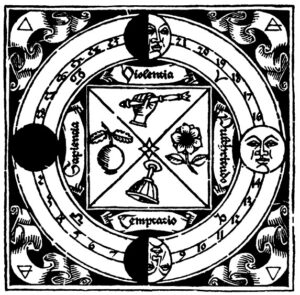
 With this post we continue our survey of the Great Wheel of the 28 lunar phases, the central symbolic mandala of Yeats’s A Vision. In last month’s episode we followed the arc of the evolving soul around the second quarter of the wheel, from the bitter conflict and unavoidable failure of the 8th phase to the brink of fulfillment in the 14th. At this point, as we reach the mysterious 15th phase, it’s time to pause for a moment, reflect on the journey the soul had made thus far, and make as much sense as possible of the 15th phase before the Wheel begins turning back toward its starting point.
There’s a fine old word for the kind of trajectory Yeats is exploring in our text: enantiodromia. (In case you’re wondering, that’s pronounced en-ANN-chee-oh-DROW-me-ah.) This is what you call the process by which something becomes its opposite and then cycles back to its origin. Biological life is like that. Looked at in isolation, it’s hard to see any common ground at all between an acorn and an oak; the acorn is tiny, self-contained, inert, waiting for a specific set of environmental changes that it may never get; the oak is not only vaster but in constant interaction with its environment, to such an extent that it defines an ecosystem around itself.
Yet each of these is the vehicle of a process that flows through the other and returns to itself. An acorn is an oak’s way of making more oaks. Equally, an oak is an acorn’s way of making more acorns. In the same sense, all the complexities of human existence can be seen as the elaborate machinery by which a fertilized ovum brings about more fertilized ova. That’s how enantiodromia works. As in these metaphors, so more generally, the process can always be looked at from both its endpoints, the acorn and the oak. Keep this in mind when you think about Yeats’s system and it will help you avoid a good many misunderstandings.
A Vision has its two endpoints, the new moon and the full moon. Each of these endpoints is also a turning point, the end of the journey away from the other and the beginning of a new journey that leads back to the other; each lives the other’s death and dies the other’s life. The new moon is the state of complete embodiment of the primary tincture, the state of immersion and dissolution in the collective reality known by turns as Nature and God; the full moon is the state of complete embodiment of the antithetical tincture, the state of perfect individuation in which all merely collective realities fade to total irrelevance. As we’ve seen already, these are the yin and yang of Yeats’s cosmology, and the soul cycles back and forth between them.
This sets A Vision at odds with the visions of history and destiny popular in Yeats’s time and ours. Most obviously, it flies in the face of the linear timelines so many belief systems embrace in the modern world: the Christian account that runs in a straight line from Eden to apocalypse, the rationalist-materialist account that runs in an equally straight line from the caves to the stars, and so on. There are plenty of examples and they all share the same structure: from a beginning along a linear trajectory toward an end that differs as far as possible from the beginning.
More subtly, it challenges the circular timelines that have been linear time’s chief opposition in the modern world. These move through a cyclic trajectory that ends where it began. In the historical theology of Marxism, for example, the cycle begins with communism before private property and ends with communism after it. In most of the apocalyptic belief systems that provide the counterpoint to today’s rationalist-materialist myth of progress, the cycle begins with primitive tribalism and ends there, too, with civilization as a temporary aberration in the middle.
Most of these circular timelines have been infused to some extent by linear thinking rooted in the Christian underpinnings of Western civilization. Where the cycles of time tracked by the Hindu and Mayan traditions, to cite only two relevant examples, repeat endlessly through infinite time, most of their Western equivalents have a “one and done” attitude to the process—you won’t hear many Marxists, for example, suggest that after a certain period of communism in the future, private property will be reinvented and keep the wheel turning! The reason, of course, is that these circular timelines have the same sort of heavy moralizing gloss as their linear rivals. The reign of private property, like the kingdom of Satan in Christian theology, is defined not merely as evil but as the source of all evils, from which the Second Coming of Christ or the proletariat or whoever is expected to liberate the world once and for all.
This is not what Yeats is doing. In the system of A Vision, neither the primary nor the antithetical tincture is good, or for that matter evil; yes, Yeats describes the antithetical as evil, but notes that this is solely from the perspective of the primary, and the reverse judgment also applies. The transition from one tincture to the other is thus neither a fall nor a redemption. It replaces one set of possible joys and unavoidable sorrows with another.
Since each phase is either primary or antithetical—the even phases are primary, the odd antithetical—the alternation between the two tinctures is one of the factors that keeps the wheel spinning. Perhaps the best metaphor available for this is to think of the two tinctures as the same kind of systole and diastole that your heart goes through with every beat. The soul contracts and focuses in its antithetical phases, and expands and diffuses in its primary phases.
In each cycle, there is a moment of stasis when one movement has completed itself and the other has not yet begun. These are the 1st and 15th phases, the nights of the new moon and full moon respectively. When the wheel is seen as a sequence of 28 incarnations, these two lives do not take place in the ordinary world. To Yeats, the conflict between Mask and Body of Fate, the world as we wish it would be and the world as it insists on presenting itself to us, is a necessary element of human existence. In its absence, we exist, but not as human beings.
In these two phases, in turn, this conflict cannot exist. In the 1st phase, the Mask is dissolved in the Body of Fate and the Will in the Creative Mind: the soul is so caught up in objective reality that it cannot conceive of a world different from the one it encounters moment by moment. In the 15th phase, the Body of Fate is dissolved in the Mask and the Creative Mind in the Will: the soul is so caught up in subjective reality that it experiences the world of its deepest and brightest dream and can know no other. These are not disembodied phases; the soul at each of these two points has a body appropriate to it, but these are not bodies like the ones we know.
To characterize the bodies and other characteristics of these two other-than-human phases, Yeats drew on his research into spiritualism, on the one hand, and the occult teachings he studied in the Hermetic Order of the Golden Dawn, on the other. The spirits of the 1st phase are those Yeats encountered over and over again at second hand in his work as a member of the Society for Psychical Research, Britain’s first and most prestigious organization for parapsychology. He discussed these beings at length in some of his essays, especially “Swedenborg, Mediums, and the Desolate Places,” in which he showed the remarkable parallels between the behavior of the spirits contacted by spiritualist mediums and the records of ghosts and phantoms recorded in legends across a broad sweep of space and time
These spirits are shadowy, formless, shapeshifting. They are easily confused by the clearer and more focused minds of incarnate human beings, and so tend to appear and speak in ways that reflect the expectations and beliefs of their human witnesses. They can be conjured up and commanded, by those who know how, but they make poor servants because they know nothing, think nothing, and remember nothing beyond what they mirror back to us from our own minds. It’s a mistake, though one very commonly made in all ages, to expect these spirits to tell the truth, to pass on accurate information about their previous existence, or to reason clearly—or at all.
At best, under some circumstances, these spirits can relay messages from unhuman spiritual entities to incarnate human beings, though this only happens when the unhuman entities choose. At worst, they mirror back the delusions of those who attempt to come into contact with them, with results that range from the absurd to the catastrophic. They are neither good nor evil, being incapable of thought and judgment, and it is through this state of complete passivity that the innocence that is the most striking characteristic of Phase 2 comes into being.
The spirits of the 15th phase are everything those of phase 1 are not. Where the latter know nothing, the former know everything, though that knowledge is always tinged by the unique personality of the soul, and assembled into a single image centered on an equally unique focus of perception, desire, and love. The spirits of the 15th phase are not at the beck and call of mediums and sorcerers, as those of the 1st phase are; they cannot be commanded, bullied, or bribed, as they have perfect inalienable possession of the one thing they desire and care for nothing else.
It is sometimes possible for mystics and artists to perceive them and get a glimpse of their state of being, and the great works of beauty our species has produced come from such glimpses. These spirits are themselves beautiful beyond anything we can experience or even dream of. It is through the time they spend in this phase that souls craft the luminous bodies they will inhabit when they have finished all the necessary circuits of the Great Wheel and step off it, into that realm Yeats sometimes calls a sphere and sometimes the Thirteenth Cone, where all oppositions and conflicts are resolved into unity at last.
Both these states, the 1st and the 15th, are the fulfillments of the labors of many lives. How the second half of the journey around the Great Wheel leads to the perfection of the 1st phase will be the subject of many posts to come. How the first half of that same journey leads to the opposite perfection of Phase 15 has been central to much of our discussion so far, but that process has not been made explicit, since its endpoint was not in view. That can be corrected now.
The entire arc of lives from the 2nd to the 14th phase can be seen as the process through which a soul gains the ability to envision and seek ideals that are wholly distinct from its environment. The ideals chosen in each life are different, as the Mask moves from phase to phase, keeping its strict opposition to the Will. The environment changes also as the Body of Fate moves through an opposite arc, confronting the soul with different challenges in every life. Each life lived out of phase teaches the soul the penalties of failure; each life lived in phase gives it a foretaste of the possibilities of success. Both give strength to the Will.
In the first quarter of the Great Wheel, the soul cannot choose the direction its Will moves or the Mask that it seeks. In Yeats’s terminology, these are enforced, not free, and in these phases they come from the social environment into which the soul has been born. By contrast, the Creative Mind and Body of Fate are free in these phases, not enforced; the soul can understand its environment in ways that seem whimsical or bizarre to those in later phases, and the environment itself is unnervingly receptive to such vagaries—a phenomenon that has an important reflection in historical terms, as we will see in due time.
The Will and the Mask, however, have no such freedom in these phases. They take the pattern assigned them by the social setting of each life. At first this happens automatically, as the tinctures are open to the impersonal and do not close until phases 4 and 5 close the primary and antithetical tinctures respectively. Once this happens, the soul must make an effort to conform to the enforced Will and Mask. As this proceeds, the soul gains strength and begins the process of unfolding its own unique capacities.
Eventually, in the tumult of Phase 8, the soul must shake off the influence of social mores and norms, but if it does so too soon it lives out of phase and experiences lives of misery and defeat. The limitations of collective thought and belief are the framework that allows the soul in this first quarter to earn the strength that will give it independence in due time. Here as always in Yeats’s system, success in the business of living comes from grappling with the inescapable conflicts of any given life and growing strong through the wrestling match, not from fleeing the conflicts into some illusory perfection that seems to promise peace.
In the second quarter, the soul has shaken off the influence of collective consciousness and now has to put something else in its place. This doesn’t come easily. It can’t come at all until the tinctures open in the 11th and 12th phases, the antithetical in the former and the primary in the latter. Where the tinctures opened onto the impersonal in the primary half of the wheel, they open onto the soul’s own depths in the antithetical half; the soul first becomes capable of imagining itself as a creator, then gains the ability to envision its potential creations.
In this quarter the Will and Mask are now free, and the Creative Mind and the Body of Fate are enforced. This change is responsible for the distinctive characteristic of the second quarter, which is rage. At first the soul rages against an environment that has suddenly become recalcitrant, refusing to allow the Will to win the Mask it now can choose freely. Later, once the tinctures open and it can gaze into its own depths, the rage turns inward, into what Yeats terms “spiritual or supersensual rage”—the soul recognizes that what holds it back from the fulfillment of its desire is in itself, the limitations of its own enforced Creative Mind. The labor needed to overcome these limitation occupies the soul for the last phases before the full moon.
One more point should be brought up here, partly because Yeats hints at it in various places, partly because it will be important when we begin discussing the Great Wheel as a historical cycle. Every incarnation, as Yeats has pointed out already, cycles through all 28 phases between birth and death. Every civilization does the same thing, so does every political, religious, and creative movement, and so does everything else that can be assigned to the Great Wheel—which, in Yeats’s view, is just about everything in the universe of human experience. In these, the 1st and 15th phases are still distinct, but in a different way.
Those of my readers who write, or paint, or practice any other creative art have already experienced this often enough. There is always a gap between the work one envisions and what actually comes out of the process. When I write fiction, for example, much of the early part of the creative process—beginning with the first stirrings of character or theme or situation, and quite often continuing well into the writing process—is a matter of discovering what the story is trying to become, how these characters and those themes and the situation that frames them are supposed to fit together.
Yet the process is never completely successful. There is always a gap between the story as I can sense it while writing it and the manuscript that goes to the publisher. Sometimes I can minimize the gap, and the novels I consider my best are those in which I was able to do this, but the gap is always there. The story I couldn’t quite get written down is the 15th phase of this process, a luminous reality forever outside the world of experience.
The same is true of each individual life. At some point in our middle years, more often than not, each of us gets as close as we are going to get to expressing whatever unique variation on the theme of human existence our life is meant to embody. The years before then lead up to that near approach; the years afterward are a struggle to keep expressing that theme in the teeth of the hard realization that there are goals we will never achieve and griefs we cannot avoid, before the final phases bring down the curtain.
Each civilization, finally, is subject to the same law. At the heart of each great culture is a vision of human possibility. The rise of the civilization is the process by which that vision is slowly and painfully discovered and understood. The zenith comes when the vision is partly but never wholly achieved. Then comes the struggle to hang on, first to the vision itself, then to the institutions and activities that once embodied it, and then finally to the bare minimum of functional social organization, before the last phases of the Wheel—Hunchback and Saint and Fool—rise up to wipe it all away. We’ll discuss all this later on.
*****
Next month we’ll proceed further around the Great Wheel and talk about the third quarter. Take the time to read ahead as far as Phase 22, and we’ll see how far the discussion gets.
I’d just been reading economic forecasts about the possible effects of the latest news from the Strait of Hormuz when this piece came in, so at first I processed it as another forecast: a vision of a techno-utopian future in which lunar colonization had reached the point where overpopulation was a danger. It took me a moment to remember what this series is about.