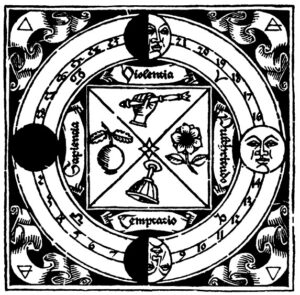
 The Great Wheel of the symbolic phases of the Moon, as noted already, is the central mandala of Yeats’s Vision. Two months ago, in the last installment of this (usually monthly) book club, we examined phases 2, 3, and 4 of the Wheel, the phases in which the soul makes the first fumbling efforts to experience itself as something distinct from its social and natural environment. Those first steps are by and large easy ones and, provided that the soul remains in phase and does not succumb to the lure of the false Mask and false Creative Mind, they are happy ones as well. The natural instincts are strong, and guide the soul through this period of childlike innocence.
Neither the ease nor the happiness will endure as the next phases arrive. Having learned from instinct and received guidance and protection from it, the soul must now outgrow it, wrestle with it, and defeat it in order to become something more than the mere product of its society and its genetics. This is anything but easy. It’s as though a plant had to tear itself up by the roots in order to fulfill its destiny, becoming an animal and roaming freely over the earth.
A brief summary of our basic terms will probably be necessary after the hiatus. The soul has four faculties, Will, Creative Mind, Mask, and Body of Fate. The two active faculties, Will and Creative Mind, are the capacities for action and perception respectively, while the two passive faculties, Mask and Body of Fate, are the goals of Will and Creative Mind respectively; think of them as the Heart’s Desire and the World As It Is and you’ll get the basic idea. Will and Mask are always in opposite phases, Creative Mind and Body of Fate likewise. Each phase defines specific positions of all four faculties, but the position of Will gives the name and number to the whole phase.
There are also two tinctures, primary and antithetical, which form the matrix within which the phases come and go. The primary tincture relates to the world around us, the antithetical tincture to the world within us. The tinctures open as they near the two climactic points on the wheel of phases, Phase 1 of complete absorption in contemplation of the cosmos and Phase 15 of complete absorption in contemplation of the unique vision of beauty that motivates the soul. They close as they move away from those points, leaving the soul to its own devices. Got all that? With this in mind, let’s proceed.
Phase 5: Separation from Innocence
As the primary tincture closed in Phase 4, leaving the awakening soul able to perceive itself as a being distinct from the cosmos, the antithetical tincture closes in this phase. This allows the soul to begin to think its own thoughts and dream its own dreams, instead of simply mirroring the commonplaces of the society in which it is born and the hardwired preconceptions of the human psyche. Reflection has become possible—“reflection” here being the capacity of the mind to think about its own thinking, to step outside its own thoughts for a moment and consider them with at least the first fragile hint of objectivity.
The essential task of the soul in this phase, in turn, is to use the freedom that has just been born in it. It matters very little in the greater scheme of things whether the freedom is used well or badly, whether it leads to triumph or disaster—though of course it matters a great deal to the person in whom that soul is incarnate, and who has to deal with the consequences! What matters is that it is used, that the soul begins the process of freeing itself from the natural and social framework that, up to this point, has defined its reality.
The true Mask in this phase, the ideal toward which the Will should strive, is therefore Excess. The Mask always derives from the phase exactly opposite from the Will, and this always offers a clue to its meaning. In this case the Mask comes from the melodramatic and assertive Phase 19, in which the unity of being the soul has attained at Phase 15 comes apart. The personality of Phase 19 seeks some conviction that will give it confidence and justify forceful and dramatic action. To the character of Phase 5—character rather than personality, for personality requires a unique orientation that is not yet possible in these early phases—forceful and dramatic action are as innate and inescapable as flooding when the river ice breaks up in spring.
These actions may be clumsy; in fact, they are rarely anything else, since the soul has not yet learned to be subtle, and the effort it needs to wrench itself free from its natural and social matrix makes all its actions awkward. Failure in this phase comes accordingly from the attempt to flee from the newborn freedom back into the familiar comforts of the collective and the instinctive. Here, uniquely in Yeats’s system, the false Mask and false Creative Mind have the same name: Limitation. Out of phase, a person of this phase obsessively proclaims laws and morals and maxims that he never quite understands, and lashes out constantly at a world that offends him by not behaving according to some set of rules borrowed from outside the self.
The true Creative Mind in this phase is titled Social Intellect. This comes from phase 25, a phase of intense moral consciousness, and gives the person of Phase 5 unusually clear perceptions of the human world around him. These are used, however, in the service of excess. The person of this phase thus becomes, in Yeats’s words, “a corrupter, disturber, wanderer, a founder of sects and peoples,” whose tremendous energy sets destinies in motion that he himself can neither imagine nor direct.
The Body of Fate in this phase, finally, is called Natural Law. As the actions of the person of Phase 5 are very nearly pure untrammeled energy and motion, they are subject to the ordinary laws of nature to a much greater extent than any subsequent phase. The person of this phase rushes on his fate, and that fate will be exactly determined by the mechanical details of speed, direction, and intervening obstacles. The consequences of these actions can therefore often be predicted by almost anybody except the one who does them.
Phase 6: Artificial Individuality
Another step away from unity with nature brings the soul into an intermediate zone between character and personality. Yeats uses the word “individuality” for this zone; where character is generic and imposed by nature, and personality is unique and imposed by the vision of the ideal, individuality is assembled by the Will out of whatever materials come to hand. There is always something forced about this assemblage, and never more so than in Phase 6, when the soul must carry out this task for the first time.
This is the first of the phases for which Yeats offers a real person as an example. The American poet Walt Whitman, author of Leaves of Grass, is a fine case study of this phase in its positive expression. Whitman assembles his individuality right out in public in his writings; the raw materials he uses are his own experiences of nature and his fellow human beings, processed through a mind that has achieved reflection, and gotten skilled at it, but is still not that far removed from the innocence of Phases 2 through 4. The extraordinary freshness and the obvious delight he takes in everything he experiences are typical of the first quarter of the wheel, when in phase; it is Whitman’s genius, and one of his great contributions to world literature, to express those with so much energy and so little self-consciousness.
Essential to that achievement are the true Mask of this Phase, which is Justice, and its true Creative Mind, which is Ideality. The construction of an individuality out of whatever raw materials come to hand is a chancy business; if the Will is bamboozled by abstractions and tries to live in an antithetical manner, according to opinions that can only be empty noise at this Phase, the result is the false Mask, which is Tyranny: the will becomes overbearing, and tries to force everything and everyone around it to obey some formula or other in which the Will itself never really believes. It’s an old and bleak story: the man who spends his life trying to force his beliefs on others in order to convince himself that those very beliefs must be true.
In the same way, the Creative Mind has to focus on the ideal. It has to be more interested in praising the best than in condemning the worst, so that it can maintain the joyous and fresh quality that is essential to this Phase. Lacking that, the soul falls too easily into the false Creative Mind, which is Derision. We have all met the kind of people whose only interest in the things around them is to find something they can scorn or mock or abuse, in order to parade their own supposed goodness by contrast. Out of phase, the soul of this Phase falls into this habit all too easily, and degradation follows. Yeats’s term “jibing demagogue” captures all too well the kind of individuality that unfolds from this.
The Body of Fate of this Phase, finally, is simply Humanity. Here Whitman is again the perfect example: the entire course of his life was determined both by his own profound humanity and by the vast concourse of humanity among whom he spent his days. It’s impossible to imagine him as a solitary figure, just as it’s hard to imagine a great many figures of the third quarter of the wheel in any other terms. There is a deeper aspect to this Phase’s Body of Fate, however. Phase 5 is almost mechanical in its drive to excess through energy, and its Body of Fate is therefore defined by the same natural laws that rule machines. Phase 6 is utterly human, by contrast, and the limits that shape its destiny are those of human nature.
Phase 7: Assertion of Individuality
Though it has to be established at first in a forced and clumsy manner, individuality possesses enormous power and resilience. It depends neither on the objective world nor on the subjective ideal for its strength, and so can bear forces that neither character nor personality could handle without shattering. This is just as well, because the young soul approaching the end of the first quarter is facing the most difficult challenge the wheel of lunar phases has to offer.
The force driving that challenge can be understood readily enough from points raised in the last installment of this discussion. In the disembodied Phase 1, Will and Creative Mind occupy the same place on the wheel, Phase 1 itself, while Mask and Body of Fate also occupy an identical place, Phase 15. In effect, the Will is submerged in the Creative Mind and the Mask in the Body of Fate; the soul cannot conceive of a world different from the one it inhabits. (On the other side of the wheel, at the equally disembodied Phase 15, the Creative Mind is submerged in the Will an the Body of Fate in the Mask, and the soul cannot conceive of a world different from its own highest ideal.)
As the Will and Mask move counterclockwise around the wheel and the Creative Mind and Body of Fate march clockwise, however, that temporary unity gives way first to differentiation and then to conflict. In this phase, as in Phase 21 at the opposite point of the wheel, that conflict is far and away the most powerful influence on the soul, and only a tremendous effort can maintain the poise that was a matter of instinctive grace a phase or two before. At Phase 7, instinct nears its apex of complexity and power, as intellect will do at Phase 21; in both cases, that apex comes just before a shattering disintegration, which is held off for the moment only by a supreme exertion of all the soul’s powers.
The assertion of individuality that gives its name to the condition of the Will, and thus to this phase as a whole, is just such an effort. The soul is reaching toward personality but cannot yet attain it; its thoughts and feelings are still drawn from the common stock, rather than springing from the self in its uniqueness; but it draws on its surroundings and its circumstances to create an image of itself. If the Will lives on the grand scale and stays oriented to the true Mask, which is Altruism—action pursued for its own sake, without thought of self—that image becomes enormously vivid and powerful. If it fixates on appearances instead and falls into the orbit of the false Mask, which is Efficiency—action pursued for some goal meant to benefit the self, which parcels out energy like a miser spending pennies—it becomes palpably false, an oversized mask of papier-maché that fools only its wearer. The true Creative Mind of this phase is accordingly Heroic Sentiment, and the false Creative Mind is Dogmatic Sentimentality.
The Body of Fate in this phase is termed “Adventure that excites the individuality.” That adventure can be lived out or it can be portrayed in literature or art, and occasionally takes both forms, but no one who is of this phase will ever succeed in leading a bland and boring life. This can be seen clearly enough in the lives and works of the four men Yeats has chosen as examples. Alexandre Dumas remains the supreme author of romantic adventure tales in any Western literature, and had a life nearly as interesting as that of his characters. George Borrow and James Macpherson are forgotten these days, but the former was one of the nineteenth century’s great travel writers and the latter one of its most successful forgers—his cycle of poems about Ossian, which he wrote himself but claimed as translations from Scottish Highland originals, were still wildly popular in Yeats’s time. Thomas Carlyle, for all his failings, was an extraordinarily influential figure in his time and after.
Phase 8: War Between Individuality and Race
In the wake of the grand adventures and mighty achievements of Phase 7 comes catastrophe. The primary tincture, the influence of heredity and environment on the self, has lost the last of its grip on the soul, but the antithetical tincture, the wellspring of power that comes from within the personality, has not yet been born. Abandoned by the instincts that once guided it, the soul must scrabble blindly for sources of strength and guidance, and fail. That failure is essential to this stage of the soul’s journey, for it is only through that experience of failed and seemingly futile fumbling that the first stirrings of personality can be born out of the wreckage of character, and of all that is collective.
That much-condemned word “race” which appears in the title of the phase probably needs an explanatory word or two. A century ago it had a much broader meaning than it has been assigned these days; it was common enough to hear “race” used for the populations of even quite small nations—a wildly popular 1921 history of Ireland by Seumas MacManus was titled The Story of the Irish Race—or even smaller groupings, such as one’s own direct ancestors. It is in that sense that Yeats means it. To him, in this work and elsewhere, “race” is shorthand for everything inherited, the entire influence of ancestry, culture, and locality that shapes every human being to a greater or lesser degree. This is what has framed the existence of each soul in the first quarter of the wheel, and this is what must be overcome in Phase 8.
It is not overcome by conquest, as in the clichés beloved by mass media and bad literature. The Will does not ride roughshod and triumphant over the outworn remnants of the past. Rather, the Will is left to its own devices by the departing past, and clutches frantically at what straws of its past certainties still remain to it. Those inevitably slip through its fingers, too, but the sustained effort of the attempt builds the strength from which personality will be born.
If the soul in this phase can rise to the challenge, it will keep up its courage through the ordeal, and learn versatility through clutching at one straw after another. If it crumples beneath the stress, it lives a life of utter terror and powerlessness. Thus the true Mask and Creative Mind are Courage and Versatility respectively, and the false Mask and Creative Mind Terror and Impotence. One way or another, it is doomed to a life of unbroken defeat, but that defeat is the crucible from which future triumphs are born; its Body of Fate is therefore termed the Beginning of Strength.
Yeats offers no historical examples of this phase and only one literary example, the Idiot from Dostoevsky’s novel of that name. Most of us have met people of this type, however: in Yeats’s words, “obscure wastrels who seem powerless to free themselves from some sensual temptation—drink, women, drugs—and who cannot in a life of continual crisis create any lasting thing.” I have known half a dozen examples fairly well, and before I read A Vision for the first time wondered at their lives and the sense of helpless terror that seemed to surround them. That Yeats offered me a way of understanding them that is both compassionate and realistic was one of the things that convinced me to take his system seriously.
*****
As noted in the last post in this sequence, each set of three phases, excluding the crisis Phases 1, 8, 15, and 22, form a complete wheel of their own. Phases 5, 6, and 7 are thus a unit, and reflecting on what Yeats has to say about them and exploring them as a complete wheel will help you get a deeper sense of how the system works.
Once again, take the time to review each of the phases just covered, using Yeats’s text as well as the notes above, and see if you can identify people you know who correspond to these phases. In the meantime, read the material on the second quarter; we’ll see how much of it we get through in next month’s post.
At this page is the full list of all of the requests for prayer that have recently appeared at ecosophia.net and ecosophia.dreamwidth.org, as well as in the comments of the prayer list posts (printable version here, current to 2/10). Please feel free to add any or all of the requests to your own prayers.
If I missed anybody, or if you would like to add a prayer request for yourself or anyone who has given you consent (or for whom a relevant person holds power of consent) to the list, please feel free to leave a comment below.
* * *
This week I would like to bring special attention to the following prayer requests, selected from the fuller list.
May Dustin, a relative of Brenainn, be healed of a recently discovered heart condition.
May 1Wanderers’s partner Cathy, whose cancer has returned, be given the physical and mental strength to fight it, and tolerate the treatment, and may she enjoy a full and permanent recovery.
May Jule from Iserlohn, Germany, who is experiencing complications in her pregnancy due to an influenza infection, recover and have a pleasant pregnancy and birth.
May Larry Mulford, who has entered hospice after a year battling with pancreatic cancer, pass in the smoothest possible manner, and may his wife be enveloped in our love.
May Marko have the strength to seize the opportunities.
May Luke Z and his house, whose furnace has problems that can’t be fixed until after the current severe weather ends, be blessed and kept safe until the cold subside.
May Pierre’s young daughter, Athena, be healed from her fatigue and its root causes in ways that are easy, natural, and as holistic as possible.
May Bob Ralston (aka Rasty Bob), who is in hospice care in Buckeye AZ, and who just lost his wife Leslie Fish, be blessed and find relief from his pain and discomfort; may Bob’s heart remain strong.
May Leslie Fish, wife of Bob Ralston, who passed away in early December, be blessed and make a peaceful transition to her next existence.
May Corey Benton, who passed away on 12/10, be blessed and make a peaceful transition to his next destination.
May Satoko L in Kyoto, who is recovering at home after weeks of hospitalization for Acute Hepatitis while in a state of immunodeficiency, continue to heal quickly and safely, and return to full vitality.
May 5 year old Max be blessed and protected during his parents’ contentious divorce; may events work out in a manner most conducive to Max’s healthy development over the long term.
May Lydia G. of Geauga County, Ohio heal and recover from prolonged health issues.
May both Monika and the child she is pregnant with both be blessed with good health and a safe delivery.
May Mary’s sister have her auto-immune conditions sent into remission, may her eyes remain healthy, and may she heal in body, mind, and spirit.
May the abcess in JRuss’s left armpit heal quickly.
May Brother Kornhoer’s son Travis’s left ureter be restored to full function, may his body have the strength to fight off infections, may his kidneys strengthen, and may his empty nose syndrome abate, so that he may have a full and healthy life ahead of him.
May HippieVikings’s baby HV, who was born safely but has had some breathing concerns, be filled with good health and strength.
May Trubujah’s best friend Pat’s teenage daughter Devin, who has a mysterious condition which doctors are so far baffled by necessitating that she remain in a wheelchair, be healed of her condition; may the underlying cause come to light so that treatment may begin.
May Kevin’s sister Cynthia be cured of the hallucinations and delusions that have afflicted her, and freed from emotional distress. May she be safely healed of the physical condition that has provoked her emotions; and may she be healed of the spiritual condition that brings her to be so unsettled by it. May she come to feel calm and secure in her physical body, regardless of its level of health.
May Frank R. Hartman, who lost his house in the Altadena fire, and all who have been affected by the larger conflagration be blessed and healed.
* * *
Guidelines for how long prayer requests stay on the list, how to word requests, how to be added to the weekly email list, how to improve the chances of your prayer being answered, and several other common questions and issues, are to be found at the Ecosophia Prayer List FAQ.
If there are any among you who might wish to join me in a bit of astrological timing, I pray each week for the health of all those with health problems on the list on the astrological hour of the Sun on Sundays, bearing in mind the Sun’s rulerships of heart, brain, and vital energies. If this appeals to you, I invite you to join me.
Hello JMG and commentariat:
I’m glad to see you go on writing about Yeats Vision. I can say your deep depiction on Yeats system is a hard test to my limited knowledge of English language, but I do my best to understand him according your current essay. I’m not skilled enough in English nor Philosophy to debate deeply this week main topic…However, I’d like to add my opinion about a paragraph you’ve written; your explanation of the nowadays taboo word “race” in Yeats time, seems IMHO very honest and necessary. I think the word “race” at least in my mothers tongue, was born before the racist ideology (or ideologies) were made up and became fashionable during the colonialist era…before to be a damned term after the sad and cruel events which happened until 1945 (cough). I think speaking about races in a wide sense it’s not the same as racism. We’ve gone from the racist extreme of European people supremacism to the opposite wrong idea: races don’t exist, there’s an only race, the human race (?); and new woke puritans like to talk about “racialized” people, denying the objective differences in skin color and other small varieties of human people. Well, of course the opposite of a bad idea is usually another bad idea. I hope I haven’t been too off topic.
“It’s as though a plant had to tear itself up by the roots in order to fulfill its destiny, becoming an animal and roaming freely over the earth.”
And as we learn to think our own thoughts and separate from the group mind, develop our mental sheath in preparation for the mental body, we prepare for our own transition.
This is really interesting, the part about Whitman and his immersion in humanity…. I am working on my next article which deals in part with the mostly unknown composer Eric Richards and he has this quote about the kind of artist he prefers:
““It is curious, many of the people whose music I like best—particularly Harley Gaber, Charlemagne Palestine, and Michael Byron—kind of dropped out for different reasons. That’s a whole area of American music that I think is important, but that no one has written about or gone into—it wasn’t part of “the scene,” partly because of the personalities of these different people. They were not what David Riesman [in The Lonely Crowd] would call “other-directed,” they were all very inner-directed people who could not really be part of a scene.”—Eric Richards
So this has me wondering what phase these inner directed types will be… presumably on the opposite side of the wheel.
It’s great to use these artists and other figures as lenses to view these interlocking wheels within wheels.
So individuality is the person, losing the clear instincts that mold character but incapable of genuine creativity, assembling an idiosyncratic identity from personal experiences. Reading ahead, it seems to take until Phase 12 for the soul to develop personality. Even those personalities would be unique but generally unoriginal in ideas (or our society would not be ossifying and presenting old ideas as new).
@Chuaquin
It is obvious to me that with “the war between individuality and race,” Yeats is referring to society or nation. It is ludricous to assume he means skin color, for even if the streotypes around skin color were true, the tendencies would be too broad to really present a struggle for the individual. I think the “white race” is largely an American concept (to assimilate different European immigrant groups into a proto-American ethnicity) that was imposed on the broader West after WWII.
In myself I notice a strong tension between involvement in such scenes, which I have been a part of but never fully, and this inner directed aspect. There is a social part of me that wants to be involved and have conversations, like here or another venue focused on certain topics. But even in those places where people are gathered around things I care about deeply, whether it is poetry, or music or radio club or a blog about the decline of western civilization, I never feel fully part of it. To use Yeat’s terminology, I always feel slightly “out of phase” with the group. Perhaps this, and instinct, is what kept me from ever becoming fully enmeshed in the group. I’m understanding the “why” of it better as I continue to get older, but sometimes it feels lonely. However, it is also quite liberating.
I’m looking forward to learning this system further. It has a ton of implications.
Typing all this I had a grand sense of deja vu.
Ecoprayer, many thanks for this as always.
Chuaquin, exactly. The word “race” is one of those puzzling terms that has no clear etymology and has had many meanings over its history; in Middle English it could mean a generation, a group of people who worked in the same trade, a type of wine, or a bloodline of good horses. The Scots Highland clan to which my father’s ancestors belonged, Clan MacGregor, has the motto ‘s rioghal mo dhream, which usually gets translated into English as “royal is my race” — “race” here not meaning white people, or even Scots, but descendants of the early medieval Scots king Kenneth mac Alpin, from whom the MacGregors trace their lineage. It’s only very recently that the word has been loaded with its current meaning.
Justin, bingo. The first and last quarters of the wheel are other-directed, though the other in question differs from phase to phase — in the first quarter it starts out as nature and then becomes the community, while in the last quarter it starts out as the community until that is replaced by God. It’s the second and third quarters that are self-directed, at various levels of intensity.
Patrick, yes, exactly. (I know, I’m getting repetitive. I’m delighted that so many of you are getting through Yeats’s somewhat murky prose and understanding what he has to say.) Our society, though, is making the transition between the 26th and 27th phases; it’s recycling old ideas as new because it hasn’t had any new ideas for quite a while now, being far into the primary half of the wheel, and since it’s pretty far out of phase it’s trying to be original and innovative (the proper role of the second quarter of the wheel) rather than letting all that flow away to be replaced by impersonal service and an orientation toward supersensual realities.
Justin, that’s the classic experience of the antithetical side of the wheel: never able to fully integrate into any collective scene. It’s balanced by the experience of the primary side of the wheel: never able to be fully separate from some collective scene or other.
Fascinating! I will comment first from my experience with children, as these phases continue to line up with what I’ve observed in child development.
Phase 5 sounds like the seven/eight/nine year old child, full of enormous energy and driven to assert physical independence by trying out any and all activities offered. If you’ve had to care for a group of munchkins like these, you can all too easily relate to the description ‘corrupter, disturber, wanderer’. Encountering physical consequences of all that energy, like skinned knees or broken arms, is a common rite of passage here. Waldorf teachers talk about the ‘nine-year-old fall’, the moment of loss and uncertainty when the child begins to perceive him- or herself as separate from family and friends.
Phase 6 fits the ten- or eleven-year-old. The child of this age is naturally ‘joyous and fresh’, enthusiastic about learning, though perhaps overconfident in their understanding of the abstract world. They need strong positive role models and active encouragement from the adults in their vicinity, otherwise an early cynicism or bossiness toward other children sets in which is a little heartbreaking to see. I well remember the discovery of sarcasm among my own schoolmates at this age, the realization that one can mean other than what one says and look good doing so.
Phase 7 is the preteen, 12 and 13. Puberty has dawned, and it is impossible not to notice childhood slipping away. ‘Reaching toward personality but cannot yet attain it,’ and ‘instinct nears its apex of complexity and power’ fit very well here. Young people of this age are obsessed with romantic and pulp fiction- the whole YA book and movie genre is targeted at this age group and those a little older. They need to be actively drawn into participation in the world (sports teams, part-time jobs, community clubs) so that they don’t fall into moody and introspective brain rot.
Phase 8, the crisis of adolescence. Age 14 and 15. Childhood is now definitely over. Very few people pass through this phase with any kind of grace or emotional stability. The awakened drives of puberty are a tyrannical and overpowering force. Awkwardness, humiliation, fear, rebellion, depression, and addiction all become possible on a new and potentially dangerous level of intensity. Steiner said that the astral body is only actually ‘born’ (that is, separated from the astral womb of family and community) at age 14. It follows from this that the karmic patterns encoded in one’s natal astrology awaken with full force at this point, and partially account for the birth of novel and unstable emotional patterns in the adolescent.
Those are my first impressions. I’m sure I’ll have more as I chew on it longer!
I seem to recognize myself in the Daimonic Man of phase 17, though the idea is somewhat frightening. Do you have any additional pointers for how to determine one’s own phase? I seem to be having a harder time making sense of Yeats today than last time you wrote about him– but my own mental faculties seem to wax and wane with some unknown tide (or perhaps the position of Mercury in the Heavens), and they’re at a low ebb just now.
I’m a little worried about saying something way off, but this text is complex enough to risk it. I may be getting ahead of myself, but I think I’m somewhere around phase 13. If I have it right, it’s something like “primary focus, but the antithetical tincture is on full blast.” As a kid, I spent way too much time in my imagination, it was my escape. Obviously, I didn’t get too far in life living in my head. It took deep study into spirituality and occult philosophy to tune my inner world properly. Thanks to couching mundane acts in a divine veneer, I have been able to live life in the physical world again. Thanking the crossing guard connects me to Venus and Jupiter, doing an in-person follow up interview connects me to Mars. (I am far too shy for my own good!) My proper orientation seems to be primary, but I had to wrangle my intense imagination first!
If my understanding needs to be fine tuned, please feel free to say something!
Hello Mr. Greer,
this is a personal „Thank you“ note that should be attached to a Box of homemade Cookies.
For a little more than a year now, I‘ve been reading through your „weird of Hali“ Series and the last time I have savoured Fiction like this was propably LeGuins „Earthsea“.
I somehow found myself growing into Religion for a while, prayer taking time of my morning meditation and ist is awesome.
Bit it also was a dark forest at times with these storys pale shimmering stones on the way helping me to go on..
It just found me at the right moment, every single Book so far.
So
Thank you for writing it, if you ever pass the mountains of southern Germany you‘ll get that Box of Cookies.
Well deserved.
Robin
PS. There is even a charakter with my name who is a Child of, I don‘t know, our fair Lady of the Bariccades and of, well, unconventinal beauty.
I like to believe that there are people who know me good enough to find this funny .
Just offering a belated thanks for this book club. I had to finish a set of meditation themes before I could start being confused by A Vision. I’m now playing catch-up, working through your November book club post, so I may not have much to say for this or the next post, till I catch some of the life preservers and re-read this and the previous post with them in mind.
Also, belated congratulations on getting through your move during such trying weather, and enjoy your new home!
Justin Patrick M. # 4:
I agree. When I’ve read the part about Walt Whitman as an example by Yeats, I’ve remembered his “Leaves of Grass” poetic style. And yes, I share some feeling of having read a man who was able to use his mind for reflection, but he also had some innocence in his world view. So I can see this example in relation to Yeats system phases is quite exact (though it’s difficult for me to grasp Yeats ideas accurately yet, so I need to read JMG essays on him several times to understand them well).
————————————
Patrick H. # 5:
Well, like I’ve written in my first comment, the term “race” is older than the racist ideologies, so it’s reasonable to think Yeats is writing about a wide idea of race (in his own context), beyond the narrow “biologism” of XIXth Century scientists. No argument here.
—————————————
JMG # 7:
Of course, that word had and has a broader meaning than racist ideologues imposed in the past and today self-proclamed woke “anti-racists” usually think. It’s interesting that you’ve written about “race” meaning in old times English. I’m not sure, but I guess the modern narrow meaning of “race” in Spanish arrived when first anthropologists and another materialist scientists imported here the racist ideology disguised as science. There was a French author named Gobineau, me think, who influenced elites across all Europe during XIXth Century and early XXth Century. But before that it seems “raza” wasn’t charged with such an ideologized meaning.
I’m excited the book club is back!
Now that you’ve begun delineating a second triad of Yeats’ phases, I’m finally beginning to understand the progression of traits/dispositions around the complete cycle. It is reassuring to know that this progression is fractal and that the unfolding of a single phase can be mapped onto each incarnation, or each chapter within a single lifetime, or each step in a complex undertaking. That tools and nations and ideologies and species may align along a particular phase as a category, while each member aligns along its own personal phase, as well as traversing through each of the phases as it ripens.
I imagine the same is true for divinities. Each is exploring or patronizing its particular areas of interest while also cyclically maturing into the fullest expression of itself. Since we tend to most experience this progression temporally, from one lifetime to another or as subdivisions within our goals, I am imagining that divinities would likely experience this progression as occurring in whichever dimension is just above the highest dimension in which they fully dwell. With our fixation on time as the unknown through which we must gropingly travel, I can see why we attribute unchanging constancy to divinites’ natural eternal nature, but it is a tad foolish. All we have to do is break our promises with divinities or curse them to discover just how brutally inconstant they can be.
So how would gods experience this cycle progressing within and around them? Some cryptic sense of an unpredictable and incomprehensible trajectory along which their causal and spiritual natures are naturally unfolding? Let’s face it, our language is not exactly up to describing the reality experienced by the divine!
I wonder if there might be divinities out there attempting to make any sense of how the lifeforce herself would perceive these cycles playing out within and around her? Cycles within cycles, and we get to play some minutely tiny part in how the lifeforce comes to know its self, as we follow along in cycles laid down before time came into existence. What a lovely tradition to be a little bewildered part of.
Dylan, thanks for this. I haven’t had much contact with children in my adult life, so can’t doublecheck this, but it seems very plausible.
Steve, I know of no fast way to do it. Learn the phases, get a sense of their rhythm and structure, and wait for insight to dawn: that’s the one option I know of.
Sean-Luc, if you’re reorienting over time toward the primary tincture, then you’re almost certainly in the third quarter (phases 16-21), not the second (phases 9-14). Souls in the second quarter are getting more antithetical over time, reaching toward the perfection of that tincture; souls in the third quarter have fully absorbed the antithetical tincture and are getting ready to cross back over into the primary.
Robin, thank you! Nonfiction pays my bills but fiction has always been where my heart is at, and I’m delighted that you find The Weird of Hali to your taste. If I ever get to southern Germany — and I may, someday; Hermann Hesse grew up down that way, and he’s a longtime fave writer of mine — I’ll take you up on those cookies. As for your namesake Robin Martense, hey, what’s a few tentacles among friends? 😉
SLClaire, welcome to the journey. All this will be in book form eventually, so catching up will be easier. In the meantime, if you get as confused as I did for the first couple of years that I studied all this, why, I have more life preservers handy.
Chuaquin, in Mexican Spanish, at least, “raza” still has the broader meaning. Mexican-Americans quite often speak of themselves as “La Raza.”
Jennifer, thank you. I’m glad things have calmed down enough, now that I’m comfortably settled in my new place, that I can pick up all the threads I had to set down temporarily.
Christophe, that’s a fascinating question concerning which I have no least feeble attempt at an answer. Nor does Yeats discuss the matter anywhere!
@ Chuaquin and Mr. Greer,
I might be mistaken, but I think “La Raza” arose out of the writings of José Vasconcelos, who wrote about La Raza Cósmica. This cosmic race was going to be the product of race mixing from all the peoples from around the world, and this would be the race that would conquer the stars.
Most Mexicans seem to have no idea who Vasconcelos was, though.
Excellenct.
Just this Summer we crossed the right mountains to think about him, allthough hunting much older storys : [ rätoromanische Mythen ] a fascinating topic for another day..
Cristophe # 15:
Thanks for your opinion. It’s very interesting to think Yeats system can be applied, not only on individual human beings, but also on nations, ideologies and even overhuman beings! Could you point any example of this system use for ideas and gods, in this or that phase? I’d be pleased to know more about it.
—————————-
JMG # 16:
It’s true Mexican-American people sometimes talk about themselves as the “Raza”, of course in a wide cultural-ethnical sense me think. It’s interesting to point that during the last dictatorship here, the regime speeches spoke sometimes about the spanish “raza”, but I think it was in a sense beyond the biological racism. Indeed, a propaganda film during early Franco times was named “Raza”. Spanish dictatorship had a lot of bad things, but it wasn’t based only in racism (like German Nazism), but more in History and Culture. It was more like Italian Fascism, Imperial
nostalgia (Rome or America Conquista), and cherry picked historical events. It’s interesting Franco regime was helped by Moroccan troops during Civil War and then he had a group of Moroccan Wards as personal service, so he didn’t care very much of racism (pragmatism). Of course, since democracy started here, the word became taboo, more since the woke influence hijacked last “progressive” governments.
Regarding the word “race,” consider also the meaning of “mill race.” This is the channel that guides the flow of water towards a water wheel, a meaning that captures those ideas of things in one’s past history that determine where one winds up. Things not under ones control.
I reckon Mr Yeats saw many more of these than we do in today’s world.
https://en.wikipedia.org/wiki/Mill_race
Even if someone doesn’t believe in reincarnation, this wheel can help understand people and produce categories to divide them into. That sounds like a third-phase thing to do, to classify people into categories, isn’t it?
John, thank you for your comments. It seems to me also, that those who are starting to look to the inner side of things on the antithetical side of the wheel can be of service to their communities and have an influence on their nations, their race in the sense that Yeats meant it, by bringing forth those things found on the inside to others who can use them. Whether that is a painting, a poem, a style or a vision -like Benton MacKaye’s vision of the Appalachian Trail, that once implemented has been meaningful to countless lives and left is mark on the nation. Or, if you are an occultist, a system such as the one being studied here.
I was curious how long you think the phase between 26 and 27 lasts?
@Chauquin: The lives of poets, musicians, artists and other creative people have always been my favorite kind of biographies to read, so I’m hoping that material I’ve stuffed my head with can be useful to this project.
Ennobled…# 17:
I didn’t know who was José Vasconcelos and which book(s) wrote. Thank you for explaining it to us. He seemed to have an interesting view of the term “race”, beyond usual European ethnocentric bias.
———————————-
Bfp # 20:
Thanks for telling us what’s a “mill race”, an English term which I didn’t know until today.
———————-
Justin Patrick M. # 22:
My biographic interests are wider than yours (I like historic politicians lives too), but I share your fondness to artists biographies, too.
@Chuaquin: You are right, I can’t say I’ve read too many biographies politicians. They are a rather uninspiring lot.
But I’ve read some of scientists, environmental thinkers, and mystics and mages too.
The biographies of people that mix science, art and magic are probably my favorite. Some of those might even have some political intrigue, but the figures aren’t politicians! ; )
Still, though, I am sure you get a lot out of your study Chauquin. Somebody needs to keep an eye on what these people get up to. …I’m not saying I won’t ever read that kind of biography.
I look books about explorers too, inventors, architects…
I was thinking before too, of Whitman, and how he was an extrovert, but very inspired by the Transcendentalists and knew Emerson and I think Thoreau. Emerson was a bit of a man about the town on the lecture circuit and the like, and seemed to have a good mix of that inner and outer aspect… but Thoreau we are looking at someone with even more of an interior focus.
@22 Justin Patrick Moore
The false Mask of the Hunchback phase is “self-abandonment” and the false Creative Mind is “fascination with sin.” Western society is turning against the woke left’s attack on our heritage and mass immigration (self-abandonment) while a backlash to explicit content (sin) is gathering force on the right.
Western civ is about to switch to Phase 27 and excessive pride (false Creative Mind) in Western civ’s past achievements, and try to emulate them (false Mask). I hope we don’t go too far in that. It could be us trying to revive the economy that sustained the “American dream” and failing due to limits to growth or it could be us trying to emulate the achievements of the Austrian Painter.
Related to the water race at a mill is the bearing race.
https://en.wikipedia.org/wiki/Race_(bearing)
“The rolling-elements of a rolling-element bearing ride on races. The large race that goes into a bore is called the outer race, and the small race that the shaft rides in is called the inner race.”
Then you have race tracks as well which are again a channel that contains moving things.
@ Chuaquin,
No problem. I believe he was not alone. There were others from his generation in Mexico who were pushing forward different strands of what would become something of a state ideology.
Hi John Michael,
Mr Yeats would perhaps have understood that acting with good grace, employing compassion where appropriate, and yet doing the needful, is a real tightrope walk. Not an easy path, that’s for sure.
Given that free will is a limited resource which can be tapped – at intervals – I do wonder what the ultimate expression of that faculty is? Perhaps we’ll get there in the final quarter, but I have a hunch that acceptance will play a large role in that story. Dunno.
Cheers
Chris
Dylan re: #11 and JMG re: your response to Sean-Luc:
Age 14 also has a particular astrological salience – that’s when the first Saturn self-opposition happens (the halfway point to the Saturn return) as well as the first Uranus self-sextile.
Based on this and on the third quarter turning back towards the primary tincture, I have to think that Phase 15 corresponds roughly to the first Saturn return.
Regarding the Vision; just doing this. Just digesting.
Regarding “race”; I am thinking of the linguistic angle to the word “race”. It would seem, that germanic, anglo-saxon, romanic and slavic languages have a similar sounding word for it. And yes, it does mean other things, or simmilar sounding other things. For instance the slavic “rasa” is close to “rosa”, that means dew or wet.
I wonder if some linguistic geeks could have a field day with this. Providing proper political derailment stopbreakes.
best regards,
V
Justin Patrick M. # 25:
Each person has its own interest areas, according its personality/character (which indeed it’s influenced by its correlative phase in Yeats terms).
No argument here about Whitman and Emerson. I also think Thoreau lived more according his rich inner life, but I don’t think he was a complete introverted man. If I remember well his own writings, in his rural home he had always a free chair for expected or unexpected visitors. And it wasn’t strange Thoreau, during his lone walks, met this or that person and had a talk with him/her.
——————————
Patrick H. # 26:
I find your brief analysis of western countries nowadays situation and their possible near future very interesting, according your knowledge of Yeats Wheel system. I also see, like you, a growing decline in woke endophobic doctrine massive support here: people seem more and more tired of it, so I also see a turn to the right wing. I share your view about the right wing tendence, too. And I hope like you the return of pendulum won’t be too rough (crossing fingers…).
—————————-
Ennobled… # 28:
I understand it. Mexico has a long cultural history, enough to try to make a local ideology, me think.
@ Patrick H # 26
I am optimistic about Western Civilization though. This isn’t the first time its going around the wheel. The Roman Empire made several of the mistakes associated with the false Mask and Creative Mind of this quadrant of the Wheel, so an accurate self awareness of its own past will warn the civilization of possible mistakes in advance.
On the other hand, moral relativism is tied to both the False Mask (self abandonment) and the True Mask (Self Realization). Once you realize that there is no Objective Good, Subjective Philosophy (assuming nothing really matters because nothing is objective) and Enforced Intellectual Action (following the logic strictly from the premises to the conclusion) lead to two different outcomes.
The key, I think, is to understand that a subjective moral compass applying to just one person is still a moral compass, and one’s own moral premises (or Ultimate Platitudes, as C S Lewis called them) are really the only moral premises that matter to oneself. Objective Moral Axioms are illusions pursued only by people who want to tell other people how to behave. If all you want is the Joy of Justice in your own life, you really just need to follow your own moral premises. Just because they are not universally applicable to everyone doesn’t mean they aren’t applicable to anyone. By definition, your own moral premises are definitely applicable to you.
So basically, when you discover that there is no Universal Moral Axiom, you have two choices – Moral Nihilism, which leads to self abandonment as you effectively abandon your own subjective moral premises, is the first choice. The alternative is to curiously and philosophically investigate your own moral compass, and determine what ideals you hold in your heart and what values are so deeply embedded in your heart that you cannot find happiness by sacrificing them. This quest eventually leads to Self Realization, the True Mask.
I am in Phase 26 myself, I think. The question of what is the Right Thing to Do [TM] has plagued me for a long time in my life, and this is what I have come to realize eventually – there is no objective moral compass applicable to everyone, and none are necessary. I cannot control the actions of other people anyway. All that matters is I have the Moral Compass of the only person whose actions I do have control over.
Scott H & all…
We certainly seem to have lived through the time of the Hunchback and are entering the time of the Saint. I see signs of both in the history of the past 42 years, and this interim phase we seem to be in.
Here are some patterns of self-abandonment I see from what has basically been the main span of my life (I was born in ’79):
-computers, computers, computers
-video games, video games, video games
These two bits of Faustian tech have led to some of the dissolution of our communities, a kind of self-abandonment that has accelerated along with the acceleration of accelerationism. People abandoned their lives to apps. Tik-tok around the clock instead of hanging out with kids from around the block.
I’m not saying I’m not guilty, though I luckily didn’t fall into the gamer trap. I played plenty of them, and had one system as a kid, but never anything beyond that. But many of my contemporaries abandoned having a life and doing something for playing a game.
Politics has certainly gotten hunchbacked. The phase started with Reagan and Thatcher here in the West. I can’t really speak much beyond the U.S. We had a CIA puppet master, then the gay nineties power couple, followed by son of puppet master, and on… (there is a reason I am not inspired to read political bios!)
It seems in the last part of the phase the divisions in America were twisted out of recognition and we abandoned ourselves into media silos and further bifurcation and opinion-feedback-loop amplification created in part as a by product of click bait headlines that rewarded the most outrage on either wing of the bird-brain spectrum.
I know cocaine has been around for awhile, but if we look to one of the drugs of choice of the 80’s… it certainly feeds into the narcissism of the time. Narcissus stares into a mirror with white lines.
That transition from phase 25 to 26 saw the self-abandonment of the hippies, who were part of the Conditional Man phase. One of their aims was to teach and improve society. We see this in some of their projects, like appropriate tech, which were (self) abandoned by many as the hunchback appeared on the stage.
Now that we are moving into phase 27, we are seeing the excesses of 26 being rectified by the goal of the Saint. Seeing what has come before as a kind of sin. The second religiosity gets under full swing, but also a return to enchantment as powers older than Christianity also reach back into this time zone from their place beyond time as we know it to work with a new generation of seekers.
I wonder if the focus on sin in the phase of the Saint will bring a return to traditions like the Sin eater or of paying priests to absolve them of sins… or a twist on those.
Just some thoughts that I’ve been thinking.
@ Rajarshi #33
“The key, I think, is to understand that a subjective moral compass applying to just one person is still a moral compass, and one’s own moral premises (or Ultimate Platitudes, as C S Lewis called them) are really the only moral premises that matter to oneself. Objective Moral Axioms are illusions pursued only by people who want to tell other people how to behave. If all you want is the Joy of Justice in your own life, you really just need to follow your own moral premises. Just because they are not universally applicable to everyone doesn’t mean they aren’t applicable to anyone. By definition, your own moral premises are definitely applicable to you.”
Thank you very much for taking the time to spell this out. 🙂 I find that I strongly resonate with everything you’ve said here.
Ive found it really interesting seeing different points of the wheel from different roles — so from the pov of a will, the 5 stage is the separation from the innocence of instinctual living, and 11 is natural law itself, as its body of fate, the ability to perceive ‘nature’ as something apart, with laws which can be understood. While from the pov of a will in 11, 11 is the systematizing instinct, the impulse to organize experience and 5, that first point of reflection and consideration apart from raw instinctual actin comes through as enforced belief, enforced because it’s still in the quarter controlled by nature itself and out of one’s subjective hands but it is beginning to have belief-about. While from a will in 19, 5 is the mask strived towards, and I’m kind of puzzled, cant quite understand it, but I note yeats calling 5 ‘where artifice begins’ when I was thinking of it more like ‘where instinct loses hold’. It’s cool the way all the phases seem in themselves to have a midline which is crossed, they are all transitions all the way around. Thanks for the series. Thinking hard about the 8-22 axis. Feel like axis in astrology too. Reflecting different approaches to same theme.
I know last post my diction was tumbling forward aggressively…. sort of aggressively receptive of the current events. I do pray that broad based similtaneous observation of the methods of the ‘d’eletes’ hastens the cycle of elite overturn or whatever you call it. Meanwhile yes quite downsized and living close to the ground. Nate hagens did a revised heriarchy of needs like consumption pyramid thar resonated w yr last post and I tried to send folks here from comments. Escape key continues to do great analysis at an absurd pace. I sort of think it must be a collaboration not a single person. https://open.substack.com/pub/escapekey/p/epstein-iii
Rajarshi # 33:
If I’ve understand well your point of view, after the fall of the Universal Moral Axiom, the only alternative to Moral Nihilism would be a “relative Relativism”, which could be based in a subjective view, not in an objective one. Well, it’s usual to blame Relativism for every problems we suffer today, by secular and religious zealots. However, I see we need some Relativism to live in imperfect, but livable democracies (for evident reasons: One Universal Moral can lead easily into totalitarisms, me think). We also need to avoid the sirens chants of Moral Nihilism, because I think the following pendulum turn after that attitude can be a new zealots attempt to impose an Universal Moral.
——————————-
Justin Patrick M. # 34:
I’m not much older than you, so I remember how first personal computers arrived to my childhood during ‘80s (by the way, my first computer was a Spectrum 48 Kb). Indeed, I belong to the last generation who lived (partly) an “analogic” childhood. In my own case, my love to books saved me from becoming a computer nerd. So I share your view about Faustian hi tech acceleration in last decades, and its negative effects in real social life. However, I’d like to say the worst of the current screens addiction has come with smartphones (universal online access) and social media.
Hmm, going back to phase 13 in A Vision, the artists that Yeats mentioned seem to be of the Decadent movement. As far as i can tell, that movement seems to resemble Romanticism, but taken to lurid extreme. Very much not like me!
“Relativism” can mean a variety of things. Descriptive relativism (the observation that different cultures have different ethical beliefs and practices) is an objective fact.
Some hold ethical ideas to be mere psychologucal projection, or perhaps meaningless utterances. I think of these as varieties of skepticism towards ethics. However, ethical assumptions are hard-wired into society and law. Among those who believe in ethics of some sort, the idea that the ethics of (say) killing depends on the circumstances, would be conceded by virtually everybody, including ethical absolutists (i.e. non-relativists).
Some anthropologists assert that an act might be right in some cultures, and wrong in others. If this is not a simply statement of descriptive relativism, then it raises the question of whether killing Jews was right for Nazi Germany, but wrong now. If we say no, then we risk becoming ethical absolutists rather than relativists. On the other hand, many ethical rules may indeed be determined by culture, in the same way that there is no absolute moral rule about which side of the road to drive on.
Buddhist writer Jayarava Attwood situates ethics within the human condition of being obligatory social animals, and not (as my old professor thought) as similar to mathematical truths, existing “out there” in the abstract. Take something like marital fidelity. Some animals pair-bond, others have no such bonds at all. Humans seem to have evolved to form alliances, but also with the capacity to cheat . Both cheating and fidelity are types of evolutionary strategy for us, and can be predicted from things like hormone levels and testicle size. Marital customs exist at the societal level, and are a different kind of strategy, since different marriage customs give rise to different types of family behavior.
Attwood also thinks the concept of free will (assumed by most ethical systems, including law) to be poorly defined and perhaps incoherent.
@Rajarshi
1. Western civilization can only learn from Rome’s example if it abandons the myth of historical progress and reacts to the current dysfunction in the education system (at least in the USA) by trying to revive an education for the upper classes that includes going over the fall of Rome in some detail. Otherwise, we’re not going to learn any lessons from history.
2. I don’t know if Yeats was being literal in suggesting that Phase 26s usually have some kind of disfigurement or disability.
@Chuaquin
Those thoughts weren’t original to me. I was repeating JMG’s arguments on that subject from a few months ago. American society has moved further into early out-of-phase Saint in recent weeks.
5 and 6 sound like the “communist” phases, followed by 7 which is the “prepper” phase. I can see how that plays out in the real world since starving to death for a misguided political ideology would likely make one more miserly for the next go around. It’s too early to tell but I might be out-of-phase at number 7 and desperately trying to salvage what’s left of the incarnation. If my physical condition is any indication i’m facing the choice of driving off the cliff or changing directions for something more interesting. My eternal gratitude is yours as always. I would have never made it this far without your assistance.
The stoics would say that the only true way to develop ones morality is to apply the 4 virtues”
Wisdom (Prudence): Navigating life with sound judgment.
Justice: Acting with fairness and integrity, particularly toward others.
Courage (Fortitude): Facing challenges and adversity with strength.
Temperance (Moderation): Practicing self-discipline and balance.
Thus each person must develop their own morality by studying and heeding these 4 virtues in their life. This is the opposite of ” laws” which ask one to pay attention to how ones action effect the society in which they live.
I think Rajarshi is talking about adopting a personal code of ethics with no attempt to try and get others to adopt it. I’d need to meditate on how this “self-realization” might play out in a Hunchback society in phase, rather than a person going through Phase 26.
I think the relativism people object to is the idea that morality is arbitrary: that, for example, whether human sacrifice is bad depends on how you or your culture chooses to look at it. (I mean, sure, sacrificing captured soldiers is technically murder but it brings us all together and stimulates the economy, so it’s really just a matter of perspective.)
On the other hand, the idea that whether something is good or bad depends on the facts of the situation is not controversial: it’s immoral for me to cut you open with blade for no reason, but not immoral for a surgeon to do so during an operation to save your life. Cultural expectations play a role in determining, for example, whether you drive on the right or on the left. Similarly, considerations that apply to humans may not apply to angels on the hand or to algae on the other, nor vice versa.
There’s a pretty wide latitude between “There is a set of rules everyone should follow under every circumstance regardless of the consequences,” and “Do whatever you want because nothing matters.”
Sean-Luc # 38:
Indeed, Romanticism attitude and behavior are the “leit motiv” for modern artists lifestyle until nowadays, which has its glory (personal freedom beyond everything) and its misery (big Self egocentrical worshipping). Romantic artist commonplaces have been repeated in every artistic groups and tendences since 1800, so Decadentism was more of the same in that sense: the Faustian style artist.
——————————
Ambrose # 39:
Of course, there are different types of Relativism, but when Universal Moral zealots (for example, Islamists and some secular scientificists alike) blame Relativism, it seems they usually attack every kind of Relativism as a whole.
It seems to be a relation between a lot of ethical systems and the free will idea. I think the belief in an absolute free will is naïve, because we’re limited by socioeconomic, biological and another influences during our life. However, it’s interesting to point that limitation or conditioning aren’t equal to determination, me think. We can always choose if we know we’re conditioned. There’s room for some intermediate situations between ideal free will and blunt determinism, beyond the binary dilemma. In the other hand, determinism is a very loved idea by totalitarisms, though ironically, I think the champion of economical influences as cause of historical events (of course: Marx), said we’re conditioned by economics, but not determined by them. Indeed, he was born in a middle-high family…
—————————-
Patrick H. # 40:
No argument here. Thank you for reminding me JMG said some posts ago, we’ve entered into the Saint phase.
—————————-
Clay D. # 42:
Thanks for reminding me (us) the Stoics ethics base. It’s interesting to notice that inner ethics sometimes can disagree with outer Laws written by political powers, so I can see why during some Roman Emperors times, philosophers were seen with fear/contempt by rulers (of course, not during Marcus Aurelius times!). Even I think philosophers were exiled from Rome for a while…Indeed, the correlation between Laws and Morality isn’t always automatic. “Legitimacy” of Law has been a continuous problem during centuries for generations of thinkers, it’s the core problem to argue within the “Philosophy of Laws”, me think.
If I’ve understood well Yeats theory of the Wheel system, even within an individual person life there can be several phases. And of course, different people can be living in different phases of the cycle(s) at the same time. So I think this or that person can have more or less self-awareness, or they can be more or less up/down in their spiritual personal level. I think these situations could influence in their free will level. Like I’ve said before, I think free well isn’t absolute because we have many conditionings during our live, but when we know we’re conditioned, we paradoxically can choose with some freedom. Depending on which phase we’re, I think we’ve got a more or less free will to decide. For example, a friend of mine, who’s a good guy, however he looks like not very aware of his “primary” personality. He depends too much of his basic instincts (food, primal feelings and so on), so I think his spiritual personal life is quite shallow. He’s not a retarded man, indeed for some personal interests is quite smart; but he doesn’t care of deep thoughts (even less spiritual topics), because he’s too centered in serving his primal tendences. I don’t know in which real phase is living now his life. But I think his free will is more limited than mine. Well, I can say I’ve had worse phases in my past where my will was more limited than today, due to my mental problems. Like I’ve pointed before, it’s possible the different phases during one individual life affect to the % of will you can have. Another example of change in % of free will it’s addiction. A person who suffers addiction (drugs, alcohol and so on) has a very low real will, evidently. However, with its remnant of personal will and another people help, it can give up its addiction, so its will can be bettered after a time.
In more general terms, the most high will level within our current human existence cannot be absolute, but I think personally there can be non-human levels beyond our material world, in which overhuman beings (call them like you want) enjoy more freedom than humans. In the other hand, the smartest non human animals could have some level of will, slightly under the less self-aware human beings.
Ennobled, interesting. I learned about the term because the big Mexican-American cultural center in Seattle when I was in my teens was named El Centro de la Raza, and watching leftists try to wiggle around that last word was an engaging spectator sport.
Robin, how fascinating! I’ve heard of the Rhaeto-Romance family of languages, as they’re called by English-speaking scholars, but I know precisely nothing about the mythologies in that corner of the world.
Chuaquin, thanks for the data point. I’d thought that the Falangist regime had much more in common with Italian fascism than with German national socialism; good to have that confirmed.
Bfp, an excellent point!
Rajarshi, nah, if the classifications are abstract they belong somewhere on the second half of the wheel, between phases 16 and 26 or so.
Justin, oh granted. Since the Mask is always the opposite of the Will, each phase on the primary side takes an opposed phase on the antithetical side as an ideal and a source of inspiration, and vice versa. As for the transition between phases, Yeats doesn’t clarify. My own guess is that it’s fairly quick — a matter of a few years, but that’s from thinking back on the hard shift from phase 25 to phase 26 in the very early 1980s.
Siliconguy, another excellent point!
Chris, Will — which is never either entirely free or entirely determined — reaches its zenith at Phase 15. We’ll get there. 😉
Brendhelm, hmm. That doesn’t really match my experience of that Saturn return!
Vitranc, that would be interesting to watch.
AliceEm, excellent! That’s the sort of reflection to which Yeats invites us.
Sean-Luc, that’s not a bad description. Just remember that the artists of every era are caught between their own phase, whatever that happens to be, and the phase of their society — it’s always a complex relationship.
Aloysius, hmm! Yes, I could see that.
Chuaquin, the system has it that each of us is of one phase in a given incarnation, but each incarnation is also a complete cycle, and there are other intermediate stages.
In relation to the subthread discussion on ethics and morality, as I said, I have resonated very well with Rajarshi’s comment – to wit, that a subjective moral compass that guides a single subject, is still a moral compass.
Here is another perspective on the matter – and I find myself resonating with it, TOO. The perspective is outlined by Sayer Ji in a new essay – https://sayerji.substack.com/p/the-fold-a-valentine…
QUOTE
“…if reality does have structure — and the evidence from physics, from biology, from sacred geometry across every tradition on Earth suggests that it does — then ethics is not a matter of opinion. It is a matter of alignment. Actions that increase coherence, that protect generativity, that distribute energy toward greater complexity and integration, are aligned. Actions that require secrecy to function, that sacrifice the vulnerable for the powerful, that concentrate energy in ways that reduce systemic resilience — these are not merely immoral. They are ontologically misaligned. They work against the grain of what is.”
END QUOTE
Perhaps there are no “objective rules”… but there are processes that we can choose to align with. And what we align with (which is also conditioned by what we contemplate) IS what will guide our actions – will we or nil we.
@JMG
A few years? I gather you think the transition of our society from the Hunchback to the Saint began with Trump’s victory in 2024, and not when Elon Musk purchased Twitter in 2022 or the rise of MAGA in 2015/6.
Slithy T. # 44:
Your example about human sacrifice in the ethics debate context has made me remember how disgusted and upset had to be Hernán Cortés and his soldiers, when they noticed the Aztecs often commited human sacrifices to their Pagan Gods. It’s a wry irony the men who conquered the Aztec Empire, very probably accepted or even liked how worked the Inquisition in Spain (prosecuting and eventually killing hidden Jews, Muslims and then Protestants), justifying it in the name of the religious unity around Catholicism dogma…
———————————-
JMG # 47:
Exactly, during early Franco dictatorship, Falange was the spanish equivalent to Mussolini Fascism. You change Roman Empire by Habsbourgs Spanish Empire (with a plus of local obsession with Catholicism) and you’ve got a cultural-historic fascism (National-Catholicism). However, the Falangist influence in the regime started to fade slowly, starting when the Allied armies defeated finally Italian and then German Fascists regimes. The “pathologic” Catholic influence in the regimen went on until the end of the regime with the natural death of Franco, thanks to the Opus Dei guys in the government, and in a lesser way, to the Traditionalists (Carlism).
********
John, according your brief depiction of Yeats system, it comes to my mind a Russian doll with more inner dolls in it (matrioshka), and a fractal structure in which each part repeats the big pattern. I hope these analogies are right to compare them with the Wheel system.
@Scotlyn: “Perhaps there are no “objective rules”… but there are processes that we can choose to align with. And what we align with (which is also conditioned by what we contemplate) IS what will guide our actions – will we or nil we.”
This correlates with Immanual Kant’s idea that both heaven and hell are within us, and that it is up to us to choose which guides our actions. I have in the past suggested that this could be extended to other concepts like valhalla being within us and thus an option for aligning with.
Thank you JMG for this series of posts / book club & study group and for everyone that participates in it. A Vision is especially fascinating and daunting.
I’m still in the processing stage and cannot yet assign myself or, for that matter, anything else to any stage of will. I read about one stage and I see things that resemble my experience but I read about another stage and see other similarities. I try to remember that there are multiple wheels, not just for one incarnation of the soul but for various stages of this life.
I’m flirting with the idea that the “collective West” or Western Civilization is in the midst of Stage 8 “If the soul in this phase can rise to the challenge, it will keep up its courage through the ordeal, and learn versatility through clutching at one straw after another. If it crumples beneath the stress, it lives a life of utter terror and powerlessness. Thus the true Mask and Creative Mind are Courage and Versatility respectively, and the false Mask and Creative Mind Terror and Impotence. ” One’s daily news delivers enough terror and impotence. Clutching at straws is also relevant. Makes one pine for Stage 1.
I see from where JMG was influenced to use “humans and going to human” as a rule of thumb to describe why humanity is always in some sort of predicament. The wheel is always spinning and relentless. If the soul makes mistakes, so what, it’s part of the necessary grind and there’s always another trip around the wheel to get it right the next time. I tend to believe that there is inherent evil that accounts for a lot of the mess we find ourselves in and it’s ironic that it’s almost comforting to believe it’s all the Evil One and his minion’s fault instead of the natural effects of a bunch of souls on an extended wash and rinse cycle. At least with evil as the prime cause there is always hope of a quick victory (that never comes).
Hi John Michael,
I’m intrigued that the outcome would be just over the halfway mark, but then, it fits reality of that inverted bell shaped curve which seems to be hard-wired into this Universe. Hmm.
Hey, thought you might be interested in down under goings on. I believe that since the allegedly religious-differences based shooting in Sydney a few months ago, changes in the general mood and vibe are afoot: What we know (and don’t) about One Nation’s rapid rise in the polls. Many of the historical cycles you’ve mentioned in the past, like say, avoiding discussing the middle ground, are mentioned in the article, but as they’re playing out today. Interesting stuff isn’t it to see it all playing out. Sorry for the off topic discussion. Events are flying in all directions.
Cheers
Chris
On reflection, besides culture- or society-based ethical relativism (in which e.g. the ethics of stealing might depend on what one’s culture thinks about private property), there might also be an individual-based version recognizing that each person has somewhat different values (and that’s okay). By this I don’t mean mere situational variations–like drinking alcohol being wrong for alcoholics but okay for others; even absolutists accept things like that–or a full fledged anarchy in which whatever a serial killer feels like doing is ethical for him. Rather, I have in mind a system like Edgar Cayce, in which one’s ideals evolve, and are personal but not entirely subjective (since we are guided to progressively higher ones). But perhaps this is a disguised absolutism.
Sorry for drifting off-topic. My brain can’t quite wrap itself around Yeats’ project, and I need to go back and re-read everything. It seems broadly modeled after astrology.
@52 Scotty
If the West were in Phase 8, we wouldn’t have a conception of the West since the unique accomplishments of the West from Gothic cathedrals to the Moon landing would not have happened. Until recently, during its early primary phases, mainstream Westerners would have been focused on mundane practicalities and on apeing the ideas and technologies of other cultures.
Scotty # 52:
I think I’m in the same situation as you; I’m not able to assign myself this or that stage of my will, yet.
—————————
Ambrose # 54:
An ethical “relative Relativism” indeed should be based in the implicit respect to the other moral choices: live and let live attitude. Which is (or should be) a common ground within a real democracy, in an ideal world. The only limit to personal choices should be the other freedom to choose their own life options, which indeed isn’t new but an old liberal (in the European sense) and democratic idea. I think the democratic consensus must be widest as possible, but individual free choice cannot limit the other own personal freedom.
Archdruid
Are you going to Between the Worlds in College Park this year? If you do I might see you there. I don’t know how far it is from where you live. Other neopagans here might be interested
@ Scotlyn # 48
The trouble I personally find with trying to build a system of Ethics is that we cannot draw value from fact. For instance, if the structure of reality shows a tendency, what justifies your confidence that we should abide by that tendency? If the universe is moving towards an Omega Point, who says that we have to move towards it as well? Who says that this Omega Point is necessarily a Good Thing?
I had this realization nine years ago, when I was 24. I was reading a liberal (and globalist) blog article about why Tribalism is harmful, and why racism and bigotry are all manifestations of that harmful trait called Tribalism. The argument was simple – humans have evolved to be in tribes and to value the ideals of their tribes. We are naturally distrustful of outgroups. The article went on to argue that this is a Bad Thing [TM], and justified this judgement by pointing out that our Tribalism comes from Evolution, from the need of our early ancestors to survive. They implicitly assumed that this makes it bad, and that therefore it is something we need to rise above.
Note that the article was specifically from an atheistic, mechanical-materialistic viewpoint, but it works under the unspoken assumption that we need to fight our way out of Nature to be kind, loving, and sympathetic. The problem that nagged me after I read the article is this: if our Tribalism comes from nature (from our evolutionary trajectory as social animals), so does our Kindness and Sympathy. If Tribalism is bad simply because it is an evolutionary handout, then so must all the things globalists would call virtues.
The underlying assumption of several atheists and materialists is that the bad things can be blamed on mechanical nature, and the good things on some immaculate thing like Human Will that needs no explanation.
For that matter, our eyes are also a product of nature and evolution. Should we pop them out?
Bad that begs the question – how do we decide whether something is good or bad? Merely being of evolutionary origin doesn’t make it bad. But it doesn’t necessarily make it good either. The traits that make us addicted to fast food come from evolution, as do the traits that make us kind to our neighbors.
So I came to realize that what makes something good or bad is something is not as simple as drawing conclusions from Ontology. This sent me down a difficult path – I had no idea now what makes something good or something bad. So I had to begin from absolute basics, asking myself whether things are good or bad to begin with. But that’s another story 😉
@ Kan # 51
Thank you for coming back to me. 🙂
In relation to alignment, yes, I think there are many different influences to which we could align our actions, and to which we WILL (consciously or unconsciously) align our actions so long as we continue to contemplate any given influence. This is clearly an implication of Yeat’s wheel, at which each “station” presents different influences (both “true” and “false”) with which the Will can/should/is-most-tempted-to align.
In relation to “Immanual Kant’s idea that both heaven and hell are within us” I am much more familiar with Solzhenitsyn’s phrasing: ““The line separating good and evil passes not through states, nor between classes, nor between political parties either – but right through every human heart…even within hearts overwhelmed by evil, one small bridgehead of good is retained. And even in the best of all hearts, there remains…an uprooted small corner of evil.”
I will say here that JMG’s new book on the Tree of Life has finally gotten me into a regular meditation routine. And, of course, most sessions are rather humdrum, and nothing to write home about. However, to date, there has been one real zinger, and it went like this. I was meditating on Sphere 6, and on its associated name “Door to Heaven and Hell”. And instantly I found myself in the middle of a tower – there were spiral stairs going up to a trapdoor above, and there was a trapdoor at this level, open, with spiral stairs going down. Beside the trapdoor, a vaguely Asian monkish type person calmly sat beside a small bowl of rice and two pairs of three foot long chopsticks.**
The chopstick story, which shows that the difference between Heaven and Hell may be a matter of perspective and of approach to the challenge at hand, came together in this image with the Solzhenitsyn quote – both story and quote being already deeply familiar to me – making me realise that (at least for me) Sphere 6 lies within my own heart, and that the option of aligning either upwards (“Heaven”) or downwards (“Hell”) is always present here.
However the importance of there being a person stationed AT the door, seemed to me to reveal something more… which is that the door cannot be held closed, or locked, against “Hell”, however attractive that might seem, because at any moment the possibility exists that someone whose perspective has been keeping them in “Hell” may work out their own way to spring themselves out of that trap, and therefore the door to “Heaven” can never be held shut against their emergence from the deep. As JMG often points out, we have some options, should we choose to look for them. 🙂
** Naturally, this chopstick story was already well embedded in my psyche – https://suzannempiscopo.wordpress.com/wp-content/uploads/2010/05/heaven-and-hell.pdf
@Scotty @Chuaquin
Re: phases
We can rule out being certain phases, and if you’re middle aged or older you can check whether the phase has a Body of Fate compatable with your own. Example: if your life is conventional or fairly dull, you are not of Phase Seven.
If we were cultured enpugh to understand Yeat’s literary examples, I think we’d have been able to understand our phase and the phase of others we know well months ago.
@Patrick H #55
Very good point.
@Chuaquin #56
I have a lot more thinking to do.
@ Rajarshi # 58
Thank you for coming back to me. 🙂
As I was reading your comment, I could not find anything I disagreed with, nor could I see (at least not with precision) what you were disagreeing with. But, then, I thought maybe it is because you are equating “ontology” with an abstraction (ie – “evolution” – whatever that means), instead of equating ontology with actual beings – you and me, but also non-human beings such as animals, plants, microbes and other earthly inhabitants, as well as gods, spirits and other celestial inhabitants….
I do think that “surprise” is one of the superpowers of a self-willed, autonomous being. We can surprise, and we can BE surprised, and that is one of the wonders of life! 🙂
Therefore, what IS cannot ever be an OUGHT, because what IS is only telling you something about what has BEEN up to now. It cannot tell you anything about what COULD BE. Still, you yourself, with your moral compass, may steer into somewhere completely new – who knows?
Still, it seems that resonance is another one of our superpowers – or maybe it is one of the superpowers of what we call “reality”… this is why the idea of aligning our own actions with what our own moral compass sees as “good” (or with WHO our own moral compass sees as “good”) resonates with me in conjunction (and not in opposition) with the idea that each of us can only be guided by the moral compass we develop for ourselves.
Be well, stay free!
The Wheel just looks like attrition to my eyes. Round and round, with endless triumphs and setbacks, and with endless life lessons. The process seems rather like a millstone, that repeatedly grinds us to dust, or like Tibetan sand mandalas that are painstakingly built, only to be destroyed and cast into rivers.
Kenneth was King of the Picts so his ‘royal race’ almost certainly refers to his wife and grandmother. The seven Siol Alpin clans were all originally from Inverness-shire and their royal palace was apparently the vitrified fort of Craig Padrig above Inverness. The Clan Gregor lands were on Loch Awe, beneath the solitary peak of Ben Cruachan, which is the symbolic centre of the region.
Rajarshi # 58:
I think maybe tribalism is “good” in a context and “bad” in another one. Or better said, even tribalism and another human tendences can be “good and bad” at the same time. For example, love to the Motherland is good to unify you with another people from your country, but bad when is used by demagogues to hate foreigners and eventually go to war. These social phenomena can indeed happen at the same time. Too much tribalism maybe is not good, no tribalism could be bad too…
Globalist claims for One Market (or even worse, One Global State) as the Good thing, could be easily answered:”Be careful with that you desire”. The dream could become a nightmare.
By the way, I don’t think racism has a biological/evolutive base, because it’s IMHO an ideology which needs to be indoctrined to people to “work”. First time I saw Black African people I was 6, there were two brothers, one of them came to my classroom. After the first surprise and curiosity, he became another child more for me and the other pupils at school.
In the other hand, I think xenophobia is a near natural tendence. Please, pay attention xenophobia isn’t the same as racism (xenophobical attitude is about countries, not races). Since early childhood, children tend to trust more in known people than unknown one, especially shy children. Then, this tendence can be favored by parents and teachers (“don’t talk with strangers”), and later, to foreigners (helped by propaganda).
———————-
Patrick H. # 60:
OK, thanks for your comment about phases. Well, I’m not young yet, but not really old neither…
————————-
Scotlyn # 62:
You’ve written about “surprise”. This term suggest to me that we aren’t really old in spirit until we don’t give up the power of surprise others or be surprised by other people or another new thing. According my personal experience until today, I can surprise/be surprised yet, so I’m not really old yet…
Brendhelm #30:
Very interesting re: age 14 and the Saturn self-opposition. I’m not familiar with this astrological phenomenon, but at the rate I’ve been assigning the phases to human development, yes, I was thinking phase 15 would correspond to age 28.
That’s the age at which Steiner said the intellectual or mind soul has the potential to awaken in the human being. It’s one of the ninefold human bodies, according to one of his schemes of spiritual anatomy, and it has to do with active thought and intellectual endeavour. This fits with the theme of Yeats’ third quarter. Age 28 could also be pegged as the climax of physical beauty during a single lifetime.
I don’t know that the wheel necessarily has to be as rigid as I’m making it with these age-related correspondences, since that would imply that we complete the cycle at age 56. But it’s worth playing with as a mental model and seeing where it leads. Thanks for the Saturn insight.
Patrick, no, I think the transition began in a serious way with the assassination of Charlie Kirk. Martyrdom is powerful stuff, and can catalyze historical change like nothing else.
Chuaquin, the Russian matryoshka dolls are a good metaphor for this highly fractal system.
Scotty, we’ll get to the section where Yeats discusses the historical phases in due time. The short form is that in the great cycle of 2000-odd years we went through phase 8 in the 6th century, in the depths of the Dark Ages. In the shorter cycle of 1000-odd years we went through that phase in the 13th century, as the medieval synthesis came apart and plunged Europe into chaos and mass dieoff. Remember that the 8th phase is always a phase of failure and disaster, when nothing constructive happens.
Chris, interesting. Thank you for the data points.
Aidawedo, nope. Based on what I’ve heard, most Neopagans would rather dine on live tarantulas than invite me to one of their events.
Tengu, Kenneth Mac Alpin started out as king of Dal Riada, the Scots enclave in what was then Pictland. He became king of the Picts by conquering them and founding the kingdom of Scotland, though he seems to have had a Pictish princess as one of his grandmothers and thus some claim to the throne:
https://en.wikipedia.org/wiki/Kenneth_MacAlpin
JMG # 66:
Thank you for confirming my intuitive metaphorical view about the Wheel as a fractal system.
(Slightly off topic…) An example of how xenophobia can be relatively “good”’is the Gypsy people, who arrived to Europe some centuries ago, but they’ve suffered an evident xenophobia by European rulers and a lot of people since then. This rejecting is correlative of the historical Gypsies rejecting of non Gypsies values (“payos”) and cultural/biological mix integration within not Gypsy culture. I think this endogamic attitude is a “good” xenophobia to some extent, because it allowed Gypsies to survive the outer aculturation, saving their own culture positive virtues (outside the Market and State Machines); but of course, Gypsy culture has an ugly side too (like every culture of the world).
JMG,
The book clubs are awesome. I am very much enjoying tackling (more like getting tackled by) these challenging works. A Vision is turning out to be particularly fascinating, and as I read your distillations I am amazed that I can follow along closely and make sense of it. Close study of the early chapters certainly has helped here. So thank you for sending me on this voyage and casting life preservers as needed!
With respect to Phase 7, can you say a bit about the creative mind being heroically sentimental? If the true mask is altruism, does this just suggest that a person of this phase can instinctively feel the world around them, and when applied altruistically, live in harmony? And the false form would imply dogmatically forcing these feelings on others?
@Scotlyn #59, I’m hoping I’ll find the table where people resist sorting themselves or their circumstances into heaven or hell, and we just hold our too-long chopsticks in the middle.
(I just wrote that as a quick witticism about finding a plot hole in a parable, but I’m realizing it actually describes my approach to and course through life very succinctly…)
My comment ties into something Patrick H said in #60:
“If we were cultured enough to understand Yeat’s literary examples, I think we’d have been able to understand our phase and the phase of others we know well months ago.”
And Tengu’s somewhat pessimistic take on how the wheel functions (which I tend to agree with and have been struggling with as I read along):
#63 “The process seems rather like a millstone, that repeatedly grinds us to dust”
As both Patrick and JMG have said, Yeats wrote for and to his contemporaries so we need to do our homework in an attempt to fully understand. I feel it is also important to get a idea of the lens through which Yeats (also Georgie Yeats) viewed the world. I’ve been thinking that his early frustrations in love and the angst he experienced living the poet’s life has overlayed his view of life and the purpose behind it with a pessimistic color scheme.
I don’t read ahead (much) and JMG said there is eventually a pay off (I’m thinking time in Phase 1 or maybe he goes on to describe an off ramp…)
My last comment I argued it was important to get an idea of how Yeats viewed the world. I’d say as important or even more so to learn more about Georgie Yeats.
Not sure if accurate but I recently read that when confronted with evidence that Yeats was still writing love letters to Iseult Gonne. Soon after Georgie began automatic-writing.
Let’s say for argument’s sake that A Vision only came about because Georgie was desperate to keep her husband, the automatic writing was all made up. What an absolute genius to conceive A Vision. This prompted me to look into her education and even though it was definitely not traditional, I see there was a strong emphasis on creativity and intellectually rigorous studies (multiple languages, painting, arts, etc.).
Does anyone have any good biographical reference(s) for Georgie? So far, I don’t see any hint of things that would cause her to have a pessimistic outlook on life?
https://www.infinite-women.com/women/georgie-yeats/
Scotty # 71:
Well, it’s said that a pessimist person is an optimist one but well informed…I think personally an optimistic view is in the long term better than a pessimistic one, but I also think it must be a realist and reasonable optimism to be happy in everyday life. By the way, thank you for your link about Ms. Yeats.
@ Walt #70
Brilliant! 🙂 🙂
Three things from the Dolomite Alps, the area of Rhaeto- Romanic culture I meet this summer.
I’ll try to take as little room as possible going of the off topic topic, my apologies if it is still annoying to anyone.
First the strangeness.
There are many similarities in European mythology. Rudolf Steiner somewhere described what once was on the island of Rügen in Germanys far north as an temple of Apollo, although there probably was an other name involved at some point, I mean the Sun still is a girl in german.
But some of the elements of this set of storys I’ve not seen before, like the people with one arm.
There is the picture of the Underworld as an island of one armed people ruled by a flaming vulture.
King Rayes has a son born with just one arm who becomes a great warrior, but always needs somebody with him to carry his shield and on several occasions one armed eagle people come for the rescue.
The second is the possibility of memory shining through.
There are houses that are still inhabited by the decendents of so and so that married a fairy, for example.
Especially the story’s about people fleeing to the high pastures to escape an invasion are fascinating,
And those places definitely worth a visit.
(Fanes Alpe)
And now the third: just a story I like very much.
This one comes from the mountaingroup called „Marmarole“, which was the very first one my list of places I wanted to see and, I don’t know, drink from the right well and light the right kind of bonfire.
Tanna was the queen of the croderes (the mountaintops).
She ruled among their cold and silent faces, wearing the Rayetas blue light as a crown.
But one day she realised that she was different from her mountains, because she had a feeling heart.
She considered the fact for a millennia and then she saw new creatures crawling around the mountainbases. Humans that had hearts like hers.
She commanded the mountains to stop moving so they wouldn’t crush the knew creatures under avalanches of snow and stone and she decided that she would be living among them to feel with them.
The mountains warned her, that she was walking into misery but Tannas mind was made up.
She went down to the people, who flourished because the mountains stood still and she meet a young king with whom she lived in a little hut in the woods and had a beautiful son.
The mountains complained and lamented for order was disturbed but Tanna didn’t hear them.
The love broke. They told me it was his fault and I didn’t doubt it.
Tanna cried and she told her son to find a live for himself and went back to the mountaintops and now she listened to them and she allowed the mountains to move again.
Loads and loads of snow came crushing down and
crushed everything in the valleys and Tanna watched her son die.
On this day Tanna decided to have a heart of stone, like the croderes had and this is why you should not ask her for mercy.
Shortened too much to do it justice.
Best witches
Robin
@Scotty # 72
I happen to have picked up this book in a second hand shop just as this book club was starting up… https://www.goodreads.com/book/show/505987.Becoming_George (Disclaimer, I’ve read about half of the book to date).
And, yes, it is fascinating. George was a powerful person in her own right. And of course many things are not either/or but both/and. I reckon there is some truth to the fact that the shared interest in developing the automatic writings certainly cemented the relationship between Yeats and his wife, at a moment when it might have gone differently, due to competing influences. It does not follow that the automatic writings were fake.
PS – one of the aspects of their married life (and family life, as they became parents to two children), was a dizzying habit of moving their residence from one place to another every few weeks. A habit that I would personally find incredibly unsettling.
PPS – Scotty, I should mention that I feel “called” everytime I see your name (handle?)… It so happens that “Scotty” is the natural way to shorten “Scotlyn” and around half of the people I know (including almost everyone I grew up with) calls me that. 😉
PPPS – further to Scotty, re the relationship between the Yeats’ and the greater context for their marriage. One of the other influences that “looms large” in the background to this biography were the twin wars that were going on for some of their life together – the World War (which Britain was deeply involved in – 1914 to 1918) and also the Irish War of Independence (which got started up in Ireland right in the middle of said World War, from 1916 onwards).
Chuaquin #73,
As for a pessimist being a well informed optimist, that sounds right. Does drive my wife crazy. There’s a meme out there that goes “90% of everything I worry about doesn’t happen. Worrying works!”.
I’m sure there is more to the wheel and A Vision than an endless grind. These book club installments are kind of like a TV show, in that I’m wondering in which episode we get a reveal on when the grind ends.
Scotlyn #76
Thank you for the Becoming George reference. I will check it out. I did not know that the Yeats moved constantly. I had a very nomadic life but every few weeks is extreme and must have impacted them and their children. Once I find out which stages Yeats and Georgie considered themselves to be in, it will be worth pondering if restlessness has to do with their creative minds or bodies of fate.
For your #77 post, no doubt the war and Irish struggles influenced them. This got me to thinking about Maude Gonne, an intense individual with a definitive active principle, especially as she immersed herself in the Irish struggle. I’m considering that Yeats attraction to Maude was a false body of fate. Maude = active and Yeats passive. So much so that a lot of the wheel that I’m interpreting as pessimism may be acceptance and endurance on Yeats’ part. Another hint may be his struggles with Alister Crowley. Love him or hate him, Crowley sought to impose his will on the universe while Yeats was more passive (if that’s a way describe his relationship with the unseen).
I was named (Scott) after a grandfather that had developed a love for Scotland, so much so his Army buddies started calling him Scotty, which eventually became my nom de’Ecosophia. I guess it doesn’t matter that my ancestor’s and one of my main ancestral lines are from Cornwall and I don’t see much, if any Scottish representation in the family tree because my ancestor, myself and now my wife love Scotland and I’d go back there in a heartbeat (we’ll maybe not during midge season….). When I see your posts and the Scotlyn name I get that same pull.
Robin S. # 75:
A fascinating and wonderful comment, me think, in spite of being slightly off topic. I think old legends and myths can be to some extent, more real than official written History to tell us truths about our past (and maybe present). Thank you!
————————————
Scotty # 78:
Well, a mild pessimism supported by rational fears can be better than an irrational optimism, but I prefer to be a reasonable optimist, though the distance with rational pessimism isn’t so big in everyday life. By the way, I’ve met people with bipolar disorder, so I’ve seen how they suffer euphoric states (irrational optimism) and then they get depressed (irrational pessimism). They’ve got the worst of those extremes!
Chuaquin, every minority that has survived as a distinct culture over the long term has done so using some fairly significant amount of xenophobia. The Romany are one good example; there are of course many others.
Mike, excellent! Yes, that’s a very good summary. The word “sentimental” has been cheapened over the years; as Yeats used it, it refers to sentiments, that is, emotions. “Heroic emotion” might communicate to people a little better these days. The Creative Mind of Phase 7 is guided by emotion, but not by petty or selfish emotions — it moves on a tide of grand and noble passions.
Scotty, one of the difficulties in making sense of the system’s background is that George Yeats was a very private person; she detested publicity as much as her husband adored it. There are finally some decent biographies of her — the one Scotlyn cites is the best I’ve encountered so far — but she’s still a difficult person to learn about.
Robin, thanks for this! The tale of Tanna the mountain queen is harrowing, but I grew up within sight of high and dangerous mountains and I’ve felt the coldness of their hearts.
“George Yeats was a very private person; she detested publicity as much as her husband adored it. ”
If W.B. was in Phase 17, I wonder what phase George was in?
Justin, she was Phase 18. That’s all covered in the published collections of Yeats’s notes for A Vision.
Okay, I haven’t read all of the phases yet or followed all of the notes, and I am sorry if I missed it in the discussion further up.
I try to look at the extensive notes as I can, because I got the nice volume, but its enough keeping up with all of this, even with your life boat filled with supplies. I figure knowing this system is a long term learning project.
I read somewhere that George went so far as to refuse author’s attribution to one of the later publishing of A Vision.
So I learnt recently that the original Nibelungenleid did not, in fact, lay too much emphasis on the ring. Its main role is that it is the “proof” Gunther’s sister uses to convince Brunnhilde (who is apparently the queen of Iceland) that Siegfreid, in fact, is the one that subdued her.
I have noticed a pattern in all the Indo-European myths. They involve a bunch of military nobles making a kind of difficult peace on the basis of an exchange that is, fundamentally, dishonest. Then a woman does something that kick-starts a long chain of grievous events that culminate in a climactic tragedy of violence that kills off almost everyone.
In the Nibelungenleid, it is the peace between Siegfried and Gunther that gets busted by their wives quarrelling in the Cathedral. This eventually leads (through the assassination of Siegfried) to the fatal banquet.
In the Illiad, the peace is made between the Sons of Achaeans and the Trojans, then Helen elopes with Paris and that leads (through the abduction of Bryseris and Chryseris and then the Lying Dream) to the sack of Troy.
The Mahabharata has the difficult peace between the Pandavas of Indraprastha and the Kauravas of Hastinapura troubled badly when Draupadi laughs pointedly at Duryodhana’s slip-and-fall, and this eventually leads (through the Game of Dice the attempted rape of Draupadi, the Exile, and the Incognito Year) into the brutal Kurukshetra War.
In the Ramayana, the difficult peace between the Ikshvakus of Ayodhya and the Rakshasas of Lanka is troubled when (1) Surpanakha proposes to Rama and Lakshmana and Lakshmana cuts her nose off, and (2) when Sita demands the golden deer and gets abducted. This leads (through the death of Bali and the assassination of Lakshmana by Meghnad) to the climactic siege of Lanka.
I think I have stumbled upon the Indo-European mono-myth.
Rajarshi #85 –
Interesting. I tend to focus on one example but by comparing different related instances such as the different Indo-European myths one can get a better understanding of the whole and a deeper understanding of the myth in question.
I’m thinking the particular myth (warriors making a tenuous peace agreement and woman as the casual factor for it to violently break down) is part or a foundation of the current grand cycle the world is moving through?
Grand Cycle, I believe is 4400 years divided into a Solar Gyre (spirituality) and Lunar Gyre (civilizational development). Mahabharata is from about 8th Century BCE then, Ramayana from about 7th Century BCE to 3rd Century CE, then Iliad around 650 BCE. My first uneducated guess is the Mahabharata and Ramayana myths were from a transition period as the Solar Gyre was winding down and the Lunar Gyre starting up in one grand cycle. Maybe a warning of troubles to come as the Solar Gyre winds down (Piscean Age) and the Aquarian Age starts up.
this is just to say: EUREKA. i have found it– this–you! all! and it happened on 2/20/26 as saturn and neptune hit 0 aries to be precise, relevant. and thus/so: i have begun! again. and with this: i am so freaking excited to have your (JMG) blog on Yeats’ magical Vision at my fingertips. this is already, two blog posts in, a treasure and a delight. i have sought companionship in a study of this text since first discovering it nearly 20 years ago. to explore the antithetical tincture, to have the 4s and 28s click. the system, the text, spun for me, and there was a rainy hot august night where i stayed up late and thought i GOT IT– but then like fairy gold it was acorn and leaf dust in the morning. it has always been just too much, though i’ve begun again and again, and have wanted to wade through it all very much.
seems i’ve needed a ferryman. and a ferrygroup, even better. and also: to slow it down, mull sections slowly, perhaps multiple times. (slow is not my speed, but always a lesson.) as an ‘english major forever,’ rooted in romanticism and transcendentalism (including the darks) this excites; as a witch-thing, ditto. as has been noted, academics seem to discount “A Vision”– helen vendler, even– yeats scholar if ever there was one, seemed to only acknowledge it as a stepchild to his other work. looking back, from this current and lovely precipice of discovery i’m currently on/at–i wasn’t ready when i began– didn’t have the necessary esoteric background for this. just like vendler. the literary is not enough for ‘a vision.’ if one doesn’t have the major arcana order memorized, for one– that’s a limit. when i read in the (second) 4/14/25 post about yeats winking at us– i can turn on my heel and go through that section w/ out thinking, putting in all trumps in where they go, from memory, which i will now, today, reread through the lenses of each. a delight, and a game, this is! and the slowing it down: ditto. thank you, JMG.
…one question here (out of sequence), as i ponder the pound section more– with the 22 trumps noted through the opening “packet” section: is it adjustment or strength and is it lust or justice for trumps 8/11, respectively? i assume strength first/justice later; not the thoth way. i suppose i will find out when i reread. but that would have been my question on the 4/14/25 post if comments were still viable there. so dipping back there, here.
late to the party but ready to fly! thank you again and again, JMG– i can’t wait for your book and to wade through all this. it’s an esoteric GOLDMINE and i am like the pockethunter in Mary Austin’s “Land of Little Rain.” — with gratitude and in awe, ~sarah w.