With this post we begin a detailed examination of the twenty-eight phases of Yeats’s symbolic lunar cycle. Each phase is a typical personality, as well as a typical stage in the course of a life, of a cultural or artistic movement, of a nation’s history, and of the rise and fall of an entire civilization. For the time being, following Yeats’s lead, we’ll focus on the way the phases work out in individual personalities, but even at this stage it’s worth taking a moment now and then to think of the wider applicability of the system.
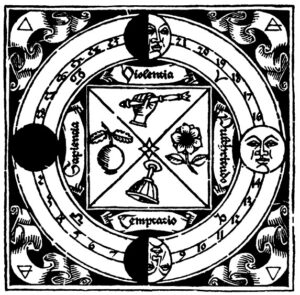 Before we begin examining the individual phases, it’s helpful to set the stage, as the complexities we explored last month may have made it difficult for readers to hang onto the broader picture. As the wheel begins a new cycle, whatever phenomenon you’re tracking begins in a state of complete receptivity in which it is defined wholly by the moment-to-moment changes in its environment. Its goal in the first quarter is to contend with its own body—that is, whatever material form allows to manifest in the world. In that conflict, the body is destined to win.
This is necessary, for it’s through the conflict with the body that the soul learns to distinguish itself from its physical and social surroundings, so that it can begin to define itself as an individual distinct from the mass. While it is preparing for this immense challenge, however, all its strength is in the things it shares with other human beings, and to some extent, all of nature. The Will is only just beginning to distinguish itself from instinct in these phases, and so instinct also provides it with its automatonism—the state into which the Will falls back when exhausted, so that it can recover its strength.
If we take a moment to glance at the four faculties—Will and Mask, Creative Mind and Body of Fate—before proceeding, this will also help give some orientation. Phases take their names and numbers from the position of Will, so the phases we are discussing in this and the next post are those that have Will in the first quarter. By definition, then, in these phases the Mask will always be in the third quarter, in the opposite phase to the Will. The Creative Mind will be in the fourth quarter, and the Body of Fate will be in the opposing phase of the second quarter.
As the cycle begins, Will and Creative Mind are barely distinguished—the person is only just beginning to notice that there is a difference between what he can make something do and what it is in any more general sense. Thinking in these early phases is completely incapable of abstraction. The Will can handle specific problems in a way that is effective because it is half, or more than half, instinctive, but it cannot generalize or systematize. These are the phases of those who are much better with their hands than with their minds, and can accomplish remarkable things but cannot tell you how or why.
By the time the first quarter ends, the capacity for abstraction has arrived, and for that reason the struggle between what the person knows and what he wants rises to a terrible intensity. In the same way, and for exactly the same reasons, the cycle begins with Mask and Body of Fate all but identical—the person can hardly imagine goals distinct from the world as it presents itself to him. As the first quarter ends, Mask and Body of Fate are in stark opposition—the person can only imagine the fulfillment of his desires as the opposite of everything the world thrusts on him.
Notice also the way that Will relates to Body of Fate and Creative Mind to Mask. At the beginning of the quarter, each of these pairings are nearly opposite, leaving both active faculties largely free. As it ends, by contrast, the Will is identical with the Body of Fate and the Creative Mind with the Mask: the person is driven by the whole thrust of his environment to will what he wills, and his mind cannot keep from contemplating the desires he can never fulfill. This is why, of all the phases, the 8th (where this happens) is the most difficult. The 22nd, where the same tremendous opposition returns, is just a little easier because its task is to let go of a subjectivity that has become a terrible burden. The 8th, by contrast, is the phase where that subjectivity has to be created in the first place, by being wrenched free of collective consciousness by raw force. Everything in the first quarter of the wheel leads up to that agonizing effort.
Following Yeats’s lead, we will leave a detailed examination of Phase 1 for later, and begin with the first incarnate phase of this quarter, Phase 2.
Phase 2: Beginning of Energy
Imagine for a moment that you blinked awake suddenly with no memories at all: no trace of language, no concept of personal identity, no practical knowledge, not even the muscle memory that plays so large a role in motor skills. Most of us experience this at the beginning of each new incarnation—there are a few who have scraps of recollection from previous incarnations even in those first days of life—and dim memories of that state sometimes surface in odd contexts. Such memories, if you happen to have them, offer a useful glimpse back at the 2nd Phase.
In this phase the Will and Creative Mind have both been wiped clean by their passage through the complete plasticity of Phase 1. The Mask and Body of Fate, by contrast, have passed through the phase of greatest intensity, the full-moon phase of Phase 15, and so have extraordinary power over their counterparts. Since this is a primary phase, like all the phases before Phase 8, the Will can only be in phase—that is, in harmony with the potentials of its own phase—by renouncing its pursuit of the Mask and letting the Body of Fate govern all. The Mask derives from the incandescent intensity of Phase 16, however, and renouncing it is beyond the powers of most souls in Phase 1. Only when the soul has passed many times around the wheel does it have the essential wisdom to live in phase this early in the cycle.
Nearly always, then, this station of the wheel is lived out of phase. What Yeats means by this is that the soul approaches life the wrong way round and suffers the consequences. This is the normal state of human existence, since it is the condition of a soul that has not yet learned the lessons of its phase. The state of being in phase, by contrast, comes when the lessons have been learned. For those who are in later phases, when reflection has dawned, thought and meditation on what it would mean to be in phase can help speed the process of learning the lesson of the phase and gaining the benefits of that condition. In these early phases, however, reflection has not yet become possible and lessons must be learned through that venerable institution, the school of hard knocks.
Out of phase, then, a person of this phase is ignorant and angry. All he knows of the life of the mind is that other people have something that he lacks, and that fact fills him with rage and bitterness; thus his false Mask is “Fury” and his false Creative Mind is “Moroseness.” He lashes out in all directions, bellowing that he is as good as anyone else—and of course he is; the thing he does not realize is that his possession of natural instinct gives him something that the intellectual intensity of the 16th Phase lacks and longs for, and that in this gift, which he does not notice or value, is his potential for magnificence. Only when he lets go of his futile attempt to imitate the blazing individual passion of the 16th Phase, and lets himself become what he already is, can he make the potential a reality.
In phase, he turns his attention away from the Mask and toward the Body of Fate, and Creative Mind rather than Will takes the lead, as it always should for those in primary phases. Rage gives way to a sense of wonder and joy that, being instinctive and therefore the summing up of all human experience, is infallible in its own sphere; the true Mask is thus “Player on Pan’s Pipes,” the expression of the inherent beauty of sheer existence itself. The true Creative Mind is “Hope,” because once the clinging to an artificial image of passion has been set aside, the mind wakes to the experiences of each moment and, because it takes delight in them without clinging, can always anticipate more delights to come.
The Body of Fate of this phase is titled “None except monotony.” This may seem to conflict with what I’ve just written, but the contradiction is apparent rather than real. Nothing much happens to the person of this phase; nature unfolds in its usual way, the Creative Mind attends to each moment as it passes, and that is enough.
Phase 3: Beginning of Ambition
In this phase the Will and the Creative Mind have moved further apart. While they still stand mostly in parallel, the soul has begun to distinguish what it wants from what it experiences: the Mask and the Body of Fate are no longer entirely merged. The soul also has the lessons of the 2nd Phase engraved on it. While these are not accessible to conscious thought in life, they guide the first stirrings of thought and emotion in the growing soul. The phase is called “Beginning of Ambition” because the Will makes its first fumbling attempts to find a direction in which its energies can be expressed.
This is still a primary phase, and so the soul can only be in phase by making the Will turn aside from its pursuit of the Mask and letting the Creative Mind’s pursuit of the Body of Fate govern all. This is just a little easier than it was in the 2nd Phase, partly because the searing intensity of the Mask has faded as it moves further from the disembodied 15th Phase, and partly because the soul is no longer quite so dazed as it was when it first emerged from the complete blank of the 1st Phase. Far more often than not, though, the soul still lives this incarnation out of phase, and learns the lessons of the phase the hard way.
Out of phase, the soul is still incapable of reflection, but it is no longer limited to the blind incoherent rage of the 2nd Phase. It has learned to mouth slogans and repeat the verbal tics of popular culture, or of whatever subculture it happens to take up, even though it cannot yet grasp the meaning of any of these formulae. This is why the title of the false Creative Mind in this phase is “Abstraction,” despite the fact that genuine abstraction is not yet possible for souls in this phase. When real abstraction takes place, the Creative Mind contemplates many individual experiences and draws an abstract form from their similarities. In the 3rd Phase, by contrast, abstract notions have as yet no connection to experience.
This is what generates the “clodhopper folly” that Yeats describes, and explains the title of the false Mask of this phase, which is simply “Folly.” The person out of phase clings to slogans and verbal labels which he cannot connect to experience, and so can only be empty noises to him. His attempts to live these formulae and impose them on others are alike disastrously inept. If instead he gives up the attempt to live in the intensely personal mental syntheses that rule the life of the 17th Phase, and lets Creative Mind and Body of Fate take the lead, he relies on clear and powerful instincts rather than a hollow imitation of intellect, and becomes vital, strong, and successful in life.
The Body of Fate for this phase, “Interest,” is a considerable help in the struggle to turn away from the Mask and live in the primary tincture rather than an imitation of the antithetical. At every moment the world presents the person of this phase with new objects that attract his attention and desires, drawing him away from the realm of empty words. If he attends to this ever-changing panoply in its own terms, it awakens his true Creative Mind, “Simplicity.” Because he no longer tries to be clever, he can become wise. In the same way, once the false Mask fades away, it becomes possible to achieve the true Mask, which is “Innocence.” It is the spirit of the child who can grasp every experience freely because he clings to none.
Phase 4: Desire for Exterior World
In this phase the paired movements of Will and Creative Mind, Mask and Body of Fate have gone further, and the four faculties are now nearly equidistant on the Great Wheel. This is always a condition of great strength, and it is also the state in which the tinctures can open or close. Up to this point the primary tincture has dominated, but both the tinctures have been open onto that immense reality that appears as Nature in the early primary phases and as God in the late primary phases. That reality, pressing in through the open tinctures, swamps the mind and makes any real attempt at thought impossible.
Now the tinctures are closing and the mind begins to awaken. Since this is an even-numbered phase, the primary tincture closes here—the antithetical tincture will close in Phase 5—and so the overwhelming grip of reality-as-Nature loosens. Reflection and genuine abstraction have become possible, though both are unfamiliar as yet, and any attempt to rely on them drives the person promptly out of phase. This is still a primary phase, and many more experiences and several more lives will be needed before the traumatic passage from the primary to the antithetical side of the wheel, where reflection becomes one of the supreme strengths of the Will, and abstraction a tool of immense power.
Out of phase, the person tries to cut himself off from the instinct that it still his surest guide — thus the title of the false Creative MInd of this phase, “Mutilation” — and imitate the emotional philosophy that is the keynote of the opposite 18th Phase. “Will” is the title of his false Mask, for as yet the person of this phase has no freedom to will what he chooses; his Will is enforced, not free, and so is his Mask; so he gives himself over to some set of abstract or conventional ideas, which intoxicate him the way that slogans and verbal formulae intoxicate the person of the 3rd Phase, and convinces himself that pushing these ideas on himself and everyone else is the action of a strong and free will. The results are never good.
In phase, by contrast, he has all the instinctive wisdom and natural grace of the two previous phases, but with an additional factor, because the capacity for abstract thought has been born. If he relies on the Creative Mind and Body of Fate as he should, his abstractions will not be empty concepts borrowed ineptly from some other mind but practical rules of thumb rooted in his own experience. Joined with instinct, this makes him shrewd, pragmatic, and usually correct. Given a leadership role, whether of a family, a community, or a nation, he will become one of those wise leaders memorable for the great good sense of their decisions and the enduring bonds of affection uniting them with those they govern.
The true Mask in this phase is “Passion,” for the innocent calm of the characters of the last two types when in phase has given way to strong desires and definite goals. The emotional philosophy that guides the person of the opposite 19th Phase is reflected here in simple passion which, guided by instinct, leads in constructive directions. The Body of Fate, similarly, is “Search.” What was once mere interest has become an act of the whole self, a passionate quest for something that is not yet clear to the person. That quest will reach its fulfillment in the 15th Phase, when Will and Creative Mind are again united.
The true Creative Mind, finally, in this phase is “First Perception of Character.” In making sense of this, remember that people in antithetical phases have personality, a quality that is wholly individual and uniquely theirs, while people in primary phases have character, a quality that is shared with many others. In this phase the Creative Mind begins to perceive these shared qualities and thus can anticipate what people of this or that character will do. In the process, the person also begins to perceive his own character, and sets the stage for its transformation into personality.
*****
These first three phases of the wheel, as noted in last month’s post, also form a complete wheel of their own. It can be very helpful to take the time to think through this: to imagine these three phases as a cycle that dawns in the 2nd Phase, reaches its fulfillment in the 3rd, and ripens into reflection and self-transcendence in the 4th. As we proceed through the phases, you will have many chances to do the same thing over again, and this will help you understand the wheel as a whole and get the facility with it that will help you make sense of the system’s practical applications when we get to those.
More generally, I encourage readers to take the time to reflect on the phases we’ve discussed in this post, and especially to see if you can find examples among people you’ve known or know currently. Those readers who have young children will also have the chance to see these three phases as they work out in the cycle of a single life. The more time you put into using the concepts of the system as tools for thinking, the more you’ll learn from it.
In the meantime, please review the text on Phases 5, 6, 7, and 8 for next month’s post!
This is incredibly lucid and helpful, so much easier to grasp than Yeat’s examples of literary and artistic figures..
“More generally, I encourage readers to take the time to reflect on the phases we’ve discussed in this post, and especially to see if you can find examples among people you’ve known or know currently.”
I recognize aspects of myself in each of the three phases you described., so I conclude my soul has been around this part of the wheel before.
You’ve also provided hints at answers to some questions that came to mind when I read last month’s assignment: what is meant by the terms personality, character, individuality, instinct, and nature, and what determines whether a life is lived in-phase or out? I’ll continue to reflect on these.
Thank you again for your insights into this challenging material.
I very strongly see the correspondences to child development in these phases. An alternation between open wonder and incoherent fury is a good way to describe the life of an infant; ‘beginning to distinguish between what it wants and what it experiences’ is the day-to-day experience of the preschooler who learns to say ‘no’ for the first time; mastering rules of thumb for day to day living along with beginning to evaluate others as potential friends is one of the things that makes one ready for kindergarten.
In the Waldorf school system where I worked for a time as a caregiver for 2 to 4-year-olds, there was a strong emphasis on encouraging physicality and non-verbal learning with the little ones, and discouraging premature intellectualism and abstraction. The word ‘precocious’ was used to describe a negative trait we sometimes saw in children- those who were too much in their heads and missing out on the important lessons of mastering their own body and its rhythms. Repeating empty pop-culture slogans and verbal tics, or learning at an early age to manipulate adults verbally rather than trusting them instinctually, was in our view a mark of the child’s being ‘out of phase’ due to not experiencing the kind of stable, supportive environment at home that they really needed.
At a first guess, I would fit all three of these phases into the ages 0 to 7 of the life of a child. Interestingly, there is a corresponding rhythm in the growth of the physical body, since infants have disproportionately large heads with tiny bodies, preschoolers have disproportionately large abdomens with short limbs, while the school-ready child of 6 or 7 has for the first time the kind of balanced physique that we recognize as being like an adult in miniature.
So as the Daimon stores memories and lessons from every incarnation, it models each successive Personality on the previous one.
I wonder if with each repitition of the Wheel, the instincts the in phase person draws on get more complex and subtle, until they, in theory*, approximate the p-zombie or goLLuM with them doing stuff that seems thought-out and intellectually advanced but really are blindly responding to the promptings of their Higher Self.
*But the souls that have the potential to become advanced Phase 2-4 probably already left the Wheel during their last late primary phase.
Dang, by this formulation I really lived my formative years way out of phase. Worse, I can’t disagree – for instance, in my late teen years, I tried quite hard to consciously live a life of stoic ethics and Christian virtue as they were communicated to me, which did quite a bit of damage. Only now am I beginning to realize that the virtues of Marcus Aurelius are appropriate mostly for a middle aged man who is established both financially and socially and have very little to offer to a young man of plebian means.
I’ll be honest that I’m struggling a bit to keep up and have had to go back and look up what “Will,” “Mask,” “Creative Mind,” and “Body of Fate” mean despite having already learned them. So this may be off-base. Nevertheless, it seems very much like most of America is somewhere in these first three phases, and in particular, phases 2 and 3. Moreover, I wonder whether the separate cultures of the United States might in fact– as suggested in books like Albion’s Seed or American Nations– be truly separate nations, with different astral bodies currently experiencing different phases. Phase 2, out of phase, sounds like much of the “American Right,” which is to say the descendants of the Southern but especially the Scots-Irish culture. Phase 3, out of phase, sounds like all of the “American Left,” or the descendants of the Northern but especially the Puritan culture. And the “out of phase” state might even result from the false identity that each shares– that is, perceiving themselves as members of a political party within a nation, rather than as separate peoples who happen to share a government.
That may be off-base, however, as I haven’t read through the other phases yet.
Goldenhawk, I’m glad to hear you’re finding this useful! The system really does need a close phase-by-phase examination before it starts to make sense.
Dylan, thanks for this. I was one of those precocious kids, btw — unfortunately I didn’t have anyone with the sense to push me into other lessons, so I was spectacularly out of phase all through the first quarter of this life. I’ll be very interested to hear your insights, and those of others with experience with children, as we proceed through the phases to come.
Patrick, nah, the daimon doesn’t prompt that way. As Socrates pointed out, it mostly says “don’t do that.” Thus the soul that’s been around the wheel many times doesn’t pursue the Mask in these early phases, but is left to its own devices in using its Creative Mind to explore its Body of Fate, so it can learn whatever lessons it still needs to pick up from these phases before leaving the Wheel entirely.
Sirustalcelion, that’s not something to regret — being out of phase is how you learn. You put your formative years to good use learning important lessons, including the limited applicability of Stoicism to the young!
Steve, that makes a good deal of sense. If in fact the future American nation hasn’t (or nations haven’t) taken shape yet, those early phases would be playing out in its/their history. It won’t be until the 8th phase of our historical cycle that the future American nation(s) emerge(s) into self-conscious existence; until then, our national consciousness is simply mouthing slogans, when it’s not ignoring verbal formulae entirely and focusing on moment by moment experience.
Hi JMG,
I hope this week is a good one for you.
> when reflection has dawned, thought and meditation on what it would mean to be in phase can help speed the process of learning the lesson of the phase and gaining the benefits of that condition. In these early phases, however, reflection has not yet become possible and lessons must be learned through that venerable institution, the school of hard knocks.
If one truly has impetus to, I would translate, switch from being a bad person to a good person, as you say, through thought and meditation, one can expect to spend months or years or decades or millenia paying back the bad karma one had “earned” up to that point, AND NOT ONLY THAT, in the meantime, one needs to not incur new bad karma. It is “a hundred-times really” a super rough road, and one should not take on this obligation, this promise, this vow, unless one truly wants and needs to embark on such an arduous journey it will take to become good.. For, one may not come out alive. That’s the rub.
One’s experience of “paying back the bad karma” phase depends upon the individual—what they did that was bad. Take Adolf Hitler or Joseph Stalin as examples. I conjecture that their souls need a few millions years to pay back the suffering they had caused in the incarnations they took during the early-to-mid 1900s. Each soul must decide, on their own, that they are ready to atone, according to the school of hard knocks. When starting out, one has no idea, usually, how dreadful, terrible, and severe the journey will be. Once a person makes such a vow, (s)he locked in and must press on ahead—uphill.
💨😤😖😇Northwind Grandma💨
Dane County, Wisconsin, USA
I realize that people of these early phases don’t usually become famous unless it’s for something brutal (phase 4 seems to be an exception when in phase). That said, do you have any more recent public figure examples of phases 2, 3, and 4? I don’t know much about the lives of most of Yeats’ examples throughout all of the phases.
The frequent mention of “instinct” continues to puzzle me. Both the way Yeats uses it and the way anthropologists use it in general; I just don’t get what “instinct” is. Is it on a particular plane? Is it entirely a non-specific generalization encompassing a raft of different things? I see it as such a vague and unsatisfying concept.
Steve T
I wouldn’t be surprised if they were in different phases – reminder that the Scots Irish came over to America about a century and a half after the original Puritans did.
Hi John Michael, Thank you for all your work. I’ve been coming to your site for some years now and have always found it though provoking. This question is off topic but I was wondering if you have an opinion about using Austin Osman Spare’s tarot cards with your series of writings on the Doctrine of High Magic? Thanks
Forgive me if you have stated this before. How much of the Wheel does the individual traverse in a single incarnation. I believe you or Yeats stated that we have one phase per incarnation, but it seems like there’s movement within a single incarnation too. For context, I’m 30, and it seems like I spent most of my life in a “hero” phase, pursuing the Mask at all cost. When that dried up around age 21, I’ve seemed to slowly move towards phase 18. I should analyze that again, but that’s my understanding as of now. But these two factoids leave me uncertain when one “settles in” to their true phase? Possibly/likely this question is predicated on a faulty understanding, as I find Yeats difficult, but I’ll leave it there for now.
Hello JMG and commentariat:
It’s very interesting to me John depiction of personality, opposed to the character description (short too but clear too…). With these two ways to be human, of course you can find the character in most people in today world; only a few would have a personality (so a real individuality).
———————————-
Dylan # 2:
I also think it’s a good idea, when you detect a child is “precocius”(he/she lives too much in his/her head and out of his/her body), to show him/her to connect with the body, before it’s too late in his childhood and for example, he/she builds a conflictive personality, not to say a personality disorder or even some worse yet.
Northwind, two things. First, what is this vow you’re talking about? Second, “out of phase” and “in phase” are not the same things as “bad person” and “good person.” You can follow the strictest moral code ever written and be hopelessly out of phase; in fact, in these early phases, if you follow someone else’s moral rules rather than your own instincts, you’re going to be out of phase. Yeats’s system has a moral dimension but it’s a good deal subtler than you’re suggesting here.
Oh, and nobody comes out alive, you know. The death rate for being alive is 100%, irrespective of what kind of morality you follow.
Kyle, not off hand, no. You’ve probably met people in each of these phases but in a society as late phase as ours, it’s basically unheard of for people of very early phases to become widely known.
Phutatorius, instinct is biologically programmed emotion and behavior. Watch teenage boys pursuing sex partners and engaging in risky behavior and you can see one set of instincts in full flower.
Peter, please post this next Monday on the weekly Magic Monday ask-me-about-occultism post on my Dreamwidth journal, or on the monthly open post here (which will go up December 24). I like to keep the conversation on blog posts on topic.
Luke, each life expresses one phase. Meanwhile, each life goes through the entire wheel of phases. It’s like a fractal pattern — the same pattern is expressed repeatedly at many different levels.
Chuaquin, Europe (and to a lesser extent the Americas) are in the last phases of the wheel, so character has become the dominant trend. Go back a few centuries and you’d encounter many more personalities.
@Northwind Grandma
@JMG
I assume the repentent person makes a vow to make amends or otherwise pay back something equivalent for all the harm they did, and the gods hold them and their later incarnations to the vow until all the karma is paid off. Or more likely, any attempt to reform oneself to become a good person is implicitly a vow to balance out all one’s bad karma.
But I doubt all karmic debts have to be fully paid off to leave the Wheel, since all actions generate karma.
Thank you for this essay. Your writings on occult philosophy are always a treat. One of the bedrocks of my sanity.
A little off topic, just something I’ve been musing on. Did Yeats associate the beginning of the antithetical phase with an unhealthy preoccupation with fantasy? My childhood self’s idea of a good recess was spending 15 minutes in an elaborate fantasy in my head. It’s only as an adult that I’ve come to the conclusion that my mind is a tool to help me interact with the world, not a place to escape from it. (Still putting in the work. I’m sure it’ll start paying dividends any day now).
Thank You
Interesting, so you’re suggesting that whatever phase a society is in skews the role of individuals also within that phase to be more pronounced? Where would place the U.S. at the moment? It feels to me like abstractions are becoming confused or disintegrating so I’d guess somewhere just after the turn back to primary, but not yet where the saints tread, so 22-25?
JMG, I’m glad the child development comments are helpful. I was one of those precocious children too, and throughout my life have had to deal with the feeling of being vaguely uncomfortable in my own body- this is specifically what Waldorf education aims to protect the child from in the early years of the incarnation process by letting them be as unconscious as possible in their play and in their rote acquisition of healthy habits and manners. Literacy and numeracy are deliberately not taught until age 7, when the child enters kindergarten. Our supervisor at the childcare centre was always telling us to talk less with the small children and lead more by example and gesture. You don’t make a building stronger by building the second story before laying the foundation- that’s the Waldorf early years philosophy in a nutshell.
Our role as caregivers was to be a powerful, loving Body of Fate for the children: the entire childcare environment and the daily rhythm of playing, eating, and resting was designed to remove as much variability and choice as possible from the children’s lives, so they could focus on learning to master their own bodies through creative play. Many parents think they are doing their small children a service by giving them choices (what to eat, what to wear, whether to go visit Grandma or not) but in fact we observed that this kind of choice-making made the children *less* sure of themselves, less grounded in the sense that the world is a stable and reliable place to grow in.
As caregivers we also functioned as the Mask for the children, who saw us as dazzlingly attractive role models to be imitated. Their Creative Minds, near the lowest point of the wheel and extremely receptive, took in every word and gesture we imparted to them, remembering and repeating, repeating, repeating. Their Wills were most at peace when they could drift along in the current of gentle activity we created for them, much like people floating down a ‘lazy river’ at a waterpark. Totally free from the burden of decision-making, learning at their own pace to paddle their hands and feet in the water or just drift along with the group according to the waxing and waning of their willpower.
This, I would guess, is analogous to the role that the collective consciousness, traditional religion, and conventional morality play in the adult of the early phases. Going with the flow, not rocking the boat, living (in phase) with quiet grace and practicality. ‘Nothing much happens’ is a good description of a healthy early childhood and a tranquil, well-adapted adulthood of the early phases.
But of course, most of us live our early childhoods somewhat out of phase, in less-than-ideal environments, because our family of origin is where the karma we bring into this lifetime manifests itself most strongly. Waldorf education is an attempt to remediate those environmental imperfections and give the incarnating soul a jump start in adapting to its own karma and unleashing its own gifts.
It seems connected that this is the theme beginning this now, and dropping today on the 10th. As dropping was notice received by me of my request for beginning a new cycle of my own life with membership in the Ancient Order of Druids in America. Yesterday, JMG – your book The Druidry Handbook arrived in the mail.
This is – enough.
@17 Kyle
America is probably in multiple phases at once. It might be in the esrly primary phases of its own cultural development, but it is also in a European pseudomorphosis and JMG has said that Faustian civilization is entering the phase of the Saint. I don’t understand the phases well enough to understand why, but I’ll take his word for it. America might be out of sync with Europe in the twilight of its European pseudomorphosis so it might be in a different late phase.
JMG # 14:
Thank you for your answer to me. So I’ll find biographies of people dead long time ago to seek true personalities, and maybe some History books.
——————————
Dylan # 18:
I was a “precocious” child too, I remember myself always with my head in the clouds and I was taught to read and write IMHO too soon. I hadn’t the luck of going to a Waldorf school like you’ve described. It seems to me a smart and sensitive education system.
I don’t want to blame my precocious childhood (so my parents and conventional schooling system) for every problem I’ve lived then during my life, but I think it influenced partially in my adult age trouble (which includes some mental problems). By luck, I’ve learnt to disconnect myself more of my mind and connect better with my body during last years.
I’m still following along. Do different spiritual traditions function best for different sections and phases of the wheel, and work by teaching how to live in-phase for people in those phases? These early phases and the role of Will remind me of ‘effortless effort’ and the lack of emphasis on abstraction that you find in say, the Dao De Jing. If different civilizations are in different phases of the wheel, then this might explain why, for example, many eastern spiritual traditions aren’t appropriate for people in the west, and vice versa.
Also, I was tempted to suggest that what Jung means by individuation is related to the antithetical phases (the forming of a personality, which seems different here than what Yeats means by the term). But maybe the point of individuation is, again, to live in-phase of whatever you’re phase you’re in. I wonder if living according to character and not to personality (in Yeats’ terms) is adhering to an archetype, but I need to reflect further on this.
Finally, is there a phase in which abstractions start to feel disappointing and incomplete, and the desires and passions you have end up giving way to the realization that what you’re most consistently drawn to in life is to sorting out your own issues and coming to terms with yourself?
It occurred to me that the cycle of the 28 moon phases in the system of Yeats is essentially a much more complex form of the same thin represented by the Cycle of the Cantrefs from the Dolmen Arch, or of the Wheel of Life from the Druid Magic Handbook. But in contrast to the Dolmen Arch, W. B. Yeats doen’t mention, to my knowledge, the turning of the wheel into a spiral with direction perpendicular to the wheel, which symbolizes in the Dolmen Arch the progress of the soul or any other entity in the process of multiple passes through the phases of the wheel.
I like that there is a confluence of ideas between Yeats’ Soul going through multiple iterations with 4 parameters slightly different each time, thus always giving a different “result” ; and Fortune’s sparks and atoms, who have their own basic movement but are subject to innumerable influences (their peers, the tracks in space left by the previous swarms, entities on the planes above, etc.).
Something always prevents durable immobility or being stuck in a rut for too long.
Equilibrium = Stasis = Death and Disequilibrium = Evolution = Life
Not a new idea but I find occult philosophy has a way to make it more impactful.
I’ve been thinking today about opposition and tension between personality and character; at some moment of the day I’ve remembered a novel I read a lot of years ago, which wasn’t worth a Literature Nobel prize, but it was interesting to read me thinks. I won’t bore you all with its content, artistic value nor its author name and biography…It doesn’t matter. I only want to tell you there was a secundary character (excuse my cheap irony in this character-ization), who in spite of being ficticious, I think it reflexed well the difference between character and personality. This novel man was a young champion of limitless human freedom and saw himself as a Prometheus spreading more freedom to the rest of people; according his strong anarchists ideas. He was proud of having left behind him the dead weigh of traditional and religious serfdoms. However, the main character of that novel realizes his friend isn’t really free, because he’s really an slave of his instincts: for example, he’s always looking for new beautiful women to conquer and sexually being surrender to his lust. I think this kind of men (or women), it’s a genuine model of person with a character, made by social influences and genetic conditioning, but not really a free self determined personality. So there’s no shortage of people in western countries (and I bet in the whole world today) who think themselves as free individuals, but indeed they’re under the mixed plethora of ideologies, fashions and in adittion to the several Spectacles, of course their utterly deep biology. They usually fool themselves thinking they have a strong personality, but they’re a fraud.
I think I’ve understood well your character/personality definitions John, enough to have written about this kind of contradictory human beings. If I’m wrong, please tell it to me…
—————————
In other subtopic, I’ve read before my current comment someone has written about Stoic virtues being impossible to really be understood and practiced by young people, so until middle age they can’t be useful to people. John has written too about this subtopic.
My personal experience with Seneca and Marco Aurelius teachings can confirm these ideas. Now I’m more or less s middle aged man, I can tell you I’ve rediscovered Stoicism in all its brightness and wisdom, and I try to live it better in my everyday life. Thank you JMG and commentariat!
Not much to add, except this bit really helps.
Wheels within wheels, cones and spirals. (I would have liked to eat an ice cream cone with Yeats.) I was already thinking of tracing back the time of the Hunchback to see if the pre-2012 conformed to that phase… I suppose when we get to the history aspect of this I can ask the question of how long does a historical phase last? I know there are no hard and fast rules per se… that it is an abstract system applied as an art more than a science. Will the coming astrological shift of early next year be a marker for a shift into the phase of the Saint? I can see that happening for various reasons.
On another note, as I prepare for my next radio transmission and listening back to favorite new music from 2025 (one of the jobs of those who’ve fell into the mask of critic and DJ), I have got this excellent song on repeat yesterday and today. Since it is related to the theme of moon phases by title and imagery, I thought I would share.
Planting by the Signs by Kentucky’s very own S. G. Goodman (w/ Matthew Rowan):
https://sggoodman.bandcamp.com/track/planting-by-the-signs-feat-matthew-rowan
or here for those who prefer YT:
https://www.youtube.com/watch?v=YBTW-GdCrH8
It’s a folk song in the high lonesome register for those who like that kind of thing. You can feel the down home funk just percolate up from the rivers of earth as you listen. : )
—
And for those who may care, here is my partial list of favorite music from 2025, as I yet wear this mask (among others).
https://www.sothismedias.com/home/music-favorites-from-2025
Patrick, hmm. I’m not at all sure that follows.
Sean-Luc, Yeats assigns fantasy to the phases from 15 to 19. The 15th phase, being disembodied, is all fantasy, the soul caught up in utter contemplation of its own richly imagined vision of beauty; during the phases that follow, the soul tries to cling to that vision in varied and increasingly fragmentary forms, while slowly learning to turn its attention back to the world.
Kyle, as I see it, the Western world entered Phase 26, the Hunchback, in the 1980s, and is now passing on to Phase 27, the Saint. Since societies, like people, live mostly out of phase, the phase now passing off had as its false Mask “Self-abandonment” and as its false Creative Mind “Fascination of sin;” the phase now beginning will have “Emulation” for its false Mask — the desperate attempt to cling to the vanished antithetical by LARPing the spiritual and cultural achievements of the past — and “Pride” for its false Creative Mind. Both those are tolerably visible already.
As for America, I don’t think it’s been born yet, so a consideration of its state will have to wait until we move on tp Yeats’s discussion of the after- and beforelife.
Dylan, thanks for this. That sort of environment would have been very good for me when I was a child, and I would have adored it. Oh, well.
David, well, there you are!
Jbucks, spiritual teachings and traditions are only meaningful to those in the second half of the wheel, phases 16-28. Before then the soul is moving toward the unfolding of its own inner potentials and any outside stimulus, however well-meant, quickly becomes one more external fetter to be thrown off. Only in the second half of the wheel does the soul, having unfolded its potential, turn to the integration of that potential with the cosmos through spirituality. As for Jung’s concept of individuation, as I see it, it’s applicable to the antithetical side of the wheel alone, and mostly to the third quarter, in which the soul is trying to return to the unity it briefly achieved at phase 15. It can only do so for brief moments, but making the effort is essential to its growth and maturation. As for becoming disappointed with abstractions, that’s a common experience all through the later part of the third quarter.
Booklover, excellent! Yes, in fact, it’s the same cycle, using a more detailed symbolism.
Thibault, a very good point.
Chuaquin, that’s about right. As for the Stoics, I was in my very late twenties when they first made sense to me, in the midst of a bitterly unhappy time, and it was Epictetus rather than any of the others who spoke to me. I needed a slap across the face and he provided it! I suspect that one of the reasons he’s always spoken to me is that he wasn’t a member of the privileged classes — in fact, for a while he was a slave.
Justin, we’ll get to that. Yeats has specific dates for the phases over the last 2000 years, which we’ll discuss once it’s time to work through the cycle in its historical manifestations.
“as I see it, the Western world entered Phase 26, the Hunchback, in the 1980s, and is now passing on to Phase 27, the Saint.”
–Oh, ok… I thought in your last Yeats essay you said Phase 26 started at 2012. Maybe I misread or misunderstood… or perhaps you meant a phase within the phase, a wheel within the wheel.
Still, also trying to see how these apply to people I know.
Thanks!
@Chuaquin #13 & 21, the tendency for children to be disconnected from their bodies is something we’re seeing more and more, and you can guess the reasons why: parents are busier, less available for quiet, unrushed time with their children, and the video screen steps in as the babysitter. Virtual reality of any kind is just tremendously unhelpful for child development. I’ve come to believe there are also debilitating factors at work in modern medicine which would be more appropriately discussed on the weekly Tuesday thread.
Our host has mentioned Eurhythmy before, among Rudolf Steiner’s accomplishments alongside the founding of Waldorf education. What wasn’t mentioned is that Eurhythmy is not only a performing art but also a system of therapeutic movement which Steiner intended to be used for children and adults who were not satisfactorily integrated with their physical bodies. Because each gesture in Eurhythmy corresponds to an element of verbal speech as well as a planet or sign of the Zodiac, a therapeutic Eurythmist can design a daily practice of movement to help with a child’s speech development, learning disability, or physical illness, according to the needs being presented. I know someone who grew up going to a Waldof school and was given extra one-on-one sessions with the school’s staff Eurythmist to help her get over her difficulties in studying and learning.
I also know a gifted young woman who runs her own childcare program and who says she can see the correspondences between speech impediments and abnormalities in the walking gait of little children. It is just fascinating how deeply our minds and bodies are manifestations each of the other.
@JMG
Last month, you said the West entered the hunchback phase in 2012.
JMG # 27:
I had forgotten Epictetus, the third Stoic member of the Roman Stoics philosophers. Thank you for reminding him to me. Of course he was different of an emperor and a rich man because he was an slave part of his life. I’ve read some Epictetus phrases online and in philosophers antologies, but I recognize I’ve never read his complete writings.
Thank you for this enlightening article. I was very mystified by A Vision, and your articles in this series are really helping me to understand what Yeats means.
This discussion reminds me of an old Chinese saying I read once – differences in quantity produce differences in quality. Your article makes it clear how the differing proportion of the two tinctures on the four entities creates such vibrant diversity of personality and character.
I have a question about my country, the Republic of India. We have seen several cycles of civilisation and collapse, but currently Indians act very childishly. We want to emulate standards set by the rest of the world and to compete with the West, disregarding the needs specific to our country.
For instance, we take pride in a space program and in our military capabilities, and in our capabilities in software engineering. But none of these actually resolve any real challenge that we face. Sure, our military is a necessity since we have such good samaritans as China and Pakistan for neighbours, but our obsession with long-range firepower is absurd given that we really do not want to go to war at all.
Likewise, while the space program does serve to hoist constellation of satellites, but we aren’t exactly eager to go to Mars or anything. We just want to do space things because that’s what all the big boys do, and we want to be seen as a big boy. The same is true for software engineering – we have so little market for actual software engineering that almost all of our software engineers work directly or indirectly for American companies, and we even take pride in people the ranks of American tech corporations like Google and Microsoft.
Pichai and Nadella are icons as much as Jack Ma is in China, but the difference is stark – the Indians serve in executive positions in American companies of repute, while Ma has founded Chinese concerns that have given Western rivals a run for their money. Even our political discourses are filled with terms like “socialism” and “nationalism”, ideas that are too obviously borrowed.
Based on all of this, I conclude that we are in the first quadrant, desperately trying to emulate the world and accepting its values, aspirations, and assumptions as fact. Which phase do you think India is in right now?
“Out of phase, then, a person of this phase is ignorant and angry. All he knows of the life of the mind is that other people have something that he lacks, and that fact fills him with rage and bitterness; thus his false Mask is “Fury” and his false Creative Mind is “Moroseness.”
This hit me like a ton of bricks in the best possible way. I can absolutely see the reflection of my own misspent youth in the false mask of fury and the false creative mind of moroseness. Also, thanks to Dylan for the insights about early childhood that relate very deeply to this topic.
For me, fury was directed toward gatekeepers who I perceived as keeping me from being the kind of musician I was meant to be, when the person standing in the way was me all along. It is very easy to live inside your own head in this era, because though we are physically safer than ever, I would argue that spiritually we are both more stunted than previous eras of human history and hence ever more in danger because of it. Retarded people tend to oversimplify and then to beat themselves down with blunt instruments of oversimplification.
“the Western world entered Phase 26, the Hunchback, in the 1980s, and is now passing on to Phase 27, the Saint. Since societies, like people, live mostly out of phase, the phase now passing off had as its false Mask “Self-abandonment” and as its false Creative Mind “Fascination of sin;” the phase now beginning will have “Emulation” for its false Mask — the desperate attempt to cling to the vanished antithetical by LARPing the spiritual and cultural achievements of the past — and “Pride” for its false Creative Mind. Both those are tolerably visible already.”
That doesn’t bear well for the Western world in a few decades. The next phase is Phase 28, the Fool. The false mask is “Malignity” and the false creative mind is “Cunning”.
Justin and Patrick, I did indeed. I’ve been reflecting further on the matter, and at this point I’d put the beginning of the Hunchback phase earlier than 2012. It was sometime in the first half of the 1980s, I’d say; 1984 might be a good symbolic date.
Chuaquin, he’s worth your while.
Rajarshi, I don’t know Indian society and culture well, but from this side of the ocean it certainly does look as though India’s somewhere in the first quarter, possibly quite early. I’ll hypothesize that it passed the 1st phase in 1947, when it shook off the British Raj. As you note, it’s been around the wheel a few times already, so it won’t be as far out of phase as a more recently arisen culture; if I had to guess, I’d say it’s making the transition from the 3rd to the 4th phase, as it moves away from a focus on purely local and internal issues and starts to take a more significant role in global politics.
Kimberly, you’re certainly right about the spiritual ignorance of this era. As our civilization lurches through the late primary phases, it’s very hard for the mass-minded to notice their own subjectivity, much less respond intelligently to it.
Anon, granted, but then the Western world has gone out of its way to guarantee itself a difficult time of it. As individuals, we’ll have to guard against the malignity and cunning of the out-of-phase.
I was also a “precocious child” who learned to read too early, and delighted in correcting the vocabulary of adults… while also (ironically) spending a lifetime of “underachievement”…
That said, my earliest, and quite magical, childhood memory was a thoroughly embodied Creative Mind knowing of my Body of Fate. In this memory I am sitting outside in the grass, under sun, with a light breeze, and there are delightful sounds and sights all around me which I am taking in one by one. Then my father materialises (by this I mean there was a real sense in which first he wasn’t and then, rather suddenly, he was) via a gap in the hedge to one side of me, comes over and offers me a brand new experience – a red, juicy, raspberry – a completely unexpected new experience of pure delight. Taking it in my mouth and tasting it was an entire world of discovery. 🙂
@ JMG # 32
India’s transition from phase 3 to 4 definitely makes sense. It is clear that the primary tincture is slowly closing in this country, even though the antithetical one is wide ajar. We believe whatever some Indologist tells us about ourselves. But we are slowly beginning to analyse the world on our own terms.
I realised that the closest equivalent of the Primary and Antithetical tinctures in Indian philosophy are the Adhibhautika and the Adhyatmika respectively. We have this classification of things into three categories – Adhyatmika (related to the self), Adhibhautika (related to the physical world), and Adhidaivika (related to the Divine, or the acts of the Gods). So if I ever want to neutralise the Binary produced by the two tinctures, I guess I have an anchor on it now 😉
I am curious, since you have studied China and Japan at length, what do you think of their phases? I know you have hopes that Japan may be able to weather the storms approaching the West soon, so do you think that they are not approaching a dangerous moment anytime soon?
Such an interesting synchronicity for me; I’ve been reading psychoanalytic material on how a person’s identity can become split into their “true self” and a “false self” (otherwise known as a schizoid position or a schizoid personality). One of the chapters of a book on this subject happens to begin with a few lines of Yeats’ poem, “A second Coming”, “Things fall apart; the centre cannot hold,/Mere anarchy is loosed upon the world.”
The true self/false self split is believed to occur at the earliest stages of life; where the psyche is either able to successfully build a stable sense of being an individual Self who is capable of spontaneous creative vitality, or fails that and splits their Self into a devitalized and compliant (precocious) outer Self and a hidden inner Self. This fits in nicely with this essay’s focus on the earliest phases of Yeats’ cycle, and the struggles of the early embodied personality.
I feel compelled to share what I’ve been reading purely based on how neatly these subjects seem to have come together 🙂
For example, I feel a clear through-line can be found if you compare this line from Phase 2: “Out of phase, then, a person of this phase is ignorant and angry. All he knows of the life of the mind is that other people have something that he lacks, and that fact fills him with rage and bitterness”, with some writing from Harry Guntrips’s “Schizoid phenomena, Object-Relations and the Self”. He posits that “the difficulties experienced in object relationships in the oral stage of absolute infantile dependence”, the earliest stage of life, create “the two basic or ultimate dangers to be escaped from”, aka the primordial fears that all pathology seems to stem from – either directly via splitting, or indirectly through other defence mechanisms.
He posits:
“The nature of the two ultimately dangerous situations may be simply described. When you want love from a person who will not give it and so becomes a bad object to you, you can react in either or both of two ways. You may become angry and enraged at the frustration and want to make an aggressive attack on the bad object to force it to become good and stop frustrating you-like a small child who cannot get what he wants from the mother and who flies into a temper-tantrum and hammers on her with his fists. This is the problem of hate, or love made angry […] But there is an earlier and more basic reaction. When you cannot get what you want from the person you need, instead of getting angry you may simply go on getting more and more hungry […] Love made hungry is the schizoid problem and it rouses the terrible fear that one’s love has become so devouring and incorporative that love itself has become destructive.” The first problem is likely to develop into a depressive state, and the second, more fundamental problem, is likely to lead into the splitting of the Self.
You can also see these ideas echoed in the False Mask “Fury”, with “love made angry”, and the Creative Mind’s “Moroseness”, with “Love made hungry”
Fascinating!
Donald Winnicott’s descriptions of these split selves give much food for thought too, both for Yeats’ cycle of phases and for the general state of the world:
“where there is a high degree of split between the True Self and the False Self which hides the True Self, there is found a poor capacity for using symbols, and a poverty of cultural living. Instead of cultural pursuits one observes in such persons extreme restlessness, an inability to concentrate, and a need to collect impingements from external reality so that the living-time of the individual can be filled by reactions to these impingements.”
And one extra tidbit, just for fun. I had a bit of a chuckle while reading this line from Guntrip: “How can the need of the exhausted regressed ego for recuperation in and rebirth from a reproduction of the womb-state be met at all, and how can it be met without the risk of undermining the central ego of everyday living? That seems to be the ultimate problem for psychotherapy.”
Because my mind immediately ran to Dion Fortune’s Moon Magic:
“I saw you as Peresephone.”
“Yes, that was right; I had worked the Isis ritual with you as far as the Persephone point. I have been Persephone to you.”
“What does Persephone do to me?”
“She is the queen of the unborn. I took you right back to childhood—and earlier. I made you as the unborn in order to rest you.”
“That is the psychology of dementia praecox.”
“And it is sound psychology, Rupert. If people would go back to Persephone when they needed to, they would not get dementia Praecox. That is the thing you get when life is too hard for you.”
It seems like the teachings of the occult hold the solutions to psychotherapy’s ultimate problem. 😉
Can the four quarters of Yeats’ wheel be associated with John Gilbert’s four worlds and the three triads of the tree of life? e.g. first quarter – the body; second quarter – the ego (thoughts, desires, life force); third quarter – the soul (will, memory, imagine); fourth quarter – the spirit (links to creator, divine father, divine mother)
JMG,
I occasionally watch a YouTube channel which consists of a Chinese professor , Jiang Xueqin, giving lectures to high school students in Bejing. Many of his topics would be families to readers of this blog such as the rise and fall of empires, how the British extracted wealth from China and India. How fiat monetary systems work. Why countries go to war etc. At this point there are 100’s of these lectures online, in both short ( 10 min) and long ( 1 hour plus ) form.
Today I listened to his latest and it followed Judaism from its creation by the Persians and it ups and downs through history until the time of Jacob Frank. Then dove in to Frankism and its effect on the modern world. He even followed that trail all the way to the Golden Dawn and Yeats. He acknowledge Yeats for his occult teachings and effect on the world.
My historical knowledge in this area is not good enough to judge whether his teaching is accurate or not. But what flabbergasted me was ” he is teaching this to high school students?”. This type of unconventional ( accurate or not) teaching of history is unknown in official education settings in the west, let alone high school. It must be some sort of elite class because the students asked questions in perfect ( but accented) English.
If the Chinese are really teaching this sort of thing to even a small portion of its students their rise in geopolitical power is far from over.
Scotlyn, that’s a lovely story — thank you.
Rajarshi, interesting. As for China and Japan, they’re at a very different stage of the process. Neither one actually became a colony of a European power, and so didn’t have the reset button of Phase 1 pushed. I see them as being at a very late Primary phase — the collapsing population of both nations, and South Korea as well, is a late-phase phenomenon. It may be that they’re roughly in the same phase as Europe.
Little Bug, fascinating indeed! Thanks for all of this. You may well be right about occultism and psychotherapy — did you know that Dion Fortune qualified as a Freudian psychotherapist, back in the early days of the movement when (in England, at least) that didn’t require a medical degree?
Anon, fascinating. Yes, I think you’re on to something.
Clay, good heavens. That’s really quite remarkable — and no, you won’t see that anywhere in the West, of course, because our educational systems have mummified. He’s right about the Frankist roots of the GD, too!
Dylan # 29:
You’ve said the bad influence of screens in children…sometimes even since they’re babies!, to explain their disconnection with their body. I agree.
Waldorf schools (where they can be available) are a good alternative IMHO to the binary opposition which happens in my country (at least) between state schools and private (catholic) education.
—————————
Clay Dennis # 40:
It’s surprised me Yeats was quoted by a Chinese teacher, meanwhile in the western countries academia usually ignores occultism. Interesting…
Narcissus and Goldmund by Hesse was one of the novels I read this year. As I was reading it, I was wondering where each of these characters could be placed on the wheel. Yesterday and this morning I was also thinking of how one of the gifts of Narcissus was his ability to really and truly read a persons inner nature. He knew Goldmund was haunted by the absence of his mother, and had an inner knowing of the path his friend would go down after he left the monastery -knowing he would live the monastery for a life “in the world.”
It’s perhaps easy to read Narcissus as the Saint… and perhaps Goldmund as a character of phase 17, who can lose themself in dispersion unless they are able make a true image from within and bring it out into the world (if I am interpreting it correctly). There is also the aspect of eros and sensuality that Yeats mentions and how it ties in with their work. This was very evident in Goldmund. Sometimes debased, other times genuine. When he worked with the master artisan, he learned how to call forth all the images of the Divine Mother he had experience in all her glory and terror and was able to bring them into his own masterpiece, only to fall prey to dispersion again.
I wonder how much of Yeats that Hesse might have read. The first version of a Vision came out in 1925, but how likely is it he got a copy? Of course there is nothing to suggest an actual connection between this book and A Vision. Narcissus and Goldmund came out in 1930, so it is possible he might have read it. I just think that one of the things that could be developed from its study is this gift for reading people that Narcissus had. Of course, he didn’t seem to be consulting this complex system… for him it seemed innate and perhaps also came from prayer and devotion.
Hi JMG,
Contemplating the Vision is slow work, but I get new insights every time I reread a chapter or one of your posts. May I ask some ambiguous questions:
1) I will admit I have not read, or reread, more then to the ninth phase, but how would one go about determining his own phase? It is said one should determine the nature of ones will. And then, how do we confirm the result so to speak?
2) Reading the 1937 version of The Vision online my search engine often offers the following website http://www.yeatsvision.com. What is your opinion of this resource?
3) Piggybacking from Justin and Patrick; can one do anything with ones knowledge of the particular phases? If one knows his own phases (overall life, phase in life) I would imagine one could endevour to get oneself in phase so to speak. But what about the civiliation in it self, if we know the phase, let us say 27/saint; and we know that the society will exibit the false mask and creative mind. What can we de? Do we just evade, or could potentially someone with the knowledge do something in acordence with the true mask and creative mind?
Best regards,
V
Another thought popped into my head, is how this discussion of Yeats, and the process of automatic writing on the part of his wife Georgie, relates to the discussion of Situationism and Surrealism on the other posts… automatism and automating being huge aspects of the Surrealist movement… perhaps seen in the dérive as being guided in the drift by the subconscious at the very least, and other forces such as the genius loci and other spirits of place for those who would Dare… (that would be left to the people following after them into the Field for the most part).
Some related thoughts around automating led me to the creation of this meme:
https://imgur.com/a/pUwWK59
and my album pick of the day:
https://nursewithwound1.bandcamp.com/album/automating-volume-one
>the video screen steps in as the babysitter
Give a toddler a smartphone and nobody bats an eye. Give that toddler a crackpipe and everyone loses their minds.
So many entities out there wanting your kid – for lunch. And people wonder why nobody is having kids these days…
>Oh, and nobody comes out alive, you know. The death rate for being alive is 100%, irrespective of what kind of morality you follow.
Or as Mike said in SLC Punk – “We all die, Steve-O”
>I occasionally watch a YouTube channel which consists of a Chinese professor , Jiang Xueqin, giving lectures to high school students in Bejing
“Governments create more problems than they solve” – exactly when did the Chinese become enlightened and tolerant of such ideas? Last I checked, they were quite the repressive people who did not say such things.
I guess you can say such things here, they just deboost and bot you instead. Keeping up appearances while being just as repressive.
Justin P. Moore # 43:
It could be Hesse had read Yeats before to write that novel, because it’s well known he had some interest in spiritual things; but it also could be a possibility Hesse, even not having read Yeats occultist texts, was a very skilled in understanding human beings soul (and psychologies), so he could present very well real people behavior and thoughts in his fictional characters.
————————————-
The Other Owen # 46:
No argument here, like usually says John. We will regret the reckless babies and children widespread exposition to screens during the next decades…
———————————-
And The Other Owen # 48:
Of course, Chinese One Party Regime is not angelical. I agree. However, it’s very interesting to ser how that awful, inhuman (and whatever you like to throw to China) dictatorship, allows and encourages meritocracy and deep knowledge between at least its most privileged members. Everything in that system tends to favor the Party line, but we mustn’t forget the Chinese made up the first meritocratic system for choosing their bureaucrats of the history… Let’s compare it with the western culture crappification, not only the low brow pop “culture”, but academia itself (humanities and hard sciences alike). I think this comparison wouldn’t be exactly an advantage of our self called (cough cough) free world…
At this page is the full list of all of the requests for prayer that have recently appeared at ecosophia.net and ecosophia.dreamwidth.org, as well as in the comments of the prayer list posts (printable version here, current to 10/20). Please feel free to add any or all of the requests to your own prayers.
If I missed anybody, or if you would like to add a prayer request for yourself or anyone who has given you consent (or for whom a relevant person holds power of consent) to the list, please feel free to leave a comment below.
* * *
This week I would like to bring special attention to the following prayer requests, selected from the fuller list.
MayCorey Benton, who passed away on 12/10, be blessed and make a peaceful transition to his next destination.
May 5 year old Max be blessed and protected during his parents’ contentious divorce; may events work out in a manner most conducive to Max’s healthy development over the long term.
May Bob Ralston (aka Rasty Bob) and Leslie Fish, both in hospice care in Buckeye AZ, be blessed and find relief from their pain and discomfort; may Bob’s heart remain strong, and may Leslie’s foot ulcers heal.
May Lydia G. of Geauga County, Ohio heal and recover from prolonged health issues.
May John N. receive positive energy toward getting through a temporary but irritating health issue.
May Patrick’s mother Christine‘s vital energy be strengthened so she can continue healing at home without need for more surgical operations.
May both Monika and the child she is pregnant with both be blessed with good health and a safe delivery.
May Mary’s sister have her auto-immune conditions sent into remission, may her eyes remain healthy, and may she heal in body, mind, and spirit.
May Marko have the awareness and strength to constructively deal with the situation.
May the abcess in JRuss’s left armpit heal quickly.
May Brother Kornhoer’s son Travis’s left ureter be restored to full function, may his body have the strength to fight off infections, may his kidneys strengthen, and may his empty nose syndrome abate, so that he may have a full and healthy life ahead of him.
May HippieVikings’s baby HV, who was born safely but has had some breathing concerns, be filled with good health and strength.
May Trubujah’s best friend Pat’s teenage daughter Devin, who has a mysterious condition which doctors are so far baffled by necessitating that she remain in a wheelchair, be healed of her condition; may the underlying cause come to light so that treatment may begin.
May J Guadalupe Villarruel Zúñiga, father of CRPatiño’s friend Jair, who suffers from terminal kidney and liver damage, continue to respond favorably to treatment; may he also remain in as good health as possible, beat doctors’ prognosis, and enjoy with his wife and children plenty of love, good times and a future full of blessings.
May DJ’s newborn granddaughter Marishka and daughter Taylor be blessed, healed, and protected from danger, and may their situation work out in the best way possible for both of them.
May Kevin’s sister Cynthia be cured of the hallucinations and delusions that have afflicted her, and freed from emotional distress. May she be safely healed of the physical condition that has provoked her emotions; and may she be healed of the spiritual condition that brings her to be so unsettled by it. May she come to feel calm and secure in her physical body, regardless of its level of health.
May Pierre and Julie conceive a healthy baby together. May the conception, pregnancy, birth, and recovery all be healthy and smooth for baby and for Julie.
May Frank R. Hartman, who lost his house in the Altadena fire, and all who have been affected by the larger conflagration be blessed and healed.
* * *
Guidelines for how long prayer requests stay on the list, how to word requests, how to be added to the weekly email list, how to improve the chances of your prayer being answered, and several other common questions and issues, are to be found at the Ecosophia Prayer List FAQ.
If there are any among you who might wish to join me in a bit of astrological timing, I pray each week for the health of all those with health problems on the list on the astrological hour of the Sun on Sundays, bearing in mind the Sun’s rulerships of heart, brain, and vital energies. If this appeals to you, I invite you to join me.
“The Will is only just beginning to distinguish itself from instinct in these phases, and so instinct also provides it with its automatonism—the state into which the Will falls back when exhausted, so that it can recover its strength.”
Interesting. This explains a number of behaviors I’ve noticed about myself over the years. Could one possible application of magic and/or be to change one’s automatisms to forms that are healthy rather than toxic? Video games, for instance – they used to be my main fallback for when I felt depleted, but I gave them up not long after I took up the SoP.
Reading the description of phase 3, I’m reminded somewhat of the souls in the Vestibule of Hell in Dante’s Inferno – the ones chasing a banner they can never catch.
Still here and still enjoying this book club! Managing to spot people I am acquainted with in my day-to- day life that I think are probably are in the first quarter, finding it a little harder to say exactly which phase, but then maybe I don’t know them well enough…
I am struggling to understand why Yeats decided to name the Mask so… I understand it is a constructed ( like a painting rather than a photograph) internal or antithetical-natured image or rôle, always in opposition to the Will that seeks it, but why ‘Mask’? Is it a mask more like a shamanic mask that would transform you, rather than a mask you would use to hide your true features? Am I looking at this the right way?
What would the West have looked like if it were in phase during the Hunchback and Saint phases?
Hi John Michael,
Thanks for leading the way through this journey and providing a guiding light.
Hmm. I’m always interested in your take upon the subject of the Will, and we’re delving deeply into the subject in this series. You know man, I reckon there’s a level of perceptivity required to see abstractions for the tools that they are. Tell ya what, I’ve encountered some rather alarming emotional responses projected at me over the years for daring to suggest that possibility. Always exciting… I’m sure you’ve had similar experiences?
There’s only so much time, energy and resources a person can direct towards a goal, and sheer force of Will, won’t as the old timers used to quip: Cut the mustard. Presumably on this journey, the exercising of the Will has to come to a state of acceptance and float along with the Body of Fate? I can’t see how it would be possible to do otherwise. Does the mage’s path eventually lead into mysticism?
Cheers
Chris
Justin, well, Jung and Hesse were friends, and Jung had a copy of the 1925 edition, so it’s not at all impossible that Hesse read it one way or another. Hesse repeated the same pattern of two male friends with very different personalities, one more or less a monk and the other fully in the world, in quite a few of his novels; I’ve thought of Goldmund and Narcissus in particular as the Will and Creative Mind respectively.
Vitranc, (1) there’s no shortcut to figuring out your own phase. I find it most useful to read the phase descriptions and pay attention to how they fit you. The Body of Fate is especially good for this, (2) It’s a very useful site; the book published by the site owner is also worth having. (3) You can find ways to support collective movement in the direction of the true Mask and true Creative Mind, and if enough people do this, it will help pull society a little more into phase.
Justin, it’s relevant — and the meme’s a keeper.
Quin, thanks for this as always.
Cliff, very much so. Anything that increases self-knowledge and reflection will help you move toward more productive uses of all your faculties.
Brendhelm, be sure that Yeats intended that. He read Dante very closely.
Free Rain, the Mask in one of its aspects is what the Will wants to be and never can be — thus a mask over the face. Yes, it has shamanic aspects.
Anon, let’s discuss that when we get to the historical cycles.
Chris, oh, dear gods, yes — tell someone their pet abstraction is just an abstraction and it can get colorful. As for magic leading to mysticism, that can certainly happen, though some just keep striving on.
@Scotlyn #36: Thank you for sharing that very beautiful memory of your early childhood!
@Kyle #8: When thinking about examples I knew of people in these first three phases, I soon strayed into fiction. If you know the Arthurian tales at all, then you may imagine Sir Balin in Phase 2, the hapless pawn of fate who is essentially good, but whose complete naivete about the world coupled with his violent overreactions to events lead to him living far enough out of phase that he strikes the Dolourous Stroke and lays waste three kingdoms without even understanding what that means.
King Arthur himself may be a good example of the fourth phase, lived in phase. A doer, not a thinker, lusty and competent in battle and at table, yet also well-rounded enough that people just like joining up with whatever he’s doing. ‘Passion’ and ‘Search’ (translated: ‘Quest’) fit well with his archetype. Gawaine may also belong in this quarter, perhaps at the third phase. These ‘plain men of their hands’ have for their Masks the troubadours of the third quarter, enchantingly elegant, as the troubadours themselves have as their Mask the proverbial knight in shining armour. Lancelot and Tristram, like the troubadours, are antithetical types, near the apex of the wheel- we’ll come to them later in this discussion.
From there my thoughts led me to Charlemagne, a real-life person who probably also fits the description of the fourth phase. A man of tremendous energy and physically larger than life, a father of his people, he was a patron of the arts while building an empire with the sword, and taught himself Latin but may well have been illiterate. His greatness fits with the historical phase in which he lived.
@Clay Dennis #40 and JMG,
I went on YouTube to check out Jiang Xueqin. At the very top of my search results was a video, ” Junk History #1: Why Prof Jiang’s Predictive History wastes your time and what to do instead”. Wow! He must have been doing something right!
Hi JMG,
I still have a hang up on the Mask. Maybe by asking this I can clear it up. I did meditate on this. The Mask is the sum total of the things absent from the Will that can make the Will complete. What if the Mask to a person is to become a medical doctor. Let’s assume they put in the work and get a medical degree. Have they attained their Mask? Or is the Mask not attained because as soon as said person attains their medical degree the Mask shifts to something else? Or maybe I’m abusing the isness of the concept. Maybe the Mask is not simply “doctor” but, literally, the sum total of what would complete the Will but i can never be. So maybe it’s a semi-abstract concept and not concretely “being a doctor”. So when you attain an aspect of the Mask, it’s not really part of the Mask, but a part of the Will. So in short, what’s the Mask if you attain an aspect of it (in this example, “doctorhood”). Hopefully this makes sense.
Inna # 58:
Indeed, that Chinese teacher must have opened a can of worms, when he’s the destinatary of such a blunt scorn…maybe he’s worth to be heard.
Thanks @anonymous, I find this helpful: first quarter – the body; second quarter – the ego (thoughts, desires, life force); third quarter – the soul (will, memory, imagine); fourth quarter – the spirit (links to creator, divine father, divine mother)
Trying to get a better feel for the nature of the creative mind, like I know what will mask body of fate feels like more clearly than the creative mind…
Dylan,
I am also finding the comments on child development and Waldorf education very interesting and useful!
JMG,
Like others here, I found this phase-by-phase elucidation most helpful! Thank you.
“Hesse repeated the same pattern of two male friends with very different personalities, one more or less a monk and the other fully in the world, in quite a few of his novels.”
I remember your essay on Hesse and have seen the pattern as well… yes, Jung and Hesse were friends, and now that we know that Jung had that book, it is interesting to speculate on what Hesse might have borrowed from his friends collection of books. Of course, Hesse had his own powerful insights into the nature of human personality. I have a biography of Hesse I found at a “free bench” where people drop stuff off in my neighborhood, called Pilgrim of Crisis. I need to get to it, and finish up reading the rest of his novels I haven’t yet read.
I like seeing Goldmund as Will and Narcissus as Creative Mind.
Thinking of Goldmund and phase seventeen again today, the popular quote from the Gospel of Thomas came to mind.
““If you bring forth what is within you, what you bring forth will save you. If you do not bring forth what is within you, what you do not bring forth will destroy you.”
It’s probably to be thought likely that my mind is straying into the Gnostic texts considering Hesse and Jung. I’m reminded of the importance of Abraxas to both Hesse and Jung…
Also, thanks for the kind words about the meme. Speaking of Situationism, I don’t know if you’ve yet read Lipstick Traces by Greil Marcus. He connects a lot of the lineage of dada, surrealism, situations, punk rock, back to gnostic thought in his work. I’m reading it now… it’s a masterpiece of musical / cultural criticism.
Can’t believe I waited so long to read some of these things, but then I was reading other things, so I guess it will all balance out as the gyre widens and the wheel turns.
@Luke Z and who knows who else, I wrote this at the start:
Will- desirer
Mask- interior/subjective aim of desire (self-image)
Creative Mind- observer
Body of fate- external focus of observation (world)
Now I am reading the Alchemist again after 25 or so years. The Alchemist calls it your Personal Legend. I think it is very precisely refering to the Mask, except in the Alchemist description, ‘when a person really desires something, all the universe conspires to help that person to realize his dream’; almost the far-ness of the mask alongside the desire of the universe for it to be apprehended is the engine of magic/ omens/ helpful ‘coincidence’. Like it’s a metaphysical pump or a motor…
Hi John Michael,
Ah, I see, you’ve encountered that reaction too! 😉 A tool, is simply a tool to be used, ignored or misused, but for the record, abstractions are not the country, and I refer to that word in the local down under sense / meaning. Years ago you brought to my attention the deeper implications of Dion Fortune’s definition of magic, and who’s Will is an important question to ask. If I may add, people are resistant to change, even when the present course is dysfunctional.
An interesting thing about Mr Yeat’s wheel is that to me at least, he’s not attempting to invoke change, no. It looks like an effort to describe how he sees the great journey, whilst the rest is up to the individual to ponder, and perhaps more importantly, act. Dunno though, diving motivations is a murky business.
Cheers
Chris
@ Justin PM, Chuaquin, JMG
I recently read Hesse’s Glass Bead Game. The end of which overlapped the beginning of this book club. I was aware it had some relevance then, but now I realise it seems to be all about the interplay of the primary and antithetical tinctures. Or perhaps a society at phase 22 looked back on from later in that quarter, the glass bead game being a product of phase 15 . This has just occurred to me, so I might not have that right at all…but I will have to think more on this! Thanks!
>Indeed, that Chinese teacher must have opened a can of worms, when he’s the destinatary of such a blunt scorn…maybe he’s worth to be heard.
I wonder why he hasn’t been shut up. You say anything on the internet, someone’s not going to like it, that’s just the way it works. The Chinese are not exactly known for free speech.
Per JMG: “…instinct is biologically programmed emotion and behavior.” I included this in my meditation this morning. I’ve concluded that instinct is something like “dark matter,” or like any of the arbitrary constants that you encounter in physics, inserted to make the equations work out. Maybe Sheldrake would replace “instinct” with “habit.” Just my two cents worth on this frigid Saturday evening ….
@The Other Owen,
I have watched a number of professor Jiang’s video’s. All of them are about the world in general and none of them are specifically about Chinese history or politics, and nothing about Taiwan, so I don’t think the government finds him threatening. He appears to be some sort of official at the school where he teaches, so he is not a rogue element.
He lived in the US in his youth and went to college at Yale, so his knowledge of the west is much more extensive than most Chinese.
It is interesting how close many of his ideas are to those of our host. He often looks at elite overproduction as the main cause of imperial collapse and uses the ideas of Turchin and Spengler in his analysis.
I watched a video where he compared the national cultural mentality of US/UK to Germans to Russians ( but not China). He then goes deeply in to the historical mentality of the Russians examining both history and culture. He specifically examines the work of Tolstory and Dostoevsky to explain the mindset of Russians.
If they pay attention, his students will be much better equipped than almost anyone in the US State department to work out any kind of diplomatic agreement with Russia.
I think he rubs many conventional historians and you tube analysts the wrong way because he does not follow the orthodox conventions of the field. Like most of academia, history and geopolitics have defined guardrails that you are not supposed to color outside of.
People are not used to seeing a Chinese perspective on History. The Chinese do not view historical figures the same way we do. We have our own moral view of who is good and who is bad because the good people kill bad people and the bad people kill good people. So one very controversial point he makes ( from a western view) is that Stalin was one of historie’s greatest and most brilliant leaders. Such a view will not get you tenure in the department at Princeton.
One of the things that he points out that applies to the Chinese governments tolerance of his work is the stages of civilization. When a civilization , like Rome, is at its peak it is very open and tolerant of new ideas and cultures because it is robust and absorbing these things makes it stronger a propels its growth. When these civilizations are on the downhill slide they become brittle and intolerant of new ideas or dissent.
We might want to consider the idea that China, which is on a definite upswing as an economy and a culture, is becoming more open to new ideas as a result of this same effect. We may becoming the intolerant and brittle ones while China becomes the new Rome.
@ JMG # 41
I have been thinking about your analyses about China, Japan, and India. I understand the history of my country and the other two a little, so I think I may have a few things to add or modify.
I think Japan did have a reset, back in 1868 during the Meiji restoration. For one thing, the restoration brought about the destruction of the old and spent order of the Samurai, and replaced it with a new government that actively sought to imitate the West. This imitation certainly signifies a return to phase 2, and from there the kerfuffle with Russia in 1905 (in which they defeated that old and Gargantuan empire) seems like a violent upsurge of energy and ambition without a clear emphasis on self-discovery that comes in the First Quadrant.
The high struggle of Japan came in the late 1960’s, when students rebelled and the police were sent to reign them in. The students retaliated by throwing bricks at the officers. This is also the time when groups like Aum Shinrikyo (which was responsible for the terrible gas attack in the Tokyo subway). I propose that this was phase 8.
Likewise, China had its reset in 1949, after which it proceeded to replicate the ideologies of Western nations – Alpha Communism first, and then Capitalism. Around the 1990’s, China began to discover its own model of business and imperialism and has since declined Western theories of economics and technology to confidently build its own. To me this appears to be its transition to phase 4, with the Primary tincture closing. More recently the government has decided to inculcate children in an understanding of its native martial arts and Confuscian culture. This may indicate its slow transition into phase 5.
I do not think there was a major cultural reset in India in 1947. Sovereignty was not preceded by a cultural collapse that you would expect from phase 1, because the Gandhian culture of the pre-independent phase continued well into the 1960’s until it was finally thrown off in the 1970’s in favor of nuclear deterrence and industrial progress. However, there was a major cultural reset in the 19th century, specifically in the aftermath of the Sepoy mutiny. You can see the new culture emerging with the advent of men like Aurobindo, Vivekananda, Gandhi, and eventually Ambedkar.
I think we are in phase 3, however, which we entered either in the 1970’s or earlier, during the freedom struggle in 1940’s. Whichever be the case, I think India’s latest Ambition is to master technology. I can understand why this would happen if we entered phase 3 in 1970’s – our Body of Fate would force our minds to focus on our limitations as a poverty-stricken country in the middle of the Cold War’s infamous technological arms-race, and we were quite insecure about our scientific and technological insufficiency.
The Other Owen # 67 and Clay Dennis # 69:
Professor Jiang has managed to avoid Chinese censorship successfully, shutting up before “painful” topics. It’s a very known trick for thinkers who live and lived in countries under dictatorships. You can say this behavior is self censorship, but indeed it’s a way to survive there. Dictatorships can be very upset with silly things, but very blind to other topics. For example, when Franco ruled Spain, there was here a few Freudian psychoanalists: on spite of their materialist and “revolutionary” view, they never were bothered by the regime. By the way, in theory you can argue about whatever topic you want in democratic western countries, but often general public topics are redirected and chosen by MSM (so economic corporations which finance them) and other Spectacle sources.
Jiang can be safe and quiet talking about Yeats in Beijing. Maybe only a few Chinese outside his students circle may know who was that author and what thought…
Speaking about changing phases… The headlines are grim: 2 Dead After Brown University Shooting, 12 Dead After Shooting at Australian Jewish Event, 1 in 4 British Teens Turn to AI “Therapy” for Mental Health, High Level Hamas Official is Assassinated by IDF Strike in Gaza City (you know what’s coming next, don’t you?). Also, a weird CNN headline, Watch: Moment “Heroic” Bystander Tackles a Gunman. A video shows a man wrestling a machine gun from the hands of a killer at an Australian shooting. Why is “heroic” in quotation marks? The man who fights a guy with a machine gun with his bare hands IS a hero. Changing phases is hard… Are we there yet?
@Kimberly and Jennifer, you’re welcome!
@Phutatorius #68: As I understand it, instinct is the colloquial name for the day-to-day functioning of the etheric body. Steiner referred to it sometimes as the ‘life body’, meaning the dimension of existence present in plants, animals, and human beings but not in rocks or corpses. I’ve also heard it referred to by Eurhythmists as the ‘habit body’. What we call ‘muscle memory’ is in fact an instinct that we’ve trained into ourselves through sheer repetition. Eurhthymy, tai chi, and basically any martial art are all practices of cultivating and shaping the etheric body so that it can maintain a healthy, life-giving support structure for the physical body as well as allow it to respond to outside stimuli quicker than mere thought.
Animals are in many ways smarter than humans because they function mostly out of this unconscious body of habits that they not only inherit from their ancestors (in the materialist, DNA sense) but also share with other living members of their species (in Sheldrake’s ‘morphic fields’ sense). To use Dion Fortune’s phrase, instincts are ‘tracks in space’ that are millions of generations deep. Animals do have astral bodies (emotions, rudimentary thoughts) but they are not very individuated, and mostly function in a collective consciousness kind of way.
Back to my old childcare centre again: our director was always emphasizing the etheric aspects of reality, since despite having been physically born at age 0, according to Steiner the human child is still tethered to an etheric ‘womb’ provided by its immediate caregivers up until age 7, at which point the child gains an independent etheric existence and can begin to regulate its own natural bodily rhythms. Prior to that age, routine and healthy habits and physical warmth are so important for the growing child because they’re very much still absorbing whatever life forces and life rhythms they find in their immediate environment. This, by the way, is why being with children under 7 is exhausting in a special way compared to being with older children- they are actually designed by nature to feed off of our life forces just as the unborn child feeds off its mother’s physical substance.
Hope all that helps you find a way to a clearer understanding of the notion of instinct.
@Free Rain, Chuaquin:
The Glass Bead Game is one of my favorite books. I will need to re-read it again after this investigation of A Vision, and see how it might tie in. If nothing else A Vision can be looked at as a kind of fascinating Glass Bead Game that Yeats played. Our investigation of it here is another kind of Glass Bead Game as we connect it to things like Jung and Hesse and all the other things people are bringing up.
Justin P. # 74:
I like The Glass Bead Game too. I think it’s the best Hesse novel IMHO.
>1 in 4 British Teens Turn to Reddit and 4chan for Mental Health
I could laugh or cry at this. I’m going to choose to laugh. Hilarity will ensue. Lots of it.
>We might want to consider the idea that China, which is on a definite upswing as an economy and a culture, is becoming more open to new ideas as a result of this same effect.
I wouldn’t be too bullish on China. I think what we’re facing is something akin to the Late Bronze Age Collapse, where we might be Babylon and China might be Hatusa. Both went *flump* during the collapse. Only one country survived it – the Assyrians. Sort of. They managed to rule everyone with an iron (ha) fist – briefly and then they collapsed too. But they were the first ones to demonstrate iron weapons (and boy did they like demonstrating them), they ushered in the Iron Age.
The era of 2100 might be characterized a few small squabbling nations, places that got overlooked by the big powers and “allowed” to flourish under benign neglect. Lot less people. Lot less blue hair. I’d go so far as to say nary a blue hair.
Dylan @ 73: thanks for that. It’s more concrete than just about any other description of instinct that I’ve seen. Muscle memory rings true – as my own experience as a rather poor classical violinist.
Technical question – will this series of post be converted to book (hopefully), later on? Many regards, and thanks.
@The Other Owen
“The therapist known as 4chan” just doesn’t have the same ring to it, does it?
>“The therapist known as 4chan” just doesn’t have the same ring to it, does it?
That’s why you wrap it in a casing called “AI”. Don’t ask where that sausage came from or what’s in it, just put it in your mouth and ingest its contents. Mmm, mmm, /b/-licious.
It’s one thing to use these tools to make cartoons or baity slop, it’s quite another to have it do mental therapy. But I guess if the only tool you have is a chainsaw. I mean, hammer, if the only tool you have a is a hammer…
The Other Owen # 77:
Indeed, the Limits of Growth affect to China global hegemony attempt too, which it also means Chinese will face a Long Decline like western world. However, it’s not written yet wether China decline is going to be worse than the EUropean one, for example. Cultural differences could play an important role, in every case. I don’t know exactly how Yeats cycles could differenciate the future of the several world powers in the future.
@slithy troves #80 – no, it’s ‘the therapist formerly known as 4chan’ and then youve got it
Luke, do you remember the opening lines of “Per Amica Silentia Lunae,” which I asked everyone to read? If not, go back and read that and you’ll find a very clear answer to your question. The Mask is not “being a doctor” or filling any other outward category. It’s whatever personal qualities the Will most lacks and thus most longs for.
Justin, no, I haven’t read Marcus! I’ll put his book on the look-at list.
Chris, exactly. Change becomes possible once you understand what you’re trying to change, but not before. The failure to understand that is what dooms most efforts for change — it’s as though people were trying to figure out how to get to their destination when they don’t know if they’re in Sydney or Perth.
Free Rain, it’s a good starting place, surely.
Phutatorius, good. Occultists tend to replace it with “the influence of the group soul on each species of living things,” for whatever that’s worth.
Rajarshi, interesting. I disagree, of course, but we’ll have to see which set of phases successfully predicts where each Asian country is headed.
Inna, ugly indeed.
Celadon, yes, the Yeats posts are already being assembled into a manuscript; the working title is A Widening Gyre.
So, I really want to add in a comment before they close for the week. I have been wrestling with this system, which is quite complex and difficult to grasp, studying it, meditating on it, and I believe Ifinally have begun to wrap my mind around it – a bit. I feel driven to understand it, despite having never heard of a Vision before or even really being familiar with Yeats’ work at all, because it presents the soul and its existence in such a unique way, one capable of creating immense amounts of meaning. By this I mean that, it seems to me most souls, myself included, go about flailing and trying to make up what the purpose of their lives are. Which is fine – we all have to, after all – but it’s so often just kind of guessed at, decided based on ‘what one wants,’ tempered by ‘what’s practical,’ with very little attempt to actually try and figure out what goals and methods seem to work based on one’s inner and outer life experience.
This system Yeats devised is brilliant in that in forces one to analyze ones own inner and outer life and try to discover one’s Tamanous – the Native American term you introduced us to, meaning one’s destiny or fate, the temper of one’s life. I can think of no better system or method than looking into the inner and outer worlds – the antithetical and primary tinctures, as it were. What is it we truly want, and what is it that life seems to keep handing us? And of course, the opposite ends of those – what we seek and can never attain, and the picture our mind creates of our external circumstances. This system, which recognizes the fact that some people really do fundamentally have vastly different life circumstances, want vastly different things from life, and have vastly different paths to fulfillment, flies in the face of the one size fits all proscriptions of both fundamentalist monotheism and fundamentalist materialism. It’s a deeply refreshing breath of fresh air in the philosophical swamp of the modern world.
I see the phases outlined in my sons. One is very much in his second phase, clever with his hands and body but almost completely uninterested in language, except insofar as it can get him what he wants, and indeed everything seems to be a means to an end with him. The other one is obsessed with a certain children’s book and repeats the plot and words endlessly, repeating the slogans and phrases without really understanding but at least existing in some sort of abstraction, much like the 3rd phase. I can look back at my life and see both phases in my early life, and I’ve also met people whose entire lives embodied these phases, since the wheel both charts a life, and each phase is a life, in a sort of recursive fractal pattern.
Looking at my own life, I began with a very developed intellectual life, and lots of dreams of changing the world, which all crashed and burned horribly. It wasn’t until later in life, when I learned to accept what life was serving up and started working with my hands, that I found any meaning or fulfillment. So, that seems to me to be very much the 4th phase – moving from antithetical to primary, having a rich inner intellectual life full of desires and dreams that you have to learn to let go, to move from Will to Creative Mind, to let go of the Mask and accept the Body of Fate. I think I may be 23rd phase – the process of crafting with my hands and the anarchic nature both seem to fit me.
I may be wrong, but it’s the process of thinking of one’s life this way that makes the true difference. Asking the questions – where do I fit on the wheel? What does my fate and desire seem to be? How do I go about dealing with this? These frame one’s life in a way that makes the frustrations and setbacks of life comprehensible within a system that allows one to find tools to start understanding and creating the life of meaning and purpose one can actually achieve within the confines of one’s circumstances. Thank you so much for introducing us to Yeats’ incredible work.
Also, I’m going to make it a point to comment using a computer rather than my phone from now on. Hopefully you find my spelling and grammar a good deal more tolerable from here on forward, because I’ve posted some atrocious slop before on your blog and I apologize and thank you for being patient with me.
JMG,
No I didn’t remember that but I did read it when first assigned. Reread it today. That and your explanation has helped me understand better. Thanks!